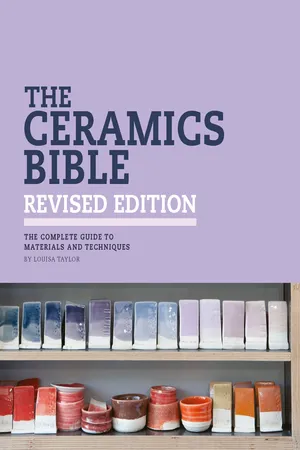
eBook - ePub
The Ceramics Bible Revised Edition
The Complete Guide to Materials and Techniques
- 288 pages
- English
- ePUB (mobile friendly)
- Available on iOS & Android
eBook - ePub
About this book
Building on the success of the original volume, this revised edition of The Ceramics Bible features new techniques, terms, images, and artist profiles—as well as the tried-and-true step-by-step instruction and comprehensiveness that students, instructors, artists, and collectors have all come to appreciate.
Since its debut in September 2011, The Ceramics Bible has been the go-to guide for anyone interested in this flourishing art form. The revised edition updates a quarter of the original content, while keeping the visually rich format and straightforward instruction that make the book such a valuable tool for makers and artists. Featuring a diverse array of contemporary artists, and a comprehensive guide to the best ceramics galleries, suppliers, residencies, workshops, and studios all over the world, this volume will teach you everything you want to know about making ceramics.
AN EVERGREEN ART FORM: Ceramics and pottery never go out of style—in fact, these art forms continue to grow in popularity year after year. Whether you're a seasoned ceramicist searching for a reliable reference volume, or a new artist working your way through beginner techniques, this book is one you'll return to again and again.
NEW AND IMPROVED: From social media marketing to 3D clay printing, the topics covered in this updated edition captures the technological and social changes that have shaped the practices and products of working ceramics artists.
MORE THAN A HANDBOOK: With a plethora of gorgeous full-color photographs—including profiles of contemporary ceramics artists and examples of their work—The Ceramics Bible is both beautiful to behold and easy to use. This book will be equally at home on a living room coffee table as it is in the workshop.
Perfect for:
• Art and design students
• Makers, craftspeople, ceramics artist, and pottery enthusiasts
• Art instructors, educators, and collectors
Since its debut in September 2011, The Ceramics Bible has been the go-to guide for anyone interested in this flourishing art form. The revised edition updates a quarter of the original content, while keeping the visually rich format and straightforward instruction that make the book such a valuable tool for makers and artists. Featuring a diverse array of contemporary artists, and a comprehensive guide to the best ceramics galleries, suppliers, residencies, workshops, and studios all over the world, this volume will teach you everything you want to know about making ceramics.
AN EVERGREEN ART FORM: Ceramics and pottery never go out of style—in fact, these art forms continue to grow in popularity year after year. Whether you're a seasoned ceramicist searching for a reliable reference volume, or a new artist working your way through beginner techniques, this book is one you'll return to again and again.
NEW AND IMPROVED: From social media marketing to 3D clay printing, the topics covered in this updated edition captures the technological and social changes that have shaped the practices and products of working ceramics artists.
MORE THAN A HANDBOOK: With a plethora of gorgeous full-color photographs—including profiles of contemporary ceramics artists and examples of their work—The Ceramics Bible is both beautiful to behold and easy to use. This book will be equally at home on a living room coffee table as it is in the workshop.
Perfect for:
• Art and design students
• Makers, craftspeople, ceramics artist, and pottery enthusiasts
• Art instructors, educators, and collectors
Tools to learn more effectively

Saving Books

Keyword Search

Annotating Text

Listen to it instead
Information
SECTION 1 Materials and tools
Types of clay
Other materials
Clay recipes
Preparing clay
Cut and stack wedging step by step
Ram’s head wedging step by step
Spiral wedging step by step
Drying overview
Drying step by step
Raw materials
Oxides
Stains
Storing ceramic materials
Tools
Kiln furniture and accessories
Studio equipment
Glazing equipment
Safety procedures

Decanting ceramic raw materials using a scoopxs
Types of clay
There are hundreds of clays available to the ceramicist. All have their positive aspects and their limitations, so choosing the right one can be difficult. Consider variables such as the applied working method and whether the piece is intended to be decorative, functional, or sculptural. Having a basic understanding of firing temperatures and clay properties will help determine the most suitable body to use.
Low-fired clay
Low-fired clay relates to a clay body with a firing point of less than 1832°F (1000°C). This can include local-dug clays that contain a high amount of iron and that melt into a liquid if temperatures exceed 2012°F (1100°C). These clays are often used for smoke- or pit-firing processes.
Terra-cotta
Terra-cotta clay (also known as red earthenware) is very plastic and versatile. It contains a high iron content (between 5 and 8%) that produces a rich orangey brown color when fired between 1832 and 2102°F (1000–1150°C). Terra-cotta was traditionally used for utilitarian items such as water carriers, garden pots, and roof tiles.
Earthenware
Earthenware clay is relatively inexpensive to buy, easy to work, and can be used for a wide range of ceramic processes. The temperature required for bisque firing is between 1976 and 2048°F (1080 and 1120°C). After bisque, earthenware remains soft and porous. Glaze has to be applied all over to ensure that it is completely watertight; it is then fired at a lower temperature of between 1922 and 2102°F (1050 and 1150°C).
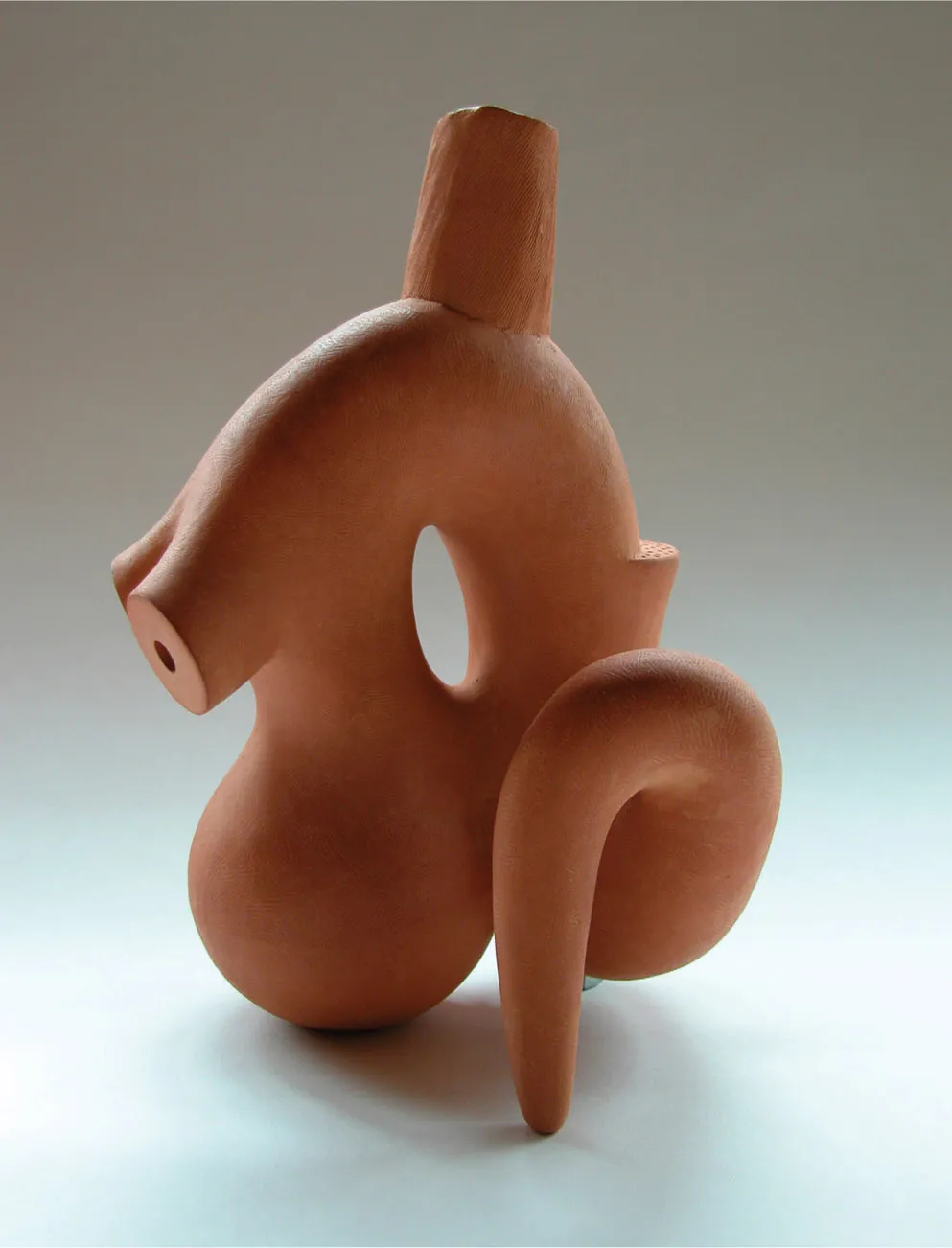
Conor Wilson (UK)
Double Chambered Vessel, 2008
H: 11in (28cm), W: 8in (20cm),
D: 6in (15cm)
Handbuilt, terra-cotta
H: 11in (28cm), W: 8in (20cm),
D: 6in (15cm)
Handbuilt, terra-cotta

Yo Thom (Japan/UK)
Chawan, 2008
H: 3½in (9cm), Dia: 4¾in (12cm)
Thrown and handbuilt, iron slip decoration and Shino glaze over the slip; wood-fired to 2336°F (1280°C/cone 9)
H: 3½in (9cm), Dia: 4¾in (12cm)
Thrown and handbuilt, iron slip decoration and Shino glaze over the slip; wood-fired to 2336°F (1280°C/cone 9)

Elke Sada (Germany)
Capriccio Oval Vessel, 2009
H: 8½in (22cm)
White earthenware and body stains; reversed monoprinting; handbuilt
H: 8½in (22cm)
White earthenware and body stains; reversed monoprinting; handbuilt

Anja Lubach (Germany)
Madonna Face Vessel, 2010
H: 7in (18cm), W: 10½in (27cm)
Thrown porcelain; the soft clay walls are manipulated with small molds of religious figurative details
Stoneware
Stoneware is a hardy material, resistant to scratching and impenetrable to water. This makes it an excellent choice for domestic ware and outdoor sculptures. It is fired between 2192 and 2372°F (1200 and 1300°C) and is suitable for an oxidized or a reduction kiln.
Porcelain
Porcelain originated in China more than 2,000 years ago. It is mainly composed of kaolin (china clay) and as a result produces a distinctive white translucent body that is completely vitrified. Porcelain is commonly fired between 2300 and 2372°F (1260 and 1300°C) and, when reduced, develops a beautiful icy tone.

Jacqui Chanarin (UK)
Rosettes, 2010
H: approx. 6–8in (15–20cm)
Slip-cast porcelain, porcelain paper clay, cut with scissors and as...
H: approx. 6–8in (15–20cm)
Slip-cast porcelain, porcelain paper clay, cut with scissors and as...
Table of contents
- Cover
- Title Page
- Copyright
- Dedication
- Table of Contents
- Introduction
- Types of ceramic ware
- Section 1: Materials and tools
- Section 2: Forming techniques
- Section 3: Glazing and firing techniques
- Section 4: Decorative and finishing techniques
- Section 5: Resources
- Acknowledgments
Frequently asked questions
Yes, you can cancel anytime from the Subscription tab in your account settings on the Perlego website. Your subscription will stay active until the end of your current billing period. Learn how to cancel your subscription
No, books cannot be downloaded as external files, such as PDFs, for use outside of Perlego. However, you can download books within the Perlego app for offline reading on mobile or tablet. Learn how to download books offline
Perlego offers two plans: Essential and Complete
- Essential is ideal for learners and professionals who enjoy exploring a wide range of subjects. Access the Essential Library with 800,000+ trusted titles and best-sellers across business, personal growth, and the humanities. Includes unlimited reading time and Standard Read Aloud voice.
- Complete: Perfect for advanced learners and researchers needing full, unrestricted access. Unlock 1.4M+ books across hundreds of subjects, including academic and specialized titles. The Complete Plan also includes advanced features like Premium Read Aloud and Research Assistant.
We are an online textbook subscription service, where you can get access to an entire online library for less than the price of a single book per month. With over 1 million books across 990+ topics, we’ve got you covered! Learn about our mission
Look out for the read-aloud symbol on your next book to see if you can listen to it. The read-aloud tool reads text aloud for you, highlighting the text as it is being read. You can pause it, speed it up and slow it down. Learn more about Read Aloud
Yes! You can use the Perlego app on both iOS and Android devices to read anytime, anywhere — even offline. Perfect for commutes or when you’re on the go.
Please note we cannot support devices running on iOS 13 and Android 7 or earlier. Learn more about using the app
Please note we cannot support devices running on iOS 13 and Android 7 or earlier. Learn more about using the app
Yes, you can access The Ceramics Bible Revised Edition by Louisa Taylor in PDF and/or ePUB format, as well as other popular books in Art & Art General. We have over one million books available in our catalogue for you to explore.