From the days of the American Frontier, the term "open spaces" has evoked a vision of unspoiled landscapes stretching endlessly toward the horizon, of nature operating on its own terms without significant human interference. Ever since, government agencies, academia, and conservation organizations have promoted policies that treat large, complex systems with a one-size-fits-all mentality that fails to account for equally complex social dimensions of humans on the landscape. This is wrong, argues landscape ecologist and researcher Charles Curtin. We need a science-based approach that tells us how to think about our large landscapes and open spaces at temporally and spatially appropriate scales in a way that allows local landowners and other stakeholders a say in their futures.
The Science of Open Spaces turns conventional conservation paradigms on their heads, proposing that in thinking about complex natural systems, whether the arid spaces of the southwestern United States or open seas shared by multiple nations, we must go back to "first principles"--those fundamental physical laws of the universe--and build innovative conservation from the ground up based on theory and backed up by practical experience. Curtin walks us through such foundational science concepts as thermodynamics, ecology, sociology, and resilience theory, applying them to real-world examples from years he has spent designing large-scale, place-based collaborative research programs in the United States and around the world.
Compelling for not only theorists and students, but also practitioners, agency personnel, and lay readers, this book offers a thoughtful and radical departure from business-as-usual management of Earth's dwindling wide-open spaces.
eBook - ePub
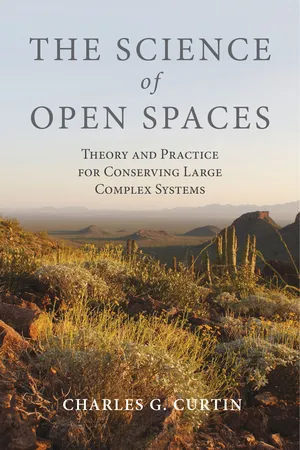
The Science of Open Spaces
Theory and Practice for Conserving Large, Complex Systems
- 257 pages
- English
- ePUB (mobile friendly)
- Available on iOS & Android
eBook - ePub
The Science of Open Spaces
Theory and Practice for Conserving Large, Complex Systems
About this book
CHAPTER ONE

Integrating Conservation and Complexity through the Perspective of Place
Earth so huge, and yet so bounded
pools of salt, and plots of land–
shallow skin of green and azure–
chains of mountains, grains of sand!
pools of salt, and plots of land–
shallow skin of green and azure–
chains of mountains, grains of sand!
—Alfred, Lord Tennyson,
“Locksley Hall Sixty Years After”
“Locksley Hall Sixty Years After”
Our Cessna banks into a tight turn above the East African savanna as Mount Kilimanjaro towers above, its summit rising through a layer of clouds. Below, a bright green expanse of wetland where hippos, elephants, and other wildlife wallow stands in stark contrast to the amber vastness of the plains of Amboseli National Park (fig. 1.1). As we enter the turn, Kenyan conservationist and ecologist David Western, handling the aircraft’s controls, points out one specific, smaller patch of green coming into view, its sharply defined edges and geometric shape belying an electric fence designed to keep elephants and other large grazers out. It is an island of savanna surrounded by a sea of dust.
Western, one of the world’s preeminent practitioners of large-scale conservation, describes the complex interplay unfolding below. Within the fenced enclosure are the remnants of native vegetation he saw when he first came to Amboseli as a student in the 1960s. The yellow “sea” represents huge tracts of land denuded by elephant herds forced to concentrate within the park’s borders for protection from poachers and conflicts with people outside the park’s boundaries. Amboseli’s establishment as a national park in 1974, intended as a solution to the problem of Africa’s declining wildlife populations, has instead created a series of new challenges. The current predicament of landscape degradation—too many elephants in too small an area resulting in too little vegetation—can be traced to an initial lack of engagement with local Maasai peoples in conservation efforts.1

Figure 1.1. The basin of Amboseli from the air, a sea of dust bisected by elephant tracks where only a few decades ago there was savanna. This is a poignant example of the impact of an imbalance between protected areas and surrounding culture—where the wildlife is forced into increasing concentrations in protected areas, where the very act of creating traditional parks that do not integrate local human needs can exacerbate conservation challenges.
Establishing Amboseli as a park to protect wildlife has also meant the loss of traditional grazing grounds for the Maasai, whose presence and lifeways historically protected the elephants from poachers, and whose grazing cattle are documented to contribute to ecological richness.2 With these pastoralists mostly removed from the park, or concentrated around established settlements and water wells, the ecosystem no longer supports the complex interactions between people and wildlife that have promoted biological diversity and sustained ecological and cultural processes for millennia.
After another pass over the plot, we fly west toward the escarpment of the Rift Valley. Upon leaving Amboseli, the landscape becomes rich and varied, as a visible interchange between people and their environment is revealed. The diversity of land use and vegetation lies in stark contrast to the relatively monotypic composition of the park. Beyond Amboseli is a tapestry of landscape features reflecting a complex interplay of ecology, economy, and culture. Our flight path from one to the other is in many respects similar to the trajectory of this book, a contrast between conventional approaches to conservation and resource management and dynamic large-landscape perspectives that promote more nuanced and resilient conservation strategies.
Traditionally, conservation offered straightforward park-based prescriptions for protecting vulnerable ecosystems, yet the reality of sustaining large, open spaces is that they are much more than the sum of their parts. The term open spaces, as I use it here, is intended to invoke not only the challenge of physical size but also of time, ecology, culture, and all elements therein. This is a fundamentally different approach to science that reconceptualizes both problems and solutions to generate more timely and effective means of addressing the vast conservation challenges we face today. An underlying issue I seek to address is that current approaches to science are extremely effective at meeting the demands of academia or agency-based careers and as such are structured around producing papers and professional advancement, but are less effective at addressing large and complex social and environmental problems. To make science more relevant at large scales means reconceiving its role and approach to make it more relevant to operating at large scales in messy systems where solutions do not break out cleanly along disciplinary lines. The following pages reflect two decades of experimentation not just with addressing large-scale conservation challenges, but also with changing the process itself to facilitate more effective problem solving.
Foundations in Complexity
Conventional ecology and conservation reward empirically based experimental design with robust quantitative results but largely ignore the larger social framework within which they are embedded. Conversely, traditional sociological approaches often discuss the need for empirical science without creating the institutions needed to develop and sustain such efforts or a means of evaluating the effectiveness of the work. What is missing is widespread application of a perspective that blends rigorous science with critical institutional factors. This has been characterized by social theorists Silvio Funtowicz and Jerome Ravetz as post-normal science: that is, extensive public engagement with the scientific process to address situations where “facts are uncertain, values in dispute, stakes high, and decisions urgent.”3 A science of open spaces links the post-normal paradigm with resilience and complexity-based perspectives, as well as the natural and social sciences, to examine how socioecological renewal and restoration stem from the emergent properties of particular land-and seascapes. At the same time, it identifies recurrent patterns of social and ecological interaction across a range of locales to find unifying strategies for successfully sustaining open spaces.
Nine thousand miles from Amboseli, Kenya, the Santa Fe Institute (SFI) sits on a hilltop above its namesake city, nestled among piñon pine and juniper. It is housed in a large, southwestern adobe-style structure that looks out across the Rio Grande Valley, the Jemez Mountains framing the western skyline. Although most academic disciplines focus on breaking down systems into pieces, SFI is a complex-systems think tank that focuses instead on synergy between biological and social systems. The Santa Fe Institute challenges the reductionist or positivist approach to science that has been a fundamental tenet of scholarship in the post–Enlightenment era in which we seek straightforward, quantitative solutions to complex, multifaceted problems. In the words of SFI cofounder and Nobel laureate Murray Gell-Mann,
In a great many places in our society, including academia and most bureaucracies, prestige accrues principally to those who study carefully some aspect of the problem, while discussion of the big picture is relegated to cocktail parties. It is of crucial importance that we learn to supplement those essential specialized studies with what I call a crude look at the whole.4
SFI’s perspective challenges assumptions inherent in Kenyan national park conservation strategy and in a host of global issues that cut across disciplines and scales. For a myopic focus on single, isolated variables in conventional science and policy is not enough to understand environmental change and the long-term dynamics of complex systems. As with SFI’s work in physics and economics, its perspective on ecology and conservation includes the importance of novel outcomes that emerge from the interaction of variables. This means embracing an approach to science so that it takes a “crude look at the whole,” and general measurements of real systems over precise data from models and microcosms. Looking at whole systems, with all of their social and ecological interweaving, demands working at large scales and across boundaries; in short, it demands working with open spaces.
This perspective of needing to focus on the interactions as much as the organisms was shared and complemented by the ecological studies undertaken in ecologist James H. Brown’s lab at the University of New Mexico, where I did my postdoctoral work (in addition to time at SFI). Field studies looked at complex relationships among climate, livestock, and seed-eating desert rodents. The surprising results first showed that desertification (defined as an increase in shrubs and a decline in grasses) was not always caused by drought or overgrazing, but could be the result of high levels of winter rainfall, which favor deep-rooted, winter-active shrubs over the native, warm-season bunch grasses. In response to these initial changes in vegetation, the exclusion of small seed-eating rodents from experimental study plots had a far more dramatic impact on the vegetation than did 1,000-pound cows. This demonstrated that desertification-prone systems can flip into a range of configurations depending on myriad outcomes from herbivore-climate interactions.5 These dynamics make clear the fundamental need to embrace, rather than avoid, complexity when undestanding ecological systems.
After finishing my postdoctoral work in 1998, I committed myself to finding professional scientific opportunities that embrace complexity and dynamic interactions at large scales. However, the kind of messy, tortuous science this entails is notoriously challenging to fund through conventional means. The usual time-honored approaches to science that emphasize publications and other academic achievements are largely incompatible with the integrated, transdisciplinary approaches needed to sustain large and complex systems. The traditional professional paradigm primarily supported single-disciplinary inquiry of relatively modest scales over large and integrated frameworks to problem solving. A new institutional form was needed to undertake this work integrating conservation and science at large scales, but how would it be achieved?
Potential professional opportunities arrived in three forms. The first was an offer to help develop the fledgling science program for the rancher-led Malpai Borderlands Group along the border between Arizona and New Mexico (Malpai is a variation on the Spanish malpais, meaning “badlands”). This vast basin and range landscape seemed the ideal opportunity to test-drive concepts emerging from the intersection of ecology and complexity theory. Meanwhile, funding from the Thaw Charitable Trust of Santa Fe provided support for an overall analysis of landscape change in the Borderlands through a repeat-photography study. A grant from the National Interagency Fire Center allowed us to develop landscape-level experiments of complex interactions. By selling our house, my family subsidized establishment of a new initiative called the Arid Lands Project, an institute committed to developing large-scale, place-based, post-normal research: a science of open spaces.
The three case studies (fig. 1.2) that ground this book are stories about the acquisition and application of knowledge. They illustrate new approaches to conservation, ecology, and policy through adaptive and collaborative frameworks for the management of large-scale systems. Overall, they demonstrate how such approaches allow local communities, scientists, and policy makers to work together and refine conservation and stewardship strategies as circumstances dictate. Rather than dictating a rigid blueprint for success, these approaches leverage creativity, complexity, and social interactions to generate novel, place-based solutions.

Figure 1.2. The case studies are hierarchically organized across scales to illustrate the common properties of conserving large and complex ecosystems, from the Malpai Borderlands (local), to the Gulf of Maine (regional), to a contrast between East Africa and the other two ecosystems (transboundary). Surrounding this space are three core influences on developing the capacity for adaptation: science, learning, and governance-policy. Science provides a formal means of acquiring knowledge and, perhaps most important, testing one’s assumptions. Learning is essentially the way social and ecological systems evolve and adapt and is necessary for sustainability. Although governance and policy are the formal processes of applying the lessons from science and learning, these processes, in turn, are influenced by governance structures that are essentially scale-matching exercises that develop the necessary structural elements for adapting to change.
In the Malpai borderlands, for example, ranchers and collaborators devised a different approach to the conservation of rangelands. They incorporated the region’s traditional values of neighbor-to-neighbor cooperation within the broader context of modern conservation and resource management. Similarly, fishermen in the Gulf of Maine have sought to change the status quo by applying their shared understanding of the ocean to confront the paradigm of federal fishery management, thereby redefining the governance process to make it more responsive to ecological and social realities.6 The Maasai of East Africa have, with conservation organizations such as the African Conservation Centre, built on millennia of experience to devise sustainable approaches to conserving open landscapes and the culture and ecology they encompass by devising collaborative approaches that span international boundaries, reconnecting wildlife corridors to conserve the large-scale fabric of the ecosystem. Through exploring these diverse examples, we can better understand how humans relate to their environment and witness the crucial role of place-based action in sustaining large landscapes. Each of these places exists at social and ecological boundaries, in tension zones between economic, ecological, and social forces where the stakes are high and new paradigms are essential for generating long-term solutions for sustaining open spaces.
The Perspective of Place
Fisherman Ted Ames gazed out across an immensity of uninterrupted space bounded only by the sky. This was not his home waters of Maine, or even the ocean at all. Ames’s view was a vista of sand and scrub in the badlands of West Texas, mile upon mile of acacia, creosote, and mesquite rolling like waves into the distance toward Mexico and the mountains beyond. The once-great desert grasslands of this region are now covered with cactus and hummocks of sand that mark the beginnings of dune formation and an end to the ecological processes ...
Table of contents
- Cover
- About Island Press
- Title Page
- Copyright
- Contents
- Acknowledgments
- Preface
- Chapter One: Integrating Conservation and Complexity through the Perspective of Place
- Chapter Two: Experiments in Post-Normal Science in Southwestern Rangelands
- Chapter Three: Experiments in the Governance of Maine’s Coastal Fisheries
- Chapter Four: Conceptual Underpinnings for Preserving Open Spaces
- Chapter Five: Resilience and the Socioecological Synthesis
- Chapter Six: Practical Aspects of Sustaining Open Spaces
- Notes
- Literature Cited
- About the Author
- Island Press | Board of Directors
Trusted by 375,005 students
Access to over 1.5 million titles for a fair monthly price.
Study more efficiently using our study tools.
Information
Publisher
Island PressYear
2015Topic
Biological SciencesPrint ISBN
9781597269933
9781597269926
Subtopic
EcologyeBook ISBN
9781610912051
Index
Biological SciencesFrequently asked questions
Yes, you can cancel anytime from the Subscription tab in your account settings on the Perlego website. Your subscription will stay active until the end of your current billing period. Learn how to cancel your subscription
No, books cannot be downloaded as external files, such as PDFs, for use outside of Perlego. However, you can download books within the Perlego app for offline reading on mobile or tablet. Learn how to download books offline
Perlego offers two plans: Essential and Complete
- Essential is ideal for learners and professionals who enjoy exploring a wide range of subjects. Access the Essential Library with 800,000+ trusted titles and best-sellers across business, personal growth, and the humanities. Includes unlimited reading time and Standard Read Aloud voice.
- Complete: Perfect for advanced learners and researchers needing full, unrestricted access. Unlock 1.5M+ books across hundreds of subjects, including academic and specialized titles. The Complete Plan also includes advanced features like Premium Read Aloud and Research Assistant.
We are an online textbook subscription service, where you can get access to an entire online library for less than the price of a single book per month. With over 1.5 million books across 990+ topics, we’ve got you covered! Learn about our mission
Look out for the read-aloud symbol on your next book to see if you can listen to it. The read-aloud tool reads text aloud for you, highlighting the text as it is being read. You can pause it, speed it up and slow it down. Learn more about Read Aloud
Yes! You can use the Perlego app on both iOS and Android devices to read anytime, anywhere — even offline. Perfect for commutes or when you’re on the go.
Please note we cannot support devices running on iOS 13 and Android 7 or earlier. Learn more about using the app
Please note we cannot support devices running on iOS 13 and Android 7 or earlier. Learn more about using the app
Yes, you can access The Science of Open Spaces by Charles G. Curtin,Charles G. Curtin in PDF and/or ePUB format, as well as other popular books in Biological Sciences & Ecology. We have over 1.5 million books available in our catalogue for you to explore.