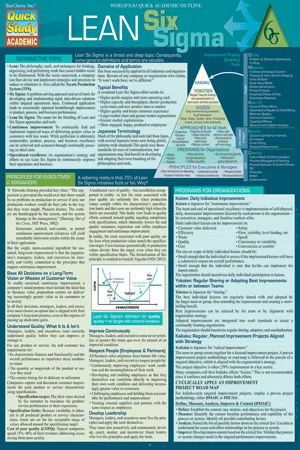
Whether curious as to how Lean Six Sigma works, in training for certification or a very experienced champion, everyone will find this tool essential as the ultimate quick reference guide to the combined process improvement methods of Lean and Six Sigma. This amazingly thorough 6-page laminated guide was developed by Craig Gygi, best-selling author, trainer, consultant, and internationally recognized leader in operational excellence. Color-coded sections, diagrams, examples, definitions, equations, flow of the process and tools for improvement are organized and designed for ease of reading and referencing at a moments notice. See for yourself, and then order a set for your team or organization. Suggested uses: • Introduction – curious about Lean Six Sigma as a certification or for implementation within your business • Training Tool – certification for yourself, your company or your team • Expert or Practitioner – as a handy reference to core principles or tools like charts and equations, but also as a giveaway to colleagues who need some support • Team – make this your company crib sheet
Trusted by 375,005 students
Access to over 1 million titles for a fair monthly price.
Commercially available software exists for nearly all Lean Six Sigma tools.
Improvement Project Problem & Objective Statements
Use problem and objective statements to scope, gain support, and launch improvement projects.
PROBLEM STATEMENT A careful description of the problem being tackled through the improvement project is a necessary and unifying start for success. The problem statement should include:
The key metric used to describe the magnitude of the problem
If possible, an estimate of the hard and soft financial impact the problem is causing
Where in the work process or organization the problem is occurring
The period of time over which the problem has been occurring
The problem statement should not include any indication of or speculation on the cause of the problem. (Including possible causes poisons the project team’s ability to objectively and thoroughly find the true root cause.)
EX: The number of issues recorded in Technical Support from European customers during 2015 was 2,375, or about 200 per month. The cost to field and resolve these issues was $743,000 in labor, systems, and materials, with a likely larger amount lost due to decreased customer loyalty and lowered employee morale.
OBJECTIVE STATEMENT
The specific goals for the improvement project are outlined in the objective statement. It should include:
An improvement goal for the key metric
A specific target date for completion of the project
An estimate of the financial value generated or savings (including intangible savings) accumulated by reaching the objective
It should not include any direction on what the solution will be to achieve the goal. (Including possible solutions limits the team’s ability to innovate an optimal solution.)
EX: Reduce the rate of customer issues received by the European Technical Support Office to less than 100 per month by March 31, 2016. This will save the department $31,000 per month on project completion and accumulate to $279,000 savings in labor, systems, and materials during 2016, not counting the intangible improvements in customer loyalty and employee morale.
5 Whys
Use to discover the true root cause that needs solving. When working to understand a problem, the visible symptoms and corresponding causes are often encountered in layers that mask the underlying root cause. Asking “Why?” at least five times is a tool for discovering and peeling back successive layers until the true root cause is found. Discovering the root cause is critical to implementing longterm improvement.
VISIBLE SYMPTOMS/ UNDERLYING CAUSES
CORRESPONDING LEVEL OF SOLUTION
IMPROVEMENT DURATION
Why?↓
Order is not ready to ship on time
Expedite the shipment
Short term
Why?↓
Production work went slower than expected
Add more production staff
Short term
Why?↓
Raw materials were more difficult than usual to handle
Refresh material handling training
Short term
Why?↓
Bad raw materials were approved for use due to low stock levels
Increase stock levels for raw materials
Short term
Why?↓
Raw material purchases are not well planned
Improve raw material order planning
Short term
Why?↓
Management hasn’t allowed time for purchase planning system improvements
Initiate purchase planning improvement projects
Short term
Purchasing management is not fully committed to continuous improvement
Coach and mentor purchasing management in principles and benefits of continuous improvement
Long term
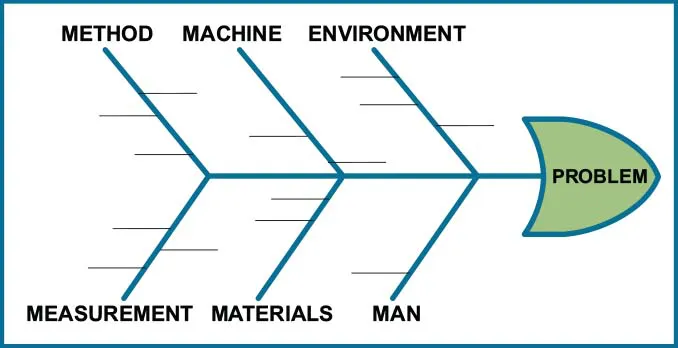
Fishbone (Ishikawa) Diagram
Use to identify or brainstorm a comprehensive collection of possible input factors.
Place a statement of the problem or symptom at the head of the fish.
Draw a backbone to the fish with six main “branches,” labeled as follows: man, machine, method, materials, measurement, and environment.
Use these categories as prompts to thoroughly consider and identify all possible input factors. Record identified factors on the fishbone diagram.
Do not be overly critical of ideas while gathering factors, as this will stifle creativity.
Later, the identified factors can be prioritized by the strength or likelihood of their impact on the...
Table of contents
DEFINING THE TOPIC
PRINCIPLES FOR EXECUTIVES & MANAGERS
PROGRAMS FOR ORGANIZATIONS
APPROACHES FOR ALL WORK
TOOLS FOR IMPROVEMENT
ROLES, RESPONSIBILITIES & CERTIFICATIONS
Frequently asked questions
Yes, you can cancel anytime from the Subscription tab in your account settings on the Perlego website. Your subscription will stay active until the end of your current billing period. Learn how to cancel your subscription
No, books cannot be downloaded as external files, such as PDFs, for use outside of Perlego. However, you can download books within the Perlego app for offline reading on mobile or tablet. Learn how to download books offline
Perlego offers two plans: Essential and Complete
Essential is ideal for learners and professionals who enjoy exploring a wide range of subjects. Access the Essential Library with 800,000+ trusted titles and best-sellers across business, personal growth, and the humanities. Includes unlimited reading time and Standard Read Aloud voice.
Complete: Perfect for advanced learners and researchers needing full, unrestricted access. Unlock 1.4M+ books across hundreds of subjects, including academic and specialized titles. The Complete Plan also includes advanced features like Premium Read Aloud and Research Assistant.
Both plans are available with monthly, semester, or annual billing cycles.
We are an online textbook subscription service, where you can get access to an entire online library for less than the price of a single book per month. With over 1 million books across 990+ topics, we’ve got you covered! Learn about our mission
Look out for the read-aloud symbol on your next book to see if you can listen to it. The read-aloud tool reads text aloud for you, highlighting the text as it is being read. You can pause it, speed it up and slow it down. Learn more about Read Aloud
Yes! You can use the Perlego app on both iOS and Android devices to read anytime, anywhere — even offline. Perfect for commutes or when you’re on the go. Please note we cannot support devices running on iOS 13 and Android 7 or earlier. Learn more about using the app
Yes, you can access Lean Six Sigma - Quick Study by Craig Gygi in PDF and/or ePUB format, as well as other popular books in Commerce & Commerce Général. We have over one million books available in our catalogue for you to explore.