- 256 pages
- English
- ePUB (mobile friendly)
- Available on iOS & Android
eBook - ePub
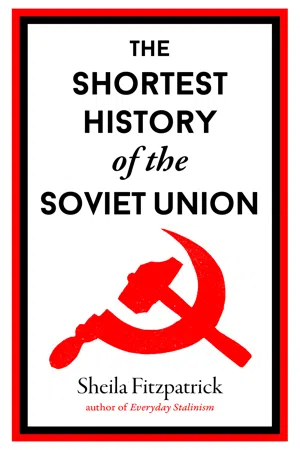
The Shortest History of the Soviet Union
About this book
'Close to a miracle... The Shortest History of the Soviet Union is an immensely readable overview of the entire history of the Soviet Union from 1917 to 1991, full of anecdotes and lively detail, but also meeting the highest academic standards' Slavoj ŽižekThe U.S.S.R. A nation that arrived in the world accidentally, and departed unexpectedly. Over a century after the Russian Revolution, the tumultuous history of the Soviet Union continues to fascinate us and influence global politics.
From revolution and Lenin to Stalin's Terror, from World War II to glasnost, this is an authoritative distillation of 75 years of communist rule, and the disintegration of an empire.Fitzpatrick charts the fate of countries often left out of Soviet histories, gives vivid portraits of key figures, and traces the aftermath of the regime's sudden collapse. She explores the rise of the oligarchs, the rebirth of the Church and the enigmatic figure of Vladimir Putin: a Soviet creation but no Soviet nostalgic. Lastly, she considers the future of Communism. Who still worships Marx and Lenin? What lessons has today's superpower, China, learned from yesterday's Soviet failure?
Trusted by 375,005 students
Access to over 1 million titles for a fair monthly price.
Study more efficiently using our study tools.
Information
11
1
MAKING THE UNION
the russian revolution was meant to spark off revolution throughout Europe. But that plan didn’t work, and what was left was a revolutionary state in Russia – the Russian Soviet Federal Socialist Republic (RSFSR), with Moscow its capital. But there had been upheavals with a variety of outcomes in non-Russian regions of the Russian Empire too. The Baltic provinces chose independence; the Polish provinces opted to enter a newly created Polish state. But by the end of the civil war set off by the October Revolution, other regions had established their own soviet republics, often with a little help from the new revolutionary state’s Red Army.
In December 1922, the Ukrainian and Belorussian soviet republics and Transcaucasus Federation joined the Russian soviet republic in a Union of Soviet Socialist Republics. Its capital was Moscow (the old imperial capital, Petrograd, would have to get used to being second city). Its emblem was the hammer and sickle, with the motto (written in Russian, 12Ukrainian, Belorussian, Georgian, Armenian, and Azeri): ‘Proletarians of the world, unite!’
The Constitution of the new Union gave the republics the right to secede, although for close to seventy years, none ever invoked that right. In the 1920s and ’30s, five additional Central Asian republics (Uzbekistan, Turkmenistan, Tajikistan, Kazakhstan and Kirgizstan) were carved out of the RSFSR, and the Transcaucasus Federation split into its three constituent parts: Georgia, Armenia and Azerbaijan. In 1939, the three Baltic states (Latvia, Lithuania and Estonia) and Moldavia were incorporated into the Soviet Union as a result of secret clauses of the 1939 Nazi–Soviet Pact, bringing the total number of republics in the Union to fifteen.
The Soviet Union was clearly a successor state to Imperial Russia, albeit with a slightly diminished territory. Whether that meant that it, too, was an empire – with Russians ruling a bunch of internal colonies in the form of national republics – was a matter of dispute. The Western powers, hostile to the Bolshevik regime and hoping for its downfall, saw it as an empire, and an illegitimate one at that. The Bolsheviks, however, had a completely different way of seeing their Union. Many of the party’s leadership were not Russian at all but belonged to one of the old Russian Empire’s oppressed minorities, such as Latvians, Poles, Georgians, Armenians and Jews. They were sworn enemies of Russian imperialism who had grown up resenting increasing discrimination against non-Russians in the last years of the Empire. They saw their role inside and outside the Soviet Union as one of liberating former colonial subjects, particularly in Asia (including the 13Central Asian territories conquered by the Russian Empire in the nineteenth century). According to the mantra of the 1920s, ‘Russian chauvinism’ was the ‘greatest danger’, meaning that of all nationalisms in the Soviet Union, the one that was pernicious was the Russian.
The Bolsheviks were committed Marxist internationalists for whom nationalism was false consciousness. Nonetheless, they recognised its popular appeal and its tendency to multiply in response to attempts to eradicate it. The Bolsheviks were not going to make that mistake: their strategy was to encourage non-Russian nationalisms, not only through administrative use of the native language and furthering of national cultures but also through the creation of separate territorial administrations, starting at the level of republic (for example, Ukraine) and going right down to the level of village Soviet (there was an array of Jewish, Belorussian, Russian, Latvian, Greek and other ‘autonomous districts’ within the Ukrainian republic). It was one of the paradoxes of Soviet rule that its administrative structures not only protected national identities but also helped to create them.
THE PROBLEM OF BACKWARDNESS
The Bolsheviks were modernisers and rationalisers through and through: modernisation in the form of state-led industrial development was their core program and a large part of what they meant by socialism. They considered Russia’s backwardness vis-a-vis the West as a great challenge to be overcome, yet in their analysis, Russia also had its own internal ‘Orient’ – Central Asia – to modernise and civilise via capital investment 14in infrastructure and industry as well as literacy schools and affirmative action programs. For the Union as a whole, modernisation and the jettisoning of tradition were high on the short-term as well as the long-term agenda. Imperial Russia’s Julian calendar, thirteen days behind the Gregorian calendar used in the West, was an early victim (meaning that once the calendar changed in 1918, the ‘October Revolution’ was commemorated on 7 November). Changes to the old orthography, emancipation of women from a range of legal shackles, legalisation of abortion, no-fault divorce, disestablishment of the Orthodox Church (seen as a particularly egregious repository of superstition) and abolition of social estates were all introduced within months of the Bolsheviks’ seizing power.
How backward was Russia before the Revolution? ‘Backwardness’ is a slippery concept that always implies a comparison with something admired as more advanced; in Russia’s case, the comparison was with Western Europe. Pulling Russia out of backwardness and into the West had been Peter the Great’s mantra two centuries earlier, and building the new capital, St Petersburg (as close as possible to Europe), and forcibly shaving the boyars’ beards were among his strategies. Russia had done well enough under Peter’s successors – notably Catherine the Great, correspondent of the Enlightenment philosophers Diderot and Voltaire – to be recognised as a Great Power in Europe by the early nineteenth century, a reputation solidified by the defeat of Napoleon’s armies on Russia’s steppes. Its territories increased in the course of the nineteenth century as it expanded southwards into the Caucasus and overran small Central Asia sovereign states ruled by khans to the east. But it was not until the early 1860s that the peasants were emancipated from serfdom as part of Alexander II’s Great Reforms. The country was also a latecomer to the industrial revolution: Russia’s industrial take-off was in the 1890s, half a century behind Britain, and it relied heavily on state sponsorship (like Japan in the same period) and foreign investment. 15

Moscow’s Red Square as it looked around 1900. Note that the name predates the Communists (‘red’ connoting beautiful). St Basil’s is on the left, the Kremlin on the right.

Moscow’s Lubyanka Square as it looked around 1900. It was renamed Dzerzhinsky Square in 1926. 16
At the time of Russia’s first modern census in 1897, the Empire’s population was 126 million, of which ninety-two million lived in European Russia (including what is now Ukraine and the eastern part of Poland). The rest was divided between the Empire’s Polish provinces and the Caucasus, both with around nine million, followed by Siberia and Central Asia. While the urban population of European Russia had tripled between 1863 and 1914, the degree of urbanisation and industrialisation sharply declined the further one moved away from the Western frontier, the Polish provinces being by far the most developed region of the Empire. In Siberia, 92 per cent of the population was rural. Less than a third of the Empire’s population in the ten-to-fifty-nine age group was literate, but this masked substantial disparities between men and women, urban and rural, young and old. Among people in their twenties, 45 per cent of men were literate, though only 12 per cent of women; for people in their fifties, the male literacy rate was 26 per cent with the female a mere 1 per cent.
In addition to the highly developed cities of Warsaw and Riga (which would be lost to the Soviet Union after the Revolution), the Union had a rapidly growing mining and metallurgical industry in the Donbass region of what is now Ukraine, much of it foreign-owned, with a workforce recruited largely from villages in Russia. St Petersburg, Moscow, Kiev, Kharkov and the port city of Odessa on the Black Sea were also industrialising, while Baku (in Azerbaijan, on the Caspian Sea) was becoming a major oil centre. 17

Imperial Russia18
For administrative and census purposes, the population was still divided into social estates (sosloviia) – nobility, clergy and townspeople, and peasantry, each group with its own rights and duties to the Tsar – although such estates had long vanished in Western Europe and struck Russia’s Western-oriented intelligentsia as an embarrassing anachronism. The peasantry, at 77 per cent, was by far the largest estate, with townspeople and other urban estates accounting for only 11 per cent. The intelligentsia, or educated class, was a modern anomaly not accommodated by the estate scheme.
While Russia was a multinational empire, the concept of nationality was too modern for the tsarist regime, and the 1897 census gathered information only on religious confession and native language. ‘Russian’ was the language claimed by two-thirds of the Empire’s population, but that included what we would now call Ukrainian and Belorussian speakers: only 44 per cent were listed as ‘Great Russians’. As for religion, about 70 per cent were Russian Orthodox (including a couple of million Old Believers who had split off from the church in the seventeenth century), with 11 per cent Muslim, 9 per cent Roman Catholic and 4 per cent Jewish.
In Western Europe, particularly Britain, Russia became a byword for unenlightened autocracy, a process helped by energetic propaganda from exiled Russian revolutionaries benefiting from Britain’s generous asylum policies. The tsarist practice of 19exiling dissidents to Siberia was known and reviled throughout the ‘civilised’ world, just as Gulag would be during the Cold War. Despite its size and great power status, the precariousness of tsarist power became evident when in 1905, following humiliating defeat in a war with Japan, it barely survived a revolution that covered the breadth of its territory and took more than a year to quell. The revolution of 1905 provided Russian radicals with a heroic legend and a spontaneously generated revolutionary institution, the popularly elected soviet (literally, council), combining executive and legislative powers. Lev Trotsky, a Marxist of the Menshevik faction, achieved instant fame as the charismatic leader of the Petersburg Soviet, but the Bolshevik leader Vladimir Lenin, returning like Trotsky from emigration, arrived late for the revolution in 1905 and played only an inconspicuous part.
REVOLUTIONARIES IN WAITING
If you wanted to have a revolution in Russia, looking to the downtrodden peasantry for support might have seemed the obvious course. That was indeed the reasoning of the first generation of revolutionaries, the so-called Narodniks (Populists) who dominated the radical scene in the 1860s and ’70s. Mindful of the long tradition of peasant revolt in Russia, they saw the peasants as potential overthrowers of the Tsars as well as a source of untainted moral wisdom. But peasants gave Narodnik emissaries short shrift, perceiving them as members of an urban elite with which they had nothing in common. It was disappointment at that rejection that paved the way for the rise of Marxism in the revolutionary movement in the 1880s. Disciples of the German socialist thinkers Karl Marx and Friedrich 20Engels, the Russian Marxists offered a ‘scientific prediction’ of the inexorable ‘necessity’ of revolution, since capitalism was historically predestined to give way to socialism. The industrial proletariat, generated by the processes of capitalism itself, was the revolutionary agent chosen by history, meaning that the peasantry became (at least theoretically) irrelevant. Commitment to the revolution, previously justified on moral grounds, was reconfigured as something closer to a rational choice, rooted in an understanding of historical necessity (Gesetzmässigkeit in German and zakonomernost’ in Russian – but in the English-speaking world, an alien concept). These were deep philosophical waters, truly grasped only by the chosen few, but all Russian, and later Soviet, Marxists knew what zakonomerno meant: that was when things went as, in principle, they were supposed to (as distinct from the ‘accidental’ and ‘spontaneous’ way they often went in practice).
Marxist revolutionaries in Russia identified with the industrial working class, but initially most of them were offspring of the nobility or the intelligentsia. As in other developing countries in the late nineteenth and twentieth centuries, higher education in Russia meant Westernisation, which often brought radicalisation as a by-product; the first characteristic (Westernisation) implied alienation from the local population, the second (radicalisation) a sense of mission to lead it. Educated Russians with radical ideas had largely appropriated the term ‘intelligentsia’ for themselves, contemptuously excluding people with the same kind of education who went on to work for the state. (The fact that Alexander II’s Great Reforms had been carefully drafted by a group of ‘enlightened bureaucrats’ 21working behind the scenes did not affect this judgement: what were mere reforms when thoroughgoing revolution and spiritual rebirth were needed?) It was the intelligentsia’s self-appointed function to criticise the government (any government, as became clear after the collapse of tsarism) and act as the conscience of the society, and this, of course, brought it into constant conflict with the imperial authorities, notably the Okhrana, or secret police. For most, radical politics was not a day job. But a minority became full-time professional revolutionaries, often during their student days, which soon led to arrests, prison terms, exile within Russia, escape from exile (not that difficult) and, if parental funds permitted it, emigration. All the revolutionary factions, no matter whether they declared their social base to be peasants or workers, were led by revolutionary intellectuals, most of whom had spent long years in emigration in Europe.
Vladimir Lenin, born Vladimir Ulyanov in 1870 in the Volga town of Simbirsk (renamed Ulyanovsk in 1924 after Lenin’s death and still, rather surprisingly, bearing that name), was a law student in Kazan when he became radicalised, partly by the execution of his elder brother for involvement in a plot against the emperor. The Ulyanovs were professional middle class in our terms (the father an inspector of schools who rose high enough to become non-hereditary nobility) and mainly Russian in terms of ethnicity, though there was some German and Jewish in the mix. Lenin’s embrace of revolution brought him into the Marxist League of Struggle for the Emancipation of the Working Class in St Petersburg, which won him the usual punishment of administrative exile within Russia, 22followed by voluntary exile outside Russia, supported financially by his mother. He joined the motley group of Russian and other Eastern European revolutionaries who congregated in London, Paris, Geneva, Zurich and Berlin – a world full of seedy lodging houses, passionate hairsplitting arguments with other revolutionaries, police spies, informers, loneliness and long hours spent in libraries.
Within his Marxist revolutionary group, ethnic Russians like Lenin and his wife, Nadezhda Krupskaya, were less numerous than Jews, Poles, Latvians and other members of national minorities within the Russian Empire, who, from the late nineteenth century, were increasingly harassed by Imp...
Table of contents
- Praise
- Title Page
- Dedication
- Contents
- Introduction
- 1: Making the Union
- 2: The Lenin Years and the Succession Struggle
- 3: Stalinism
- 4: War and Its Aftermath
- 5: From ‘Collective Leadership’ to Khrushchev
- 6: The Brezhnev Period
- 7: The Fall
- Conclusion
- Acknowledgements
- Further Reading
- List of Images
- Index
- Also by Sheila Fitzpatrick
- Copyright
Frequently asked questions
Yes, you can cancel anytime from the Subscription tab in your account settings on the Perlego website. Your subscription will stay active until the end of your current billing period. Learn how to cancel your subscription
No, books cannot be downloaded as external files, such as PDFs, for use outside of Perlego. However, you can download books within the Perlego app for offline reading on mobile or tablet. Learn how to download books offline
Perlego offers two plans: Essential and Complete
- Essential is ideal for learners and professionals who enjoy exploring a wide range of subjects. Access the Essential Library with 800,000+ trusted titles and best-sellers across business, personal growth, and the humanities. Includes unlimited reading time and Standard Read Aloud voice.
- Complete: Perfect for advanced learners and researchers needing full, unrestricted access. Unlock 1.4M+ books across hundreds of subjects, including academic and specialized titles. The Complete Plan also includes advanced features like Premium Read Aloud and Research Assistant.
We are an online textbook subscription service, where you can get access to an entire online library for less than the price of a single book per month. With over 1 million books across 990+ topics, we’ve got you covered! Learn about our mission
Look out for the read-aloud symbol on your next book to see if you can listen to it. The read-aloud tool reads text aloud for you, highlighting the text as it is being read. You can pause it, speed it up and slow it down. Learn more about Read Aloud
Yes! You can use the Perlego app on both iOS and Android devices to read anytime, anywhere — even offline. Perfect for commutes or when you’re on the go.
Please note we cannot support devices running on iOS 13 and Android 7 or earlier. Learn more about using the app
Please note we cannot support devices running on iOS 13 and Android 7 or earlier. Learn more about using the app
Yes, you can access The Shortest History of the Soviet Union by Sheila Fitzpatrick in PDF and/or ePUB format, as well as other popular books in History & 20th Century History. We have over one million books available in our catalogue for you to explore.