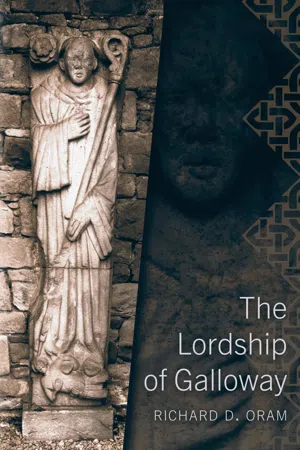
In viewing Galloway from the wider context of the northern British mainland, Irish Sea and wider Hebridean zone, it has been possible to explore the dynamics of state-building, dynastic interactions, and the close inter-relationships of the territories connected by the western seaways, which most traditional 'national' histories obscure. From this wider perspective, the development of the lordship of Galloway can be considered in the context of the spreading power and regional rivalries of English, Irish and Scottish kings, and a reassessment of the emergence of the unitary lordship controlled by Fergus of Galloway and his family. Traditional interpretations of the relationship of Fergus and his successors with the kings of England and Scotland are challenged and new light is thrown on the beginnings of the processes of progressive domination of Galloway by, and integration into, the kingdom of the Scots. The end of the autonomous lordship in the 1230s is projected against the backdrop of the aggressive state-building activities of King Alexander II and the transformation of its rulers from independently minded princes and warlords into Anglo-Scottish barons.
- 300 pages
- English
- ePUB (mobile friendly)
- Available on iOS & Android
eBook - ePub
The Lordship of Galloway
About this book
Trusted by 375,005 students
Access to over 1.5 million titles for a fair monthly price.
Study more efficiently using our study tools.
Information
Subtopic
Scottish HistoryIndex
History1
ORIGINS
When the lordship of Galloway appears in historical record for the first time in the twelfth century, it is as a monolithic political unit. This unitary lordship has exercised a powerful hold over the historiography of Galloway, with the notion of a single political entity spanning the whole region from the Rhinns to the Nith having been projected backwards from the reality of the twelfth into the mythos of earlier centuries. Although the descent of the recorded lords is unknown, it has often been assumed that they represented the continuity of a long-established authority in the Scottish south-west, a kingdom of Galloway and the Gall-Gaidhel which originated in the ninth or tenth centuries with the infiltration of Scandinavian and hybrid Norse-Gaelic colonists into the mainland, where their leaders usurped the political power of the former Northumbrian masters of Galloway. This is, however, at best a simplistic interpretation of the evolution of the political entity which dominated the northern Irish Sea for over a century down to 1234, where the complex interplay of mainland British, Irish and Isles-based powers provided the circumstances for the development of a fiercely independent power which looked to the maritime world of the west rather than to its Scottish hinterland.
SCANDINAVIANS, IRISH AND ISLESMEN
THE SCANDINAVIAN DIASPORA
The chain of events which led to the formation of the lordship of Galloway can be traced back over 200 years to the reverberations felt round the Irish Sea of the expulsion in AD 902 of the Norse from their settlement at Dublin.1 Although the colony was re-settled around 917 by a Viking warband from Britanny and secured in 919 by a decisive victory over the Irish in which Niall Glúndub, King of Ailech and Tara, was killed,2 the preceding decade saw the plantation of colonies elsewhere around the northern Irish Sea basin. Irish tradition, for example, records the movements of Ingimundr, a Dublin Norse warlord, who after an abortive attempt to establish a new base in north Wales, occupied the Wirral and attempted to seize Chester.3 A similar process may be recorded in Amounderness, where Norse and Norse-Gaelic names occur in some density.4 It was on the southern limits of this area of Norse settlement that the Cuerdale hoard, deposited c.903, was discovered. Alfred Smyth has linked the deposition of the hoard with political instability at York after the death of King Guthfrith, but the high percentage of Hiberno-Norse material in it points towards an Irish origin, probably Dublin.5 Amounderness, controlling the western end of the trans-Pennine Ribble-Aire gap, leading through to York, was an important area to be controlled by dynasts aspiring to rule in both York and Dublin. This strategic significance was underscored by its purchase in 934 from the Scandinavians by King Athelstan and its grant to the Church of York.6 Further evidence for the shockwaves emanating from the expulsion of the Norse from Dublin were felt all the way up the coast from Morecambe Bay to the Solway. The origins of Norse and Norse-Gaelic settlement in Cumbria, where the indigenous Anglian élite fled in the face of Scandinavian incursion, can likewise be dated to the period c.902-c.914.7 It is as part of this general dispersal of Norsemen around the Irish Sea that the early colonisation of Galloway should probably be seen.
Settlement in Galloway was limited in numbers and extent. The chief body of Dublin Norse, under the leadership of Ragnall, grandson of Imar (Ívarr), headed further north and east and was active over a wide area from central Scotland south to York. Their first major raids penetrated Strathclyde and struck into the heart of the Picto-Scottish kingdom in Strathearn and Strathtay. The invaders plundered Dunkeld in 903 before suffering a defeat in Strathearn in 904 in which Ragnall’s brother or cousin, Imar, was slain.8 A Norse army remained active, however, in south central Scotland, especially within Strathclyde, after that date.9 There is no firm evidence for Ragnall’s movements from c.904 until 910, when, seizing the opportunity presented by Edward the Elder of Wessex’s defeat and slaughter of the Danes of York at Tettenhall in 910, Ragnall turned south and occupied the city soon after. As King of York, Ragnall began to settle the Norse army on land seized from the church. This new pressure on the northern rump of Northumbria forced its ruler, Ealdred of Bamburgh, into alliance with the Scots. In c.918, in a hard-fought contest on the Tyne at Corbridge, Ragnall defeated a confederate army of Scots and Northumbrians in a battle that evidently confirmed his mastery over the territory from the Humber to at least the Tyne.
In the aftermath of this victory, Ragnall turned west and re-entered the Irish Sea world. From the rapidity with which he assembled a fleet, won a major naval engagement off Mann, and imposed his rule on the Norse colony at Waterford,10 he must have found ships available to him west of the Pennines, presumably among the Norse colonists in those areas. Control of the trans-Pennine routes, possibly via the Aire Gap but more probably along the Stainmore route from Teesdale into the Eden Valley, enabled Ragnall and, after his death in 920, his kinsman Sigtryggr (who had re-established the base at Dublin) to exercise rule over a kingdom which spanned the Irish Sea. The Dublin-York axis was maintained down to the middle of the tenth century, foundering in 952 with Óláfr Cuarán’s second expulsion from the kingship of York.11 While that event ended the direct political link between the Ostman cities of Ireland and the kingdom of York, the lines of communication were certainly not severed. Indeed, it was while heading for the Norse colonies in the west along the Stainmore route that Óláfr’s successor at York, Eiríkr Bloodaxe, was attacked and killed in 954.12
By the middle of the tenth century, the Norse colonies in Cumbria were well established. The existence of a semi-independent Scandinavian lordship in the upper Eden valley in north Westmorland, centred on Penrith, has been postulated in the second half of the 900s, and has highlighted the presence of zones of intensive Norse settlement and lordship down the Solway coastlands.13 While the origins of this colonisation may have lain in the post-902 diaspora, it has been pointed out that the unsettled military situation down to c.920 would hardly have produced favourable conditions for large-scale settlement. The twenty-five years before the invasion of Cumbria by Edmund of Wessex in 945,14 however, was a time of comparative stability, marked by what has been interpreted as an episode of rapprochement between Cumbrian kings and Norse settlers.15 It is possibly in similar circumstances, facilitated by Dublin-Norse control of the Northumbrian political and spiritual heartland at York and domination of the Cuthbertine community at Chester-le-Street, that two zones of Scandinavian settlement in Galloway, centred on Whithorn and Kirkcudbright, were established and consolidated.
NORSE GALLOWAY
In the absence of documentary materials from which to construct a coherent narrative history for the Scandinavian colonisation of parts of Galloway, great weight has been placed on the place-name evidence for this process.16 While traditional historical records can be used to form the most basic of outline discussions of the Scandinavians’ roles in the political development of the lordship, they cannot be used to show that they had any lasting impact on the region. Archaeology and place-names, however, emphasise that they cannot be dismissed as an irrelevance and that they settled along the northern shore of the Irish Sea in sufficient numbers to make a significant impression on the place-name record. Indeed, place-names constitute the principal body of evidence for Scandinavian settlement throughout Galloway.
The main distribution of Scandinavian settlement names in Galloway forms two main blocks, one centred on the southern Machars, the other concentrated in the lower Dee valley around Kirkcudbright. The Machars group has attracted particular a...
Table of contents
- Cover
- Title
- Copyright
- Contents
- List of maps
- List of illustrations
- Acknowledgements
- List of abbreviations
- Foreword
- Introduction
- 1 Origins
- 2 Fergus
- 3 Division and recovery
- 4 Zenith and nadir: Alan 1200–34
- 5 The heirs of Alan: de Quincy, de Forz and Balliol
- 6 A spiritual counterpart: The medieval diocese of Whithorn c.110-c. 1300
- 7 Colonisation, integration and acculturation, c. 1160–1300
- 8 ‘And he built castles and very many fortresses’: the physical evidence
- 9 Land and society
- Conclusion: The failed kingdom
- Family trees
- Maps
- Bibliography
- Index
Frequently asked questions
Yes, you can cancel anytime from the Subscription tab in your account settings on the Perlego website. Your subscription will stay active until the end of your current billing period. Learn how to cancel your subscription
No, books cannot be downloaded as external files, such as PDFs, for use outside of Perlego. However, you can download books within the Perlego app for offline reading on mobile or tablet. Learn how to download books offline
Perlego offers two plans: Essential and Complete
- Essential is ideal for learners and professionals who enjoy exploring a wide range of subjects. Access the Essential Library with 800,000+ trusted titles and best-sellers across business, personal growth, and the humanities. Includes unlimited reading time and Standard Read Aloud voice.
- Complete: Perfect for advanced learners and researchers needing full, unrestricted access. Unlock 1.5M+ books across hundreds of subjects, including academic and specialized titles. The Complete Plan also includes advanced features like Premium Read Aloud and Research Assistant.
We are an online textbook subscription service, where you can get access to an entire online library for less than the price of a single book per month. With over 1.5 million books across 990+ topics, we’ve got you covered! Learn about our mission
Look out for the read-aloud symbol on your next book to see if you can listen to it. The read-aloud tool reads text aloud for you, highlighting the text as it is being read. You can pause it, speed it up and slow it down. Learn more about Read Aloud
Yes! You can use the Perlego app on both iOS and Android devices to read anytime, anywhere — even offline. Perfect for commutes or when you’re on the go.
Please note we cannot support devices running on iOS 13 and Android 7 or earlier. Learn more about using the app
Please note we cannot support devices running on iOS 13 and Android 7 or earlier. Learn more about using the app
Yes, you can access The Lordship of Galloway by Richard D. Oram in PDF and/or ePUB format, as well as other popular books in History & Scottish History. We have over 1.5 million books available in our catalogue for you to explore.