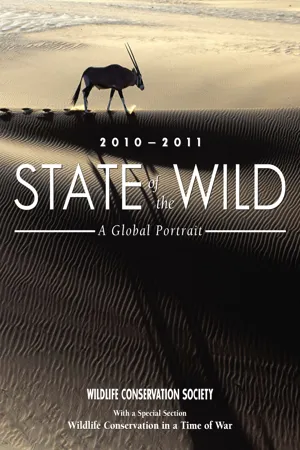
State of the Wild is a biennial series that brings together international conservation experts and writers to discuss emerging issues in the conservation of wildlife and wild places. Each volume in the series combines evocative writings with a fascinating tour of conservation news highlights and vital statistics from around the world.
One-third of each volume focuses on a topic of particular concern to conservationists. This 2010–2011 edition considers how destabilization and war affect wildlife and wild places.
Only recently has the international community begun to appreciate the cost of conflict—simmering tension, war, and reconstruction—on the natural world. This special section examines the role that conservation plays in the context of human conflict considering issues such as, Can the work of saving wildlife and wild places help ameliorate tensions? Can conservation deepen political understanding? Can conservation help in post-conflict situations?
The book’s twenty essays are intermixed with poetry and beautiful photos that capture our connection to the wild.
State of the Wild’s accessible approach educates a wide range of audiences while at the same time presenting leading-edge scientific overviews of hot topics in conservation. Uniquely structured with magazine-like features up front, conservation news in the middle, and essays from eminent authors and experienced scientists throughout, this landmark series is an essential addition to any environmental bookshelf.
Trusted by 375,005 students
Access to over 1.5 million titles for a fair monthly price.
Our planet’s wild places—its myriad forests, grasslands, freshwaters, scrublands, and deserts, not to mention the largely unknown oceans—contain boundless biological interconnections. Exploring the natural world, directly through research and travel or indirectly through films and books, provides us an education on how wonderful and varied ecosystems are, and how our human societies are degrading the planet. Here, in State of the Wild, we share information on emerging issues in the conservation of wildlife and wild places over the past two years.
The opening essay, “State of the Wild: Wounded Wilderness,” reveals the discovery of mercury contamination in even our most remote wild places. Often, we hope that oceans, rivers, and forests will somehow absorb the unwanted output from our industries and cities, but the consequences of this practice are playing out on a planetary scale.
From this overarching view, the focus narrows to showcase conservation victories and losses around the world in “Global Conservation News Highlights.” These serve to describe the present state of the wild and, in sum, are both comforting and worrisome. “Discoveries” synthesizes news from the past two years in a different way, highlighting some of the new species that were discovered on the exhilarating expeditions of wildlife biologists and recreational naturalists. This is followed by “Rarest of the Rare,” a poignant catalogue of species in decline, some of which may not last beyond a few more generations unless conservation efforts are redoubled. We hope that “Rarest of the Rare,” rather than serving as an epitaph, will inspire a desire to learn more about wildlife and to work toward its long-term survival. The section continues as we follow a State of the Wild series tradition by returning to the theme of the previous volume (2008–2009)—Emerging Diseases and Conservation: One World–One Health—to explore why the intersection of wildlife, livestock, and human health continues to make headlines.
With the background and context provided by these pieces, we can better appreciate the contributions made by the 2010–2011 “Champions of the Wild”—individuals who have truly dedicated their lives to conservation. Subsequent parts of the book analyze wildlife conservation challenges, both local and global, and contemplate the theme of this edition: the conservation of wildlife during times of conflict. We hope you are inspired by the science, issues, species, and places presented in this book.
Caribou bulls cross the Alatna River, Gates of the Arctic National Park, Alaska.
STATE OF THE WILD:
Wounded Wilderness
GARY PAUL NABHAN
My canoe skimmed along a small lake in Alaska where I had traveled for a fishing trip. The quiet was punctuated only by the rippling water and distant bird calls. As I looked out upon snow-capped peaks, coniferous forests, and meadows carpeted with blueberries, I spotted a trail frequented by Dall’s sheep (Ovis dalli dalli) and a few bears. I tried to imagine just how far south this boreal forest ecosystem stretched from Alaska into Canada, imagining the miles and miles of trees and wilderness that separated me from the distant cities I know. All I could see before me was the cold blue waters of Takahula Lake below the Arrigetch Peaks in the Brooks Range, some 70 miles from the nearest settlement of any size. I had not considered Russia and China across the Arctic Sea to the west, a source of airborne pollutants that blow into this area. But my mind would soon have to grapple with the fact that I was now enjoying a contaminated wilderness.
GARY PAUL NABHAN is founder and facilitator of the Renewing America’s Food Traditions collaborative and is based on Tumamoc Hill in Arizona, the first restoration ecology site in the world and home of the Alliance for Reconciliation Ecology. His latest book is titled Where Our Food Comes From.
I had been out canoeing on Takahula Lake since seven in the morning, but the Arctic dawn had already occurred many hours earlier. It was July in the Gates of the Arctic National Park, and I was the only one on the water. That is to say, the only human, but there were plenty of Pacific loons (Gavia pacifica) and trumpeter swans (Cygnus buccinator), as well as moose wading on the far side of the lake. The air was crisp and clear; the water fresh from glacier melt; it seemed for a moment that I was partaking in the quintessential wilderness experience.
As I cast my line toward a shallow shoal between me and the shore, I saw the shimmering serpentine body of a green-spotted northern pike (Esox lucius) dodge its splash, then turn and spot the spoon-shaped lure. The fish lunged toward the lure, its boney jaw clamping down hard on the hook. Within half a minute, I had the pike in my hands, a sleek, 16-inch body quivering within my firm grip. I was thrilled.
But as I set about removing the hook from its upper jaw, I remembered what park ranger Pete Christian had said when Inupiaq elder James Nageak and I had gone out fishing the day before. Pete did not want to discourage us from fishing altogether but asked us to consider catch and release for a peculiar reason: high levels of mercury had been found in lake trout in the Gates of the Arctic National Park and the Noatak National Preserve. Many of the fish in a number of freshwater lakes in Alaska were already unfit to eat on a regular basis, primarily as a result of airborne contaminants that had blown in from factories and power stations thousands of miles away.
Levels of methylmercury found in loons’ blood and feathers serve as an indicator of the health of North American lakes.
Mercury? I was astounded that fish in a wilderness lake contained enough methylmercury to cause neurological damage and impair reproductive health in people as well as in other fish-eating animals. Because the risk threshold for humans is the consumption of only two fish per month, some physicians discourage anyone from eating more than six ounces of any kind of fish per week, and they warn pregnant women against eating fish considered to be “apex predators.” Why? It turns out that the deadliest forms of mercury are organic mercury compounds. Exposure to just a few drops of certain compounds may be enough to cause death. Methylmercury is the most persistent form, remaining stored in body tissues rather than being excreted away. From microbes to crustaceans to predatory fish, it bioaccumulates up the food chain.
Although I had caught a pike and not a lake trout, I was unsure whether I should bring the fish back to the kitchen for breakfast or release it. I hesitated for a moment, gripping the pike between my palms to sense the power of its wildness. Then I leaned over the wooden hull of the canoe and released the fish into the crystal clear but contaminated waters of Takahula Lake. I paddled back to camp, the fish bucket empty, but the memory of that slimy green pike still occupying my mind.
As an occasional visitor to Alaska from Arizona, I would not have been particularly vulnerable to mercury exposure by eating one or two fish during this trip. But nearly everyone else I was camping with was an Alaskan resident whose family and community depended on wild-caught fish and game for much of the year. Habitual consumption of either lake trout or pike from these parts would pose a real health risk for them.
When I returned home from the Arctic wilderness, I read a six-year study that the Western Airborne Contaminants Assessment project had undertaken in the most remote lakes in national parks across western North America. Two bodies of freshwater not far from Takahula—Burial Lake and Matcharak Lake—were among those sampled for evidence of airborne contaminants that can bioaccumulate up the food chain. The fish inhabiting these lakes carried not only dangerously high levels of mercury but also problematic levels of the insecticide dieldrin, a toxin kno...
Table of contents
About Island Press
About the Wildlife Conservation Society
State of the Wild
Title Page
Copyright Page
Dedication
Table of Contents
Wildlife Conservation in a Time of War
FOREWORD - Conservation and the Global Economic Recession
Introduction: Future States of the Wild
PART I - STATE OF THE WILD
PART II - FOCUS ON THE WILD
PART III - EMERGING ISSUES IN THE WILD
Acknowledgments
Notes
Index
Island Press | Board of Directors
Frequently asked questions
Yes, you can cancel anytime from the Subscription tab in your account settings on the Perlego website. Your subscription will stay active until the end of your current billing period. Learn how to cancel your subscription
No, books cannot be downloaded as external files, such as PDFs, for use outside of Perlego. However, you can download books within the Perlego app for offline reading on mobile or tablet. Learn how to download books offline
Perlego offers two plans: Essential and Complete
Essential is ideal for learners and professionals who enjoy exploring a wide range of subjects. Access the Essential Library with 800,000+ trusted titles and best-sellers across business, personal growth, and the humanities. Includes unlimited reading time and Standard Read Aloud voice.
Complete: Perfect for advanced learners and researchers needing full, unrestricted access. Unlock 1.5M+ books across hundreds of subjects, including academic and specialized titles. The Complete Plan also includes advanced features like Premium Read Aloud and Research Assistant.
Both plans are available with monthly, semester, or annual billing cycles.
We are an online textbook subscription service, where you can get access to an entire online library for less than the price of a single book per month. With over 1.5 million books across 990+ topics, we’ve got you covered! Learn about our mission
Look out for the read-aloud symbol on your next book to see if you can listen to it. The read-aloud tool reads text aloud for you, highlighting the text as it is being read. You can pause it, speed it up and slow it down. Learn more about Read Aloud
Yes! You can use the Perlego app on both iOS and Android devices to read anytime, anywhere — even offline. Perfect for commutes or when you’re on the go. Please note we cannot support devices running on iOS 13 and Android 7 or earlier. Learn more about using the app
Yes, you can access State of the Wild 2010-2011 by Eva Fearn in PDF and/or ePUB format, as well as other popular books in Biological Sciences & Zoology. We have over 1.5 million books available in our catalogue for you to explore.