Nursing and Informatics for the 21st Century - Embracing a Digital World, 3rd Edition, Book 3
eBook - ePub

Nursing and Informatics for the 21st Century - Embracing a Digital World, 3rd Edition, Book 3

Innovation, Technology, and Applied Informatics for Nurses

  1. 210 pages
  2. English
  3. ePUB (mobile friendly)
  4. Available on iOS & Android
eBook - ePub

About this book

Innovation, Technology, and Applied Informatics for Nurses explores informatics trends emerging over the next decade including personalized healthcare, telehealth, artificial intelligence, voice recognition, and predictive analytics. Emphasis is placed on their importance, benefits, and key challenges for nurses. Digital health and patient-generated data in the context of remote monitoring are highlighted with a focus on digital health tools, issues, challenges, and implications for the future. A featured case study includes the use of patient-generated data during the COVID-19 pandemic including critical lessons learned. A discussion of the technological building blocks of sensors and the Internet of Things highlights examples of how healthcare delivery system models of care are being transformed. Applied data science as an emerging healthcare discipline explores natural language processing, data science frameworks, implications for data bias, and ethical considerations. The conceptual building blocks of artificial intelligence and machine learning are outlined resulting in a call for all nurses to develop an improved understanding of implications for our practice and our patients. Telehealth is described as including modalities, services, virtual care, human factors, and financial, legal, and regulatory considerations. Key drivers and stakeholders advancing simulation-based care delivery are discussed including recommendations for how healthcare organizations can perform event simulation as they prepare to meet the risk management needs of the future. This book concludes by highlighting documentation best practices implemented during the COVID-19 pandemic.

Nursing and Informatics for the 21st Century – Embracing a Digital World, 3rd Edition is comprised of four books which can be purchased individually:

Book 1: Realizing Digital Health – Bold Challenges and Opportunities for Nursing

Book 2: Nursing Education and Digital Health Strategies

Book 3: Innovation, Technology, and Applied Informatics for Nurses

Book 4: Nursing in an Integrated Digital World that Supports People, Systems, and the Planet
Frequently asked questions

Yes, you can cancel anytime from the Subscription tab in your account settings on the Perlego website. Your subscription will stay active until the end of your current billing period. Learn how to cancel your subscription.
No, books cannot be downloaded as external files, such as PDFs, for use outside of Perlego. However, you can download books within the Perlego app for offline reading on mobile or tablet. Learn more here.
Perlego offers two plans: Essential and Complete
  • Essential is ideal for learners and professionals who enjoy exploring a wide range of subjects. Access the Essential Library with 800,000+ trusted titles and best-sellers across business, personal growth, and the humanities. Includes unlimited reading time and Standard Read Aloud voice.
  • Complete: Perfect for advanced learners and researchers needing full, unrestricted access. Unlock 1.4M+ books across hundreds of subjects, including academic and specialized titles. The Complete Plan also includes advanced features like Premium Read Aloud and Research Assistant.
Both plans are available with monthly, semester, or annual billing cycles.
We are an online textbook subscription service, where you can get access to an entire online library for less than the price of a single book per month. With over 1 million books across 1000+ topics, we’ve got you covered! Learn more here.
Look out for the read-aloud symbol on your next book to see if you can listen to it. The read-aloud tool reads text aloud for you, highlighting the text as it is being read. You can pause it, speed it up and slow it down. Learn more here.
Yes! You can use the Perlego app on both iOS or Android devices to read anytime, anywhere — even offline. Perfect for commutes or when you’re on the go.
Please note we cannot support devices running on iOS 13 and Android 7 or earlier. Learn more about using the app.
Yes, you can access Nursing and Informatics for the 21st Century - Embracing a Digital World, 3rd Edition, Book 3 by Connie Delaney, Charlotte Weaver, Joyce Sensmeier, Lisiane Pruinelli, Patrick Weber, Connie Delaney,Charlotte Weaver,Joyce Sensmeier,Lisiane Pruinelli,Patrick Weber,Connie White Delaney, Connie White Delaney, Charlotte Weaver, Joyce Sensmeier, Lisiane Pruinelli, Patrick Weber in PDF and/or ePUB format, as well as other popular books in Business & Leadership. We have over one million books available in our catalogue for you to explore.

Information

Year
2022
Print ISBN
9781032249810
eBook ISBN
9781000573510
Subtopic
Leadership

Chapter 1 Top Informatics Trends for the Next Decade

Joyce Sensmeier
DOI: 10.4324/9781003281016-1
Contents
Introduction
Emerging Trends and Nursing’s Role
Top Informatics Trends for the Next Decade
Personalized Healthcare
Telehealth
Artificial Intelligence
Voice Technology
Predictive Analytics
Mobile Device Integration
Conclusion
References

Introduction

Since the beginning of the COVID-19 pandemic, clinicians and patients have witnessed an astounding degree of digital transformation. From the widespread adoption of telehealth to the rapid advancement of voice technologies, nurses are central to this digital evolution. Today’s nurses must embrace and understand technical innovations to stay current and effective in delivering care. Nurses also work in partnership with nurse informaticists at the forefront of the implementation of information technology in healthcare. From its inception, the specialty of nursing informatics has been indispensable for its role in technology assessment and adoption (American Nurses Association, 2015). The nurse informaticist’s role includes safeguarding patient safety and minimizing the potential for error that technology can trigger. Optimizing the capabilities of technologies and systems to enhance nursing documentation and improve workflow efficiency are among the critical components of the nurse informaticist role (HIMSS, 2020b). As digital transformation continues to accelerate, it is important for all nurses to be knowledgeable of emerging trends and embrace the positive impact while mitigating the risks. This chapter reviews the top informatics trends for the next decade and details their importance for nurses, including key drivers, benefits and challenges for adoption.

Emerging Trends and Nursing’s Role

The innovations experienced over the past decade have been instrumental in preparing us for an increasingly digital future in the way healthcare is managed, experienced and delivered. The ultimate promise of digital transformation is to leverage digital capabilities to achieve improved performance and more importantly, improved outcomes (Adler-Milstein, 2021). Future innovations will have significant value for nurses. These advances may enhance a current process to make it more efficient or streamline documentation through improved automation. Improvements in interoperability will enhance the connectivity of systems and allow us to understand and leverage the deep store of data and information (KLAS Research, 2021). These new capabilities will build evidence that increases our knowledge and understanding of which nursing practices lead to improved health outcomes. This digital transformation holds great promise for enabling nursing practice that can leverage innovation to support and enhance the work of nurses. However, nurses must work in partnership with nurse informaticists to build capabilities that make this transformation beneficial to nursing practice. The future of nursing depends on active engagement and transformational leadership to support a culture of clinical inquiry. Innovative leaders will inspire others to cultivate and apply innovation to achieve a sustained impact on clinical practice and outcomes (Ridge, 2021).
Nurses have an infinite number of day-to-day responsibilities including documentation of patient care, administering medications, procuring supplies and communicating with family and clinical team members (Scott, 2021). Each of these responsibilities takes time away from patients. Innovative technology can alleviate some of this burden by increasing efficiency, streamlining communications or procuring data from smart devices. Decreasing the documentation burden on clinicians and across healthcare settings is an important priority of professional organizations, government agencies and applied informatics efforts (Collins et al., 2018). Capturing data by using cardiac monitors or smart pumps that are interfaced with the electronic health record (EHR) will free up nurses from cumbersome or duplicative tasks, enabling them to use their knowledge and skills to deliver quality patient care. The disruption caused by the pandemic is also creating new opportunities for the adoption of digital health technologies to transform healthcare delivery (Bannon, 2020). Nurse executives from health systems across the country are now relying on a vast array of digital health tools, driven, in part, by their use during the pandemic (Jercich, 2021).
It is imperative that nurses keep up with the pace of innovation and yet stay true to the art and science of providing care (Carroll, 2021). Given the rapid acceleration of technical innovations, nurses practicing in the coming decade will need to be proficient in using emerging technology. Nursing expertise is essential when designing, analyzing and applying data to ensure health equity using digital platforms and other innovative technologies (National Academy of Medicine, 2021). The demand and significance of knowledge generation to improve nursing and healthcare continue to be urgent (Delaney et al., 2021), and now is the time for nurses to embrace and understand informatics trends to fully engage in the digital evolution.
To address the rapid advances in digital health, the Australian Digital Health Agency has developed the National Nursing and Midwifery Digital Health Capability Framework (Australian Digital Health Agency, 2020), for use as a resource to guide individuals, employers and educators in their workforce and professional development planning and delivery. The Framework ā€˜has been created to:
  • define the digital health knowledge, skills and attitudes required for professional practice,
  • complement existing individual knowledge, skill and attitudinal frameworks and
  • provide a solid basis for tailored learning.’
The Framework represents a central theme of safety and quality in healthcare within the digital healthcare environment and consists of five domains which describe capability statements for nurses and midwives progressing from formative to proficient levels. This resource asserts that technology should be understood and used appropriately by nurses and midwives to deliver safe, quality care. This Framework emphasizes the need for nurses to maintain knowledge in relation to digital health innovations and their use, relevant to their practice.

Top Informatics Trends for the Next Decade

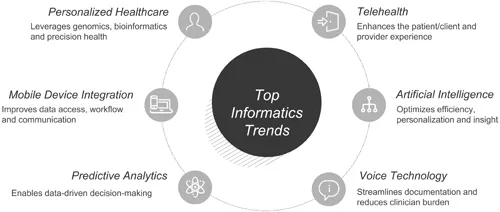
As the digital health landscape evolves, innovation continues to progress as well. This section describes the top informatics trends that are essential for nurses to understand and embrace as we move beyond a primary focus on the EHR, until they are assimilated as foundational to healthcare delivery in the next decade (see Figure 1.1).
Figure 1.1 Top informatics trends.

Personalized Healthcare

Personalized healthcare leverages genomics, bioinformatics and precision health to tailor healthcare to the individual characteristics of each person. The personalized care model embraces patient engagement and emphasizes long-range planning based on a person’s predicted response or risk of disease. To encourage patient and consumer engagement, applications are now widely available to monitor personal health or track physiologic data or physical activity.
Our current healthcare system is experienced at retroactively fighting disease, but often deficient in proactively keeping people healthy. Personalized healthcare offers a new way of treating patients based on a data-informed understanding of an individual’s personal health. According to Hood (2021), ā€˜This is the essence of personalized healthcare—treating each individual according to that person’s unique traits.’ With the passage into law of the 21st Century Cures Act in 2016, we anticipate that precision health will change the face of healthcare by allowing for personalized disease prevention and treatment (Starkweather et al., 2018).
The research agenda of the National Institute of Nursing Research (NINR) at the National Institutes of Health (NIH) includes a focus on developing personalized strategies to treat individuals with precise interventions and to prevent adverse symptoms of acute and chronic illness across the continuum of care (National Institute of Nursing Research, 2016). This focus area of research, also labeled symptom science, is building evidence-based symptom management strategies assembled on a foundational understanding of the biology of symptoms. By advancing symptom science, NINR promotes the goals of developing and testing new interventions to reduce the disabling effects of symptoms and improve patient health outcomes. The ultimate aim of this field of research is to be able to precisely identify individuals at risk for symptoms and develop targeted strategies to prevent or diminish the severity of symptoms (Dorsey et al., 2019).
As we look ahead toward realizing the opportunity to leverage the benefits of personalized health strategies, potential challenges are considerable. Integrating the necessary information for assessing an individual’s predicted response to treatment using today’s EHR capabilities will be a daunting task. The system requirements include technologies that can manipulate massive amounts of data integrated into networks of health information (McCormick & Calzone, 2021). Additionally, adequate storage requirements and levels of security, decision support tools, privacy safeguards and big data analytics are each necessary for managing these data to achieve optimal results. However, breaking through these barriers will enable us to realize the ultimate promise of personalized healthcare. To build this new ecosystem, organizations must give individuals ownership and control over their data so that they will have the necessary information to manage their own care (Spence, 2021).

Telehealth

Telehealth is a vehicle for delivering virtual healthcare to provide community-based care and other services for chronic conditions, mental health counseling, in-home patient monitoring and palliative care. Telehealth will enhance the patient/client and provider experience by using a variety of technologies and methods to deliver virtual medical, health and educational services. Growth in the use of telehealth services has enabled access to healthcare that is not limited by time, place or the availability of skilled healthcare professionals. Nursing practice is well-positioned to develop and deliver telehealth services. There is an urgent need for nurses to embrace telehealth services to ensure patients receive the care they need at the optimal place and time (Sensmeier, 2020). And studies have shown that patient satisfaction with virtual visits is comparable to, and in some cases better than, in-person care (Rose et al., 2021).
Telehealth has rapidly become a common delivery method for routine care during the COVID-19 pandemic. Between June 26 through November 6, 2020, over 30% of weekly health center visits occurred via telehealth, according to the Centers for Disease Control and Prevention (CDC) (Demeke et al., 2021). The US Congress temporarily lifted geographic restrictions and enhanced reimbursement so that health centers could expand telehealth services and continue providing care during the pandemic. Sustaining expanded use of telehealth after the pandemic will require continuing the new flexibilities in telehealth services and reimbursement policies. Some providers are signaling a shift to a hybrid care model, which will replac...

Table of contents

  1. Cover
  2. Half-Title
  3. Series
  4. Title
  5. Copyright
  6. Dedication
  7. Contents
  8. Foreword by Deborah Trautman
  9. Foreword by Kedar Mate
  10. Foreword by Howard Catton
  11. Preface
  12. Acknowledgement
  13. Editors
  14. Contributors
  15. Introduction
  16. 1 Top Informatics Trends for the Next Decade
  17. 2 Canadian Health Outcomes for Better Information and Care: Making the Value of Nursing Visible through the Use of Standardized Data
  18. 3 Consumer-Generated Whole-Person Health Data: A Structured Approach
  19. 4 Sensors and the Internet of Things
  20. 5 Applied Data Science
  21. 6 Understanding the Foundations of Artificial Intelligence: Data, Math and Machine Learning
  22. 7 Artificial Intelligence for Nursing and Healthcare: Potentials and Cautions
  23. 8 Artificial Intelligence-Based Model for Monitoring Pressure Ulcer Changes in Bedridden Patients: A Case Study from Taiwan
  24. 9 Telehealth and Virtual Care
  25. 10 Simulations-Based Care Delivery
  26. 11 Case Studies in Applied Informatics during COVID-19
  27. Index