![]()
III. Come l’anima nel corpo
l. 2
![]()
Chapter 11
Beyond Liturgical Architecture: Work as a Means of Perfection and Enhancing the Value of Sacred Spaces
l. 2Marie Stephanie N. Gilles
Master of Architecture degree holder, PhD in Urban and Regional Planning (ongoing), University of the Philippines; Principal Architect, SNG Design Enterprise; ASEAN Architect (with specialization on Liturgical Architecture); Founding Chairperson, Guild of Liturgical Designers – Philippines; Founding Chairperson, United Architects of the Philippines Committee on Liturgical Architecture and Sacred Spaces;
[email protected].
Abstract. The design of sacred spaces is an important facet in the professional work of the believer. The work of a liturgical architect is to bring God to earth through the physical expressions of piety aimed to lift man back to God. This work is of great significance as a means of human perfection, starting with the faithful adherence to the original concept, precision in timing and dimensions, careful attention to details which collectively lead towards a transcendence of design from the material to the spiritual. Its objective is to provide the occasion and the proper setting for the faithful to lift up their aspirations to God, a vertical upward movement reminiscent of the gothic spires that give testimony to the supremacy of the Highest Being.
This paper shall describe Catholic and Protestant sacred spaces, then shall set out to make important comparisons between their respective architectural features. A contrast is made between the elaborate iconography of the Catholic Tradition vs. the austere simplicity of Protestant sacred spaces, especially in the modern Philippine setting: iconoclastic, devoid of sacred images and statues of saints as well as symbols of the sacraments. The actual trend for the latter is that of resorting to transitory spaces such as multi-purpose rooms, auditoriums and concert halls for their worship sessions. This phenomenon of minimalism is evocative of the austere interdenominational prayer rooms found in secular buildings such as airports or hospitals, whereas Catholic chapels in commercial structures such as malls and office buildings continue to revive the neoclassic traditions that enrich these liturgical spaces.
A discussion of the parameters of Sacred Architecture follows: Verticality, Permanence and Iconography, with additional parameters of Dignity and Solemnity for sacred spaces in secular settings, e.g. chapels in shopping centers, as prescribed by the Catholic Bishops Conference of the Philippines, to ensure meaningful attendance to liturgical celebrations.
Finally, the paper ends with some case studies of actual renovation projects undertaken by the author in her capacity as a liturgical architect, aiming to illustrate how enhancing the aesthetic value of a church or chapel contributes to its overall significance as a sacred space.
Keywords: transcending liturgical architecture, inculturation, renovating sacred spaces, Guild of Liturgical Designers.
11.1 Architecture is both Human and Divine
l. 20According to the Oxford Dictionary, the term “classic” refers to quality and excellence. In the field of architecture, that description is often applied to the buildings of ancient Greece and Rome. It is a commonly held belief that these were the places where artists have never been more successfully caught between a meeting of the human and the divine. It is called ‘classic’, because of its recognized excellence and the highest quality in both materials and craftsmanship in the execution of the design and building of their structures.
At the very core of Greek philosophy on natural environment was the belief that all architectural edifices—ranging from the sacred to the secular—must be aligned with, and respective of the landscape of the gods, especially when we speak of temples which were supposed to be their sacred dwellings (Figures 1 and 2). This presence of the deity or guardian spirit that permeated the entire landscape was called the genius loci.
The duty of the builder, then, was that of reaching out and identifying the sacred spirit fundamental to each location. It was only after the spirit was identified would the architecture become in partnership with the divine landscape.1
Figure 1: The Parthenon in Acropolis, Greece. Source: https://upload.wikimedia.org/wikipedia/commons/d/da/The_Parthenon_in_Athens.webp (12.10.2017)
Figure 2: The Pantheon in Rome, Italy
11.2 Liturgical Architecture and Sacred Spaces
l. 43Liturgical architecture deals with designing spaces for use by the faithful, specifically those intended for liturgical celebrations. It is a discipline that requires a certain level of commitment and demands certain skills aside from specialized knowledge from its designers. It is a unique branch of architecture in the sense that it allows for transcendence, starting from the materiality of the structure into the spirituality of the sacred space, since it is designing the House of God Himself. There is an upward movement of lifting up to God reminiscent of the vertical spires of towers in gothic cathedrals that point upwards to the high heavens. There is a lot of symbolism and iconography involved, as these signs and symbols reveal a reality far greater than the material representations they convey. As it is a sublime space, its primacy stemming from the fact that it is devoted to spiritual functions, it necessarily entails careful attention to details: precision of measurement, symmetry and classic proportions, accuracy as to implementation of the design, while fostering awareness of its significance as a work of sublime import.
Liturgy is “the participation of the People of God in ‘the work of God’.”2 It is the “exercise of the priestly office of Jesus”3 in which God is worshipped and adored and people are made holy. God begins the work of sanctifying people in time and space and brings that work to completion. Those who participate actively by responding to God in worship and in service are given the privilege of becoming co-workers in the divine plan.
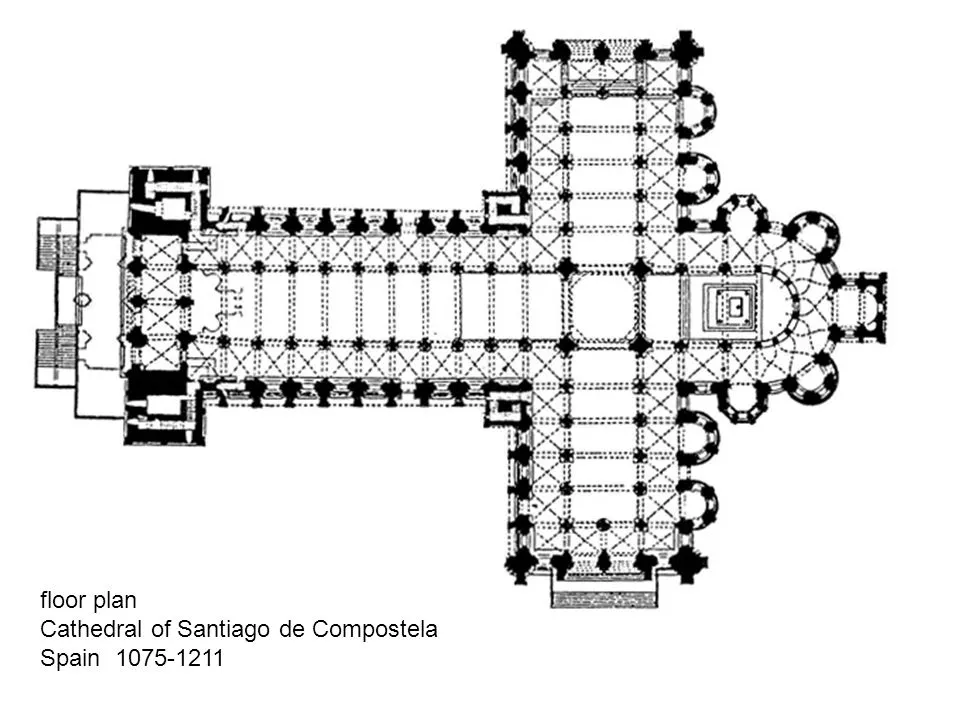
It was around twenty one centuries ago that Christ lived among us, instructing His disciples, and instituted the sacraments. The theology of liturgical space allows us to connect places of worship with the earthly places visited by Christ.4 Liturgical space (Figure 3) brings us back to those places where Christ had walked, spoken and gathered His disciples, from the seashore to the Cenacle, teaching them the basics of the Christian faith and strengthening them in their resolve to make fishers out of men, in their mission as apostles. It allows for the celebration of the mysteries of His Passion, Death and Resurrection, and re-presents before our very eyes the signs and symbols of the sacraments that He instituted.
Figure 3: Latin Cross Plan of the Cathedral, Santiago de Compostela, Spain. Source: http://images.slideplayer.com/13/3986117/slides/slide_3.webp (12.10.2017)
11.3 Transcendence of Sacred Spaces
l. 58Religious architecture and sacred spaces evoke the ethereal, inspire awe, mystery, contemplation. Architecture has the ability to turn geometric proportions into shivers, stone into tears, rituals into revelation, light into grace, space into contemplation, and time into divine presence. A transcending architecture disappears in the very act of delivering us into the awesome and timeless non-space of the holy. The Estonian-born American-bred architect Louis Kahn called it the “immeasurable”, the Sw...