![]()
Paintings against the temporal power of the Papal State
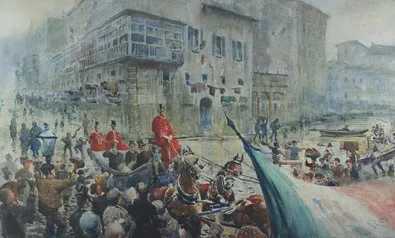
The first coming of King Vittorio Emanuele II in Rome on 30 December 1870
The painting ‘The First Coming of King Victor Emmanuel II to Rome on 30 December 1870’ is not part of the Roma Sparita collection, but is owned by the Central Museum of the Risorgimento.
King Victor Emmanuel II in Rome on December 30, 1870 by E. Roesler Franz
There is certainly a connection in terms of esoteric meaning between this painting and the 40 paintings depicting the Tiber that are part of the Roma Sparita series. The esoteric significance of this painting is an indictment of the temporal power of the Papal States, as the king’s carriage (representing the newly born Italy as confirmed by the Italian flag in the foreground) gallops by. This is in contrast to the background depiction of a flooded Rome in front of the Basilica of San Lorenzo in Lucina with a person in a rowing boat, representing the decadence of the Papal State, unable to manage the city of Rome in a modern way. So this picture simultaneously highlights both the new Italy marching forward and the danger posed by the flooding of the Tiber, which the papal government was unable to put an end to.
It was on this occasion that King Victor Emmanuel decided it was necessary to find a solution to prevent Italy’s capital from flooding. This painting certainly has a link with Roma Sparita, particularly the forty paintings with the Tiber as the central subject. In fact, with the embankments, Rome was finally reborn to a new life of progress and modernity.
The Tiber
Within the framework of Roma Sparita, consisting of one hundred and twenty watercolours, forty paintings have the Tiber as their main subject, which represents the connecting element of the whole series, thus uniting the different symbologies hidden in the individual watercolours. The number forty represents sacrifice ( Jesus’ forty days in the desert, the forty days of Lent and the forty years Moses and the people of Israel spent in the desert). In calculating the forty Tiber paintings, I did not take into account the very few paintings in which the river Tiber plays only a marginal role.
Thus the forty Tiber paintings represent the suffering of Rome due to the inability of the papal government to stem the Tiber, which periodically caused flooding and damage. And whose rebirth for the city of Rome was manifested with the unification of Italy as a symbol of progress and civilisation, when the new regime was finally able to embank the Tiber River.
So the reason why Ettore included all these paintings in the series Roma Sparita is not because of a romantic or nostalgic choice of the river Tiber, but an act of accusation against the temporal power of the Papal State for the carelessness with which it had managed Rome.
The river (which, before the walls, was an essential part of Rome before it was annexed to the Kingdom of Italy) in the Roma Sparita series represents the glue that unites particular places in the city charged with symbolic meanings based on the esoteric teachings learned from Jewish mysticism.
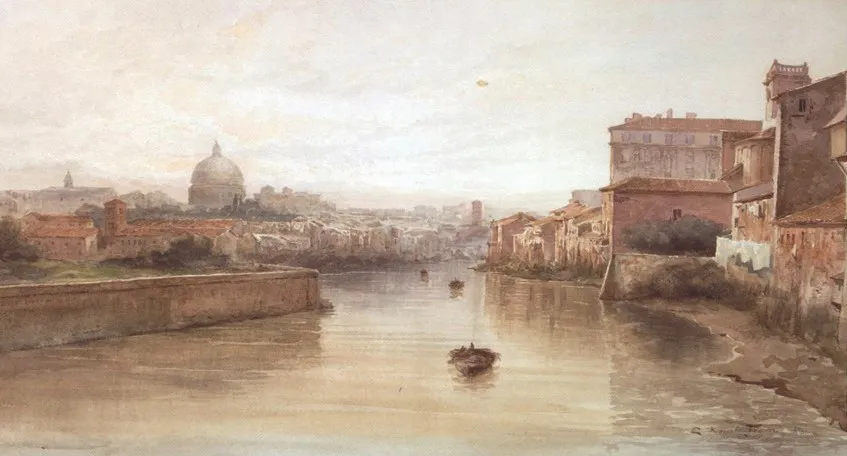
View of the Tiber, with the Palace and garden of the Farnesina and the Ponte Sisto.
In fact, during the period in which he assiduously frequented the Ghetto in Rome (when he painted watercolours and took some forty photographs), he met rabbis from the Roman Jewish community and explored various teachings with them.
For the Kabbalistic tradition, speculation on the spirit found its symbolic element in water. The Kabbalah and the system of the Sefirot represent, for Jewish mysticism, a means of contemplating and ordering , intuitively, a superior reality, inaccessible by rational means. In the book Babir, the three consonants BRK allow the construction of the equivalence between Berakà (blessing ) and Berekà (pond, accumulation of water) and from there the flow of life in its relationship with the divine (from top to bottom or from bottom to top) becomes fully symbolised by a circulation of waters.
Malkut, the bride, the Shekinah, the object of the most poetic appellations, like the fiancée in the Song of Songs, is then the ‘irrigated garden’, and is irrigated or fertilised by Tiferet through Yesod, the fountain that does not dry up, the spring of souls, the virile member.
And Tiferet acts as the intermediary between the top and the bottom of the sefirotic tree as Shamayim, i.e. sky, i.e. water of fire (and thus the spermatic rain); kabbalistically esh plus mayim, fire plus water, with God in the role of demiurge. And Tiferet, fountain and root, is such because it comes from Geburah, the rigor of fire, and from Hesed, the water of grace and origin of the world.
Just as in Genesis the world originates from the waters, so in theosophy it originates from the waters of Hesed, who is the symbol of Abraham, placed at the foundation of the building of the lower world. Tiferet and Yesod are inexhaustible fountains or springs because the inexhaustible immensity of the waters of Hesed receives nourishment, through Bina who gives form to the world in gestation, from the inexhaustible primordial waters of the sea or upper basin of Hokma, the Holy Spirit or Sophia.
This inexhaustibility of the waters of Hokma is concealed in turn in the peculiarity of Jewish thought, which sees the world as the intentional creative act of God; hence there is always something new above the sun, and the new is given by the eternal flow of the creative spring above, whose water fills the Hokma basin, flowing from it as a blessing from Sefira to Sefira to irrigate Malkut.
There, in Hokma, is the origin of human thought, the pool of archetypes, the highest level to which the mystic can ascend from vessel to vessel. The Kabbalist who wants to climb higher is equivalent to the alchemist who has descended too low.
But the Sefirot, as the Sefer Yetzirah warns, are ten and not nine, ten and not eleven. Another Sefira, and only one, is the one who fills the basin of Hokma from above : it is Keter, the will of God, the Source that g ushes forth from the primordial Darkness, from the night of Tohu and Bohu from which the world was born.
‘From Ponte Sisto on the left part of the garden of the Farnesina, on the right old medieval houses and the Falconieri palace. In the background the Church of S. Onofrio and the Bell Tower of the Church of S. Spirito and the dome of S. Pietro.’ Private collection.
To these waters the human eye cannot reach, above the waters of Hokma, no human foot can rest, as it is written: ‘And the Spirit of God hovered over the surface of the waters’. Ettore’s interest in painting watercolours in which water is depicted is surely linked to his knowledge of the esoteric symbols of water that link it to the Spirit of God or the Holy Spirit.
In the New Testament, from the Gospel according to Mark: ‘Behold, before you I send my messenger; he shall prepare your way. The voice of one crying out in the wilderness: Prepare the way of the Lord, make straight his paths’. John baptised in the desert and proclaimed a baptism of conversion for the forgiveness of sins. The whole region of Judea and all the inhabitants of Jerusalem flocked to him. And they were baptized by him in the river Jordan, confessing their sins. John was clothed in camel’s hair, with a leather belt around his waist, and he ate grasshoppers and wild honey. And he proclaimed, ‘He who is stronger than me comes after me: I am not worthy to stoop to untie the laces of his sandals. I have baptised you with water, but he will baptise you with the Holy Spirit’.
The watercolours depicting the water of the river Tiber, from an esoteric point of view, are the spirit, which pervades the whole city of Rome.
Broken Bridge
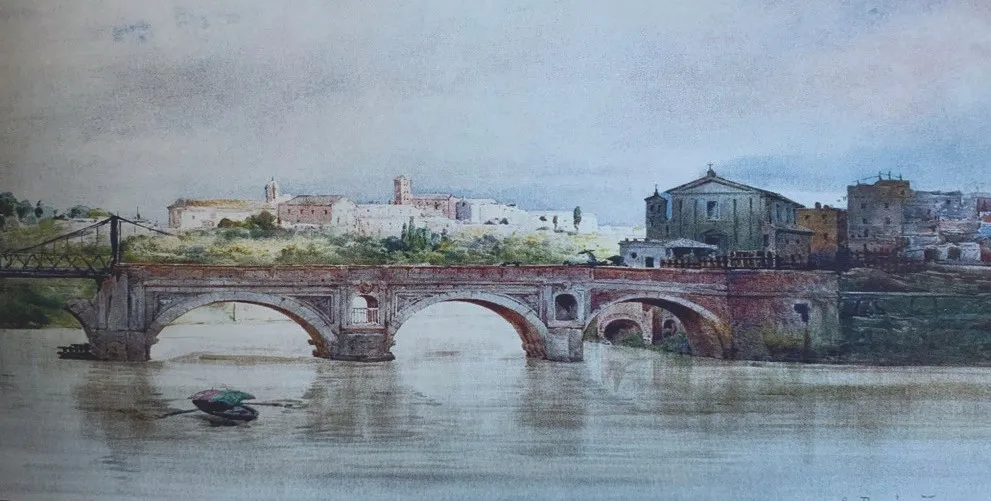
One of Ettore’s favourite subjects was the broken bridge, which he painted in numerous pictures.
The oldest bridge whose remains have come down to us is the Aemilius Bridge, dating back to 179 BC, which stands where Ponte Rotto stands today, but only the bases of the piers remain. For the first thirty years it was made of wood, then the consuls Publius Cornelius Scipio Aemilianus and Lucius Mummius had it built entirely of masonry, the first brick bridge in the city: unluckily, scourged by floods, it collapsed and was rebuilt several times; the final blow came with the flood of 1598, when three of the six arches collapsed. This gave rise to the name ‘Ponte Rotto’, which replaced the name ‘Ponte Santa Maria’. For two hundred and fifty years it remained mutilated, until in the mid-nineteenth century it was given a new lease of life, thanks to the new metal footbridges that restored its path. In 1887, during the construction of the embankments, it was decided to demolish the surviving arches and eliminate the footbridge for good. Only the arch that is still visible near the Tiber Island was spared.
Ponte Rotto or Senatorial Bridge, from Ponente, with the Aventine in the distance
In esoteric terms, the bridge signifies the emotional and spiritual bond. A passage from one world to another, from one state of consciousness to another, the bridge expresses evolution and elevation. Inseparable from the river over which it is thrown, the bridge allows access to the other bank and takes up the esoteric vision, particularly the Buddhist one, of the existence of two levels, represented by the two banks of the river, the profane level and the sacred level. Consequently, the metaphor of the bridge alludes to rites of passage and crossing the bridge is equivalent to overcoming one’s condition, proceeding to initiation, reaching awakening. In many mythologies the bridge also connects the world of the living to the realm of the dead. On a concrete level, the bridge evokes emotional ties. Its symbolic meaning is reflected in the expression ‘to burn one’s bridges’, which defines the severing of all relationships.
The twelve painting...