Choreography craft and vision
eBook - ePub

Choreography craft and vision

Developing and Structuring Dance for Solo, Duet and Groups

  1. 420 pages
  2. English
  3. ePUB (mobile friendly)
  4. Available on iOS & Android
eBook - ePub

Choreography craft and vision

Developing and Structuring Dance for Solo, Duet and Groups

About this book

This book offers a comprehensive toolbox of approaches to analysing and creating contemporary choreography. Are you ready to deepen your understanding of the world of dance and the creativeprocess of choreography? In this book about choreography you will learn how to develop dance and performance.In order for you to truly enjoy the process of choreography, I will offer you tools to help youenter into a creative flow.Because ultimately, that's what it's all about: getting into a free flowing joyful process with the dancers and having plenty of fun along the way, as you develop a solo, a duet or a group piece for the stage or a film.You will learn how to expand your repertoire and how to trigger in your dancers, identification and connection with your theme.I will present various ways in which you can develop and structure your work. Tools withwhich you can introduce tension, multiple facets, variety and powerful dynamics into your dances, allowing a dramaturgy to emerge.You will receive over 120 exercises to inspire you for your rehearsals or classes.You can now preview the entire book online for free or download a reading sample.Take a look.It will inspire you and your dancing and it will improve your choreography.When it comes to choreography, many dancers are initially lost.Nevertheless, there are people who can't dance and still develop great pieces.Maybe you're a gifted mover, but that doesn't mean that your material works in onepiece.Even if your movements are great and others admire you for how you dance, it can happen very quickly that the sensation of your skills wears off very quickly and your movementsseem arbitrary. Especially if you have transferred them to a group. And you ask yourself in such a moment: What am I doing wrong? My dancers are great, my movement material is innovative, but on stage it all seems interchangeable and it's just movement. And you think: This is all pointless.No, that's not it! It's about how you deal with everything. How you connect the dancers with your ideas and with your material. How you manage that the dancers make your visions andyour movements theirs. How to get them there to identify with what moves you. But even that is not enough.You need to know more about how dramaturgy works in dance. How you build up an arc of suspense and what that has to do with space and rhythm. How to create interestingcontrasts and how to deal with music and movement.This book covers all of that.

Trusted by 375,005 students

Access to over 1 million titles for a fair monthly price.

Study more efficiently using our study tools.

Information

Publisher
STAGE VERLAG
Year
2022
Print ISBN
9783982118734
eBook ISBN
9783982118796
Topic
Art
Subtopic
Art General

1 Sub-text and spirit

When we watch a dance piece, we see more than just human bodies. We perceive energy, spirit, soul in a dance performance – or the lack thereof. It is, therefore, worth asking how we, the choreographers, can fill a mere set of steps with a deeper meaning, a subtext that touches the audience. Without this subtext, the performance will seem disappointingly empty, no matter how sophisticated the choreography or how excellent the dancers. Spectators will walk out feeling unsatisfied, but unable to put their finger on what they were lacking, and the critics' reviews will be along the lines of 'Pretty, but predictable'.
It takes more than dance steps to provoke an emotional response in an audience. It takes more than dancers who play their part in the piece. What makes dance come alive is when we witness dancers feeling their movement. In a group piece, we will notice how each dancer experiences their steps differently, sometimes opposing another dancer's feeling, sometimes harmonising with it. Many choreographers expect their dancers to innately know the secret behind the dance steps and be able to share it with the audience through their 'expression'. Unfortunately, this hardly ever works. The dancers don't know what kind of expression is expected of them. I recently overheard two dancers talking about how they often didn't know what they were supposed to represent, and how difficult it was to dance expressively when they didn't really know what the dance was about. They worried about making mistakes, and they solved this problem by holding back their own emotion and just moving with 'general expression'. Is this what a choreographer really wants? 'General expression'? If that is not what you want, you will need to inspire your dancers. Let them feel. Encourage them to nurture and show emotion in their dance.
Drawing on internal resources
For many people, art is the expression of an inner conflict or tension. They draw from this tension when creating their art. Imagine, for instance, a man moving from Greenland to New York. He cannot get used to the confined spaces. Before his mind’s eye, the houses are constantly overlaid by visions of wide-open spaces. His sense of constriction and his longing for open space create tension within him. From this tension emerges the desire to produce a dance piece expressing these thoughts, and to share his experience with other people living in New York.
If you want to use material from an internal conflict in a dance piece, you need to find a connection, an open channel between your inner reality and the outside world. Merely seeing images of wide, open spaces between skyscrapers doesn't make our Greenlander's experience a piece of art. He needs to be able to translate his sentiment into movement, and then check whether his translation truly expresses his experience. So our channel has to work in both directions – inside to outside, and outside to inside. Developing and refining this channel is key to any artistic work, because it is only with open, fine-tuned channels that we can connect to both our inner selves and the outside world, feel how we react to the world, and feel how it prompts us to create dance pieces.
Naturally, going through everyday life with our channel wide open also makes us vulnerable – without walls around our soul, unprotected, out in the open. You will feel when you are open, allowing the world inside, and when you are keeping it out. When you completely shut out all external impulses, you may notice that you keep choosing the same topics for your pieces, or you may feel as if you were running out of ideas altogether. In the end, it is our choice: either we can be satisfied living between constant repetition and total lack of material, or we decide to work on the connection between ourselves and the world, inside and outside.
Choreographers are always training their dancers. On one hand because better dancers means better dance pieces, and on the other because choreographers improve their own practice while training their dancers. So if you work with your dancers on developing their internal resources, you will benefit from it as well.
If you use one of the following approaches to your material, your dancers will need to be familiar with the theme you want to develop:
Guided composition The dancers improvise and react to directions from outside.
Visualisation Basing movement on imagery.
Identification Moving according to a previously outlined character sketch.
Emotion Developing movements from a set emotion.
Intention
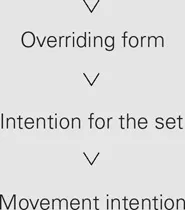
Whether you are putting together a show dance repertoire or developing artistically authentic material as an expression of your innermost self, each movement, each set and each piece has an intention and an associated stylistic form.
Connection between
intention as a whole and movement
Whenever you watch dance rehearsals or pieces at the theatre, ask yourself:
  • Can you feel an intention in the dance sequences (even if you can't express it verbally)?
  • In group pieces, do the intentions of the individual dancers complement or contrast each other when the dramatic arc requires it?
  • Is there an overall intention and an associated stylistic form?
  • Do you perceive a scenic intention?
  • How do the dancers' movements show intention?
  • What precisely expresses intention?
  • Is there anything that seems replaceable?
Because it is difficult to express the intention for the dance in words, it is all the more important to keep in dialogue with the dancers. Convey to them WHAT IT IS. What is the piece about? What are we doing? If we can't answer these questions, if we don't feel where we are going before we start, we won't get anywhere.
The power of the choreographer's initial impetus to stage a piece often dwindles once the rehearsals become more and more complex. But growth ends when the roots are cut, and your intention is the root of your piece. Keep reminding yourself what your intention is. Your intention gives you and your dancers a point of reference. It tells you where you are going and what you are looking for, and if you succeed in sharing this with your troupe, it will give them a sense of direction and of meaning.
If you take commissions for choreographies on a certain theme, you will have to delve deep into the material until you discover something you can identify with, a personal intention in the given theme. You need to whet your appetite for creating a piece for and the only way to do this is to find the the point where your personality and the material meet. If you are asked to choreograph a dance for a play, it can be a challenge to meet the director’s vision as well as identifying with the material.
Experiment with the following extremes to get a feeling for the connection between form and intention:
Intention Form
The dancers adhere to the intention. The dancers adhere to the form.
At what point in the piece (which scene) do you deviate from the form? Where do movement and intention connect?
How does the sequence change if the dancers still adhere to the intention? Which movements carry the intention?
Which parts of the movement material drop out if the dancers remain true to the intention? What seems to be exchangeable?
When does the style of your choreography express your desired overall intention?
At which points does it depart from it?

2 Theme – Structure – Dramaturgy

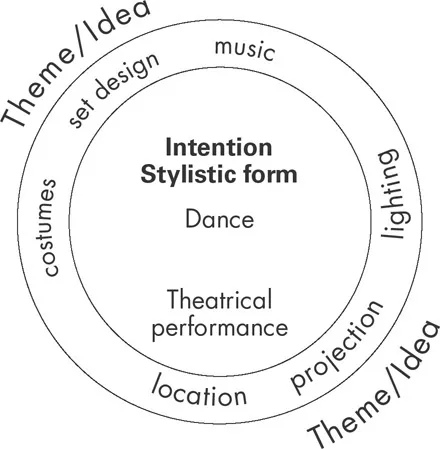
Even before a piece is created and staged, its energy is already there. It translates into the choreographer's impetus, seeking its expression. The form of the energetic expression is made up of different elements gathered around a central theme or idea.
You can choose any theme or idea: movement for movement's sake, the occupation of the Central African states, simple dancing to music, or experimentation, but you must have one, otherwise you have nothing to develop. Everything you bring together to create your performance, the dancers, the lighting, all the elements that are external to the choreographer, none of it exists unless you can develop an intention from an impetus.
Theme and material
In principle, you can create a good piece from any topic. It is what you make of your theme that counts, much more than the actual theme itself. However, if your subject matter is shallow in terms of content, it will take more blood, sweat and tears to turn it into a good piece than it otherwise would. Sometimes, a really promising theme turns out to be nothing but a bauble once you've started to work on it; sometimes, an idea that seemed nothing more than a trifle develops into an excellent theme that may stay with you for a long time. If you come across a topic and you can immediately specify how you are going to create a piece from it, it may well turn out that you have narrowed down the theme too early. Give your material time to develop. Don’t feel guilty about putting it out of your mind or putting it aside. If it means something to you, it will return later on, pulling your sleeve and asking for attention.
If an idea seems promising because i...

Table of contents

  1. Choreography
  2. Dance
  3. Acknowledgements
  4. Table of Contents
  5. Studies
  6. Exercises
  7. 0. Introduction
  8. 1. Sub-text and spirit
  9. 2. Theme – Structure – Dramaturgy
  10. 3. Design principles
  11. 4. Thematic development
  12. 5. Arrangement and composition
  13. 6. Solo
  14. 7. Pedagogical aspects
  15. 8. Acting, language and dance
  16. 9. Dance and film
  17. 10. Stage design
  18. 11. Lighting
  19. 12. Study and exercises
  20. Epilogue
  21. About the author
  22. Notes
  23. Thanks for your feedback
  24. Photo directory
  25. Copyright

Frequently asked questions

Yes, you can cancel anytime from the Subscription tab in your account settings on the Perlego website. Your subscription will stay active until the end of your current billing period. Learn how to cancel your subscription
No, books cannot be downloaded as external files, such as PDFs, for use outside of Perlego. However, you can download books within the Perlego app for offline reading on mobile or tablet. Learn how to download books offline
Perlego offers two plans: Essential and Complete
  • Essential is ideal for learners and professionals who enjoy exploring a wide range of subjects. Access the Essential Library with 800,000+ trusted titles and best-sellers across business, personal growth, and the humanities. Includes unlimited reading time and Standard Read Aloud voice.
  • Complete: Perfect for advanced learners and researchers needing full, unrestricted access. Unlock 1.4M+ books across hundreds of subjects, including academic and specialized titles. The Complete Plan also includes advanced features like Premium Read Aloud and Research Assistant.
Both plans are available with monthly, semester, or annual billing cycles.
We are an online textbook subscription service, where you can get access to an entire online library for less than the price of a single book per month. With over 1 million books across 990+ topics, we’ve got you covered! Learn about our mission
Look out for the read-aloud symbol on your next book to see if you can listen to it. The read-aloud tool reads text aloud for you, highlighting the text as it is being read. You can pause it, speed it up and slow it down. Learn more about Read Aloud
Yes! You can use the Perlego app on both iOS and Android devices to read anytime, anywhere — even offline. Perfect for commutes or when you’re on the go.
Please note we cannot support devices running on iOS 13 and Android 7 or earlier. Learn more about using the app
Yes, you can access Choreography craft and vision by Konstantin Tsakalidis in PDF and/or ePUB format, as well as other popular books in Art & Art General. We have over one million books available in our catalogue for you to explore.