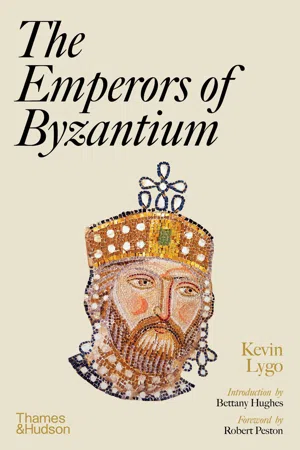
The Byzantine empire was one of the most successful states of the Middle Ages, ruling over a huge terrain straddling Europe and western Asia for an unrivalled eleven hundred years. Yet its history remains largely unfamiliar. This chronicle brings this majestic yet turbulent period to life through the lives of its emperors: supreme military commander, Head of State and Gods representative on earth, no less. These were the men and women that presided over many of the foundations of the modern world, from the establishment of the Eastern Orthodox Christian faith, to the magnificent artistic heritage of Hagia Sophia and Mount Athos, and the creation of a visual template for Christian art. Each illustrated biographical entry contributes to the story of how Byzantium shaped our art, culture, religious beliefs and justice systems, and the role this extraordinary empire played in halting repeated invasions, allowing the idea of Europe to flourish. Through stories of nobility and petty revenge, of religious devotion and brutal genocide, and of sexual intrigue and artistic brilliance; from soaring intellectuals to illiterate peasants, eunuchs and despots, this is a humanizing portrayal of individuals, whose role impacted the lives of millions.
- 336 pages
- English
- ePUB (mobile friendly)
- Available on iOS & Android
eBook - ePub
The Emperors of Byzantium
About this book
Trusted by 375,005 students
Access to over 1 million titles for a fair monthly price.
Study more efficiently using our study tools.
Information
Topic
ArtSubtopic
History of Ancient ArtMacedonian Dynasty (867–1056)
The Macedonian era is seen as the second golden age of Byzantium. It was founded by an unlikely usurper, Basil I; having murdered his predecessor, he became a patriarchal figure (he was more likely Armenian than Macedonian) who established the second-longest reigning dynasty in Byzantium’s extensive history. The Macedonians initiated a renaissance in art, literature and architecture; and the territorial expansion that culminated under Basil I’s great-great-grandson Basil II (‘The Bulgar-Slayer’) was greater than it had been since the 7th century. The Byzantines were the dominant power in Europe and the Near East throughout the 10th and 11th centuries.
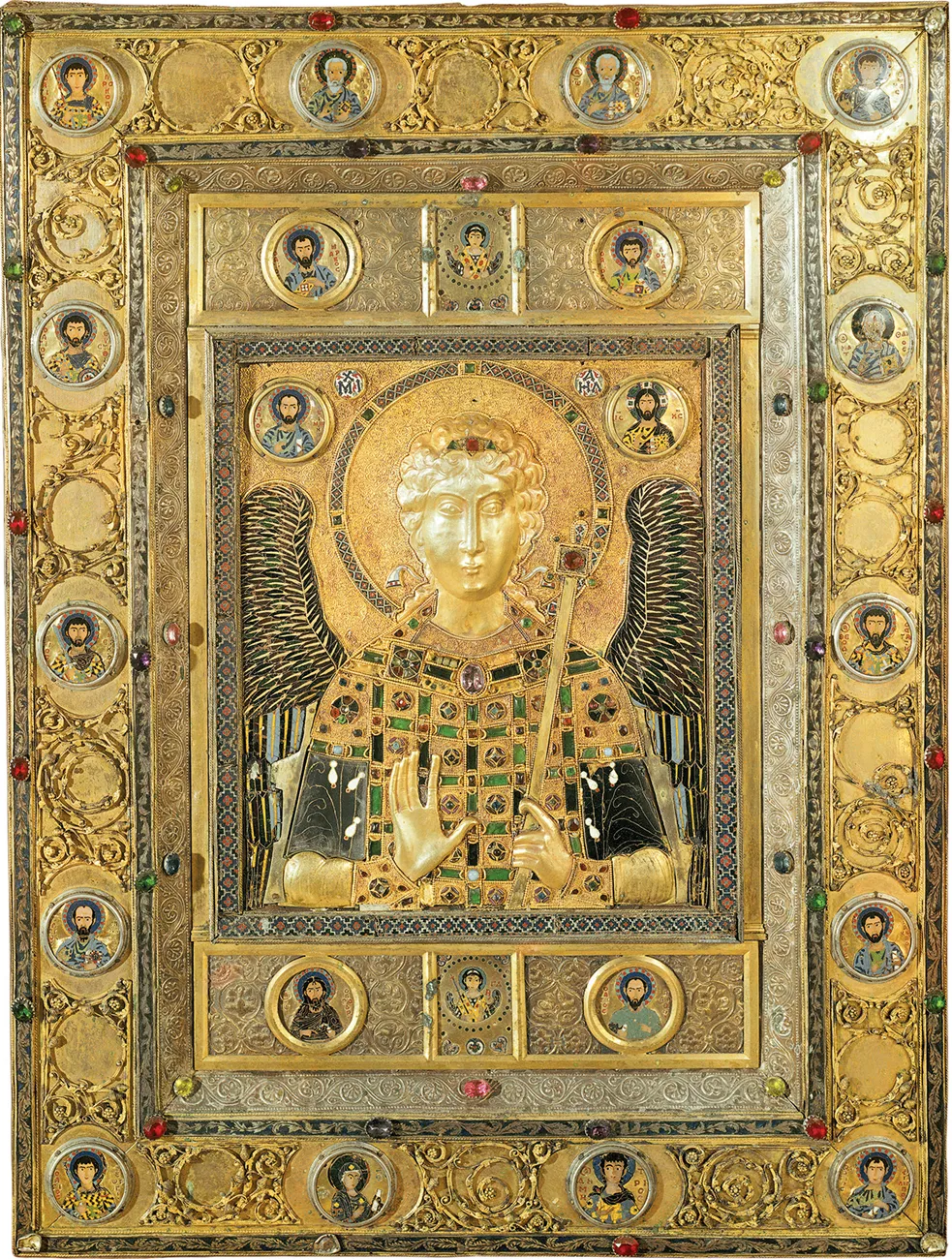
A magnificent repoussé and enamel image of the Archangel Michael, now in the Treasury of San Marco, Venice, c. 1000.
Basil I
September 867 – August 886
No family was ever so favoured by God as the Macedonians – a surprising thing when one remembers that it was a family rooted in the ground by murder and bloodshed. Yet that plant took root, and sent out such mighty shoots, each bearing imperial fruit, that no other can be compared with it for beauty and splendour.
MICHAEL PSELLOS, early 1060s
Basil I, founder of the Macedonian dynasty that was to rule Byzantium for 200 years, symbolizes the paradox of the Byzantine Empire itself. A violent and cruel man, uneducated and illiterate, he established a dynasty and a government that oversaw the return to the empire of much of its former glory, both military and intellectual. He took the crown by stealth and brutal murder, and in reality was more likely to have been from Armenia than Macedonia. His great dynasty was thus probably not really Macedonian at all. His successor, Leo VI, was quite possibly the illegitimate child of his predecessor, Michael III, a man he had befriended and murdered, and it is possible, therefore, that his descendants were a continuation of the Amorian dynasty that had ruled before. Whatever the truth, Basil was undeniably a force of nature.
With unknown but certainly humble origins, Basil was possessed of two extraordinary qualities: enormous physical strength, and an ability to train any horse he encountered. He would defeat champion wrestlers in competitions and later slaughter men with his bare hands, but it was his almost magical ability to tame horses that drew the interest of the fickle emperor Michael III.
There are many versions of the story, but it seems plausible that Michael III was given a magnificent white stallion that was wild and seemingly unmanageable. When somebody suggested that they let their talented groom, Basil, attempt to tame it, Michael witnessed his powers at first hand. Basil took the horse’s bridle in one hand and stroked its ear with the other, whispering all the while. The horse was instantly tamed, and Michael hired Basil on the spot as his chief groom.
There was also a story that, when he first arrived in Constantinople, Basil was in the vicinity of the church of St Diomed when the abbot walked out and called Basil’s name, having not seen him and having no knowledge of him. Basil answered the call and entered the church, where the abbot looked after him. This episode was later cited as a portent of Basil’s greatness.
Michael III, known by later historians – without much evidence – as ‘Michael the Drunkard’, quickly fell under the spell of his new friend, promoting him through the ranks of the palace. He even gave him the most favoured position of parakoimomenos (‘one who sleeps nearby’) so that they were virtually inseparable. There is a later inference, again unfounded, that they were homosexual lovers, but in any case Michael certainly enabled Basil to thrive at court. He even made Basil divorce his wife, Maria, with whom he already had a son, Constantine, and marry Michael’s mistress, Eudokia Ingerina, who also bore him a son, Leo. Bizarrely, Michael then made his own sister, Thekla, live in Basil’s household – a strange ménage à quatre that continued for several years. Upon Michael’s death, however, Thekla fell in love with a nobleman called John Neatocomites, only for Basil to send him to a monastery and force Thekla to be confined to her house, where she eventually died. The nature of Basil’s relationship with his second wife is unclear, but she bore him two more sons after Leo – Alexander and Stephen, born in 870 and 867 – and four daughters, Anna, Anastasia, Helena and Maria, all of whom became nuns.
In the world of court politics, Basil also worked ruthlessly to secure the throne. He recognized Bardas, the brother of the emperor Michael’s mother, Theodora, as a threat to his ambitions and so poisoned Michael’s mind against him, insisting continuously that Bardas was plotting against him to take the throne for himself. Bardas heard of this dangerous conspiracy against him and confronted the two of them in person. Both Basil and Michael signed a document assuring Bardas that it was untrue. However, when they were all preparing for an expedition to invade and reclaim Crete from the Saracens, Bardas was set upon and murdered, with or without the direct involvement of Basil. Michael was stunned but ultimately complicit: choosing to believe Basil, he wrote to the patriarch explaining that Bardas was conspiring against him and that he had therefore ordered his immediate execution. On returning to Constantinople, Michael sat in Hagia Sophia and in front of all assembled nobles read out this proclamation: ‘The caesar Bardas plotted against me to slay me, and for this reason induced me to leave the city. Had I not been informed of the conspiracy by Simbatius and Basil, I should not be alive today. It is my will that Basil, the high chamberlain, who is loyal to me, who has delivered me from my enemy and who holds me in great affection, should be the guardian and manager of my empire and should be proclaimed by all as basileus.’

Mosaic of the Virgin and Child in the apse of Hagia Sophia, Istanbul, installed during the joint reign of Basil I and Michael III to celebrate the end of Iconoclasm. Patriarch Photios marked the occasion with a homily given on Holy Saturday 867.

Photios was the favoured patriarch of Basil I and served him well throughout his reign. He was an opponent of Iconoclasm and erstwhile protector of the future emperor Leo, who nevertheless removed him from his post once he became emperor himself. Illustration from the Chronicle of John Skylitzes in Madrid, 12th century.
In just nine years Basil had come from obscure stable-boy to co-emperor; now he just needed to rule alone. So, in 867, a year after being honoured by Michael, he attended a banquet, got Michael ‘the sot’ drunk, and then had him murdered in his bed. The empire was finally his alone. This illiterate peasant, who spoke poor Greek and was violent by nature, became a ruler who established a lasting dynasty and re-established Byzantium as the most powerful empire in the world. He achieved an astonishing amount in a relatively short time. He instituted a reform of the entire legal system not attempted since the time of Justinian, publishing both the ambitious Procheiron (handbook [of the law]) and the Epanogoge (or Eisagoge, introduction [to the law]), which would last for centuries. His armies were also stronger than they had been since Justinian; they destroyed the Paulicians, and had the Saracens in retreat in the Latin West, as well as the Persian East. Both the Bulgarians and the Serbians were converted to the Orthodox church and, with the aid of Photios, he had demonstrated to the pope in Rome that Byzantium was the higher religious force.
Basil extended the territories under Byzantine control to a degree that was never surpassed. He restored and repaired the great buildings of the capital as well as the wider empire, and built a glorious church, the Nea, the like of which had not been seen since Hagia Sophia itself, thus reaffirming Byzantium’s status as the greatest city on earth. (Not a stone of the church remains today, but contemporaneous descriptions reveal it to have been a magnificent building, decorated with extreme opulence.)
Basil adored his son Constantine, but loathed Leo, who was rumoured to be Michael III’s son, and regularly tormented and abused him. Basil was told that Leo was planning to kill him and had secreted a sword in his boot ready to strike Basil down. As he was riding near his father, Leo gave him his sword, and Basil, in the belief there was a political conspiracy, had Leo arrested and thrown in prison. He even wanted him blinded but was persuaded otherwise by Photios the patriarch. Leo was, in fact, completely innocent of the charge and eventually released.
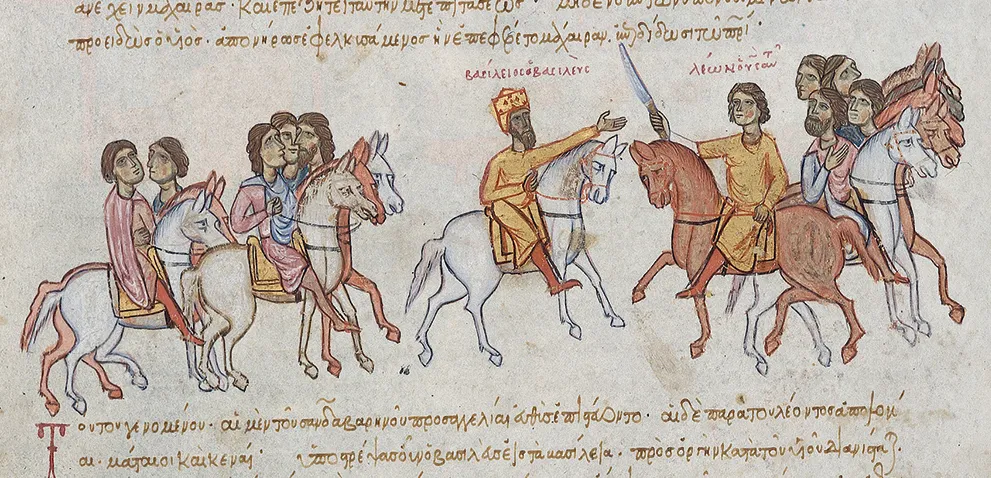
Miniature from the 12th-century Madrid Skylitzes, showing Leo handing his father Basil I a sword – an act that led to his arrest on charges of attempting to attack the emperor.
Basil’s end mirrored his beginning, with a death that was bloody and violent. It was probably ordered by Leo. Basil spiralled into depression after the premature death of his favoured son, Constantine, and lost all interest in governing his empire, believing, according to the prevailing psychology of the times, that tragedy was divine retribution for the murders he had committed to obtain the crown.
Finally, in the summer of 886, while out hunting, the 74-year-old emperor went after a large stag on his own as the rest of his party rested; he became entangled in the antlers of the stag, fell from his horse and was dragged 26 km (16 miles). The party saw the emperor’s rider-less horse return and went in search, only to find him half dead and still attached to the stag. A guard cut him loose, but when Basil regained his wits he instantly ordered the guard be executed because he had dared to raise a sword against the sovereign. The emperor was carried home where, suffering from internal bleeding, he clung on for nine agonizing days, eventually dying on 29 August. It is not inconceivable that this incident was a story designed to cover up the fact that his death was ordered by Leo and carried out by Leo’s future father-in-law, Stylianos Zautzes, who just happened to be present. For all his great achievements, Basil died by violence, just as he had risen through violence; his end was lamented by few.
Leo VI
August 886 – May 912
This emperor was much given to study, particularly the effects of astronomical phenomena. He set verses to music for singing in church, verses of great sweetness. He was a devoted reader of Archimedes, more so than anyone at that time.
JOHN SKYLITZES, second half of 11th century
On the death of his father, Basil I, Leo immediately had Michael III reburied with full imperial honours, giving rise to the rumour that Michael was indeed Leo’s real father. He also removed the redoubtable 70-year-old patriarch Photios, replacing him with his own 16-year-old brother, Stephen, and promoted Stylianos Zautzes – the father of his mistress, later his wife, Zoe – to the newly created rank of basileopator (a chief aide of sorts).

Leo VI and various saints on a votive crown in enamel and silver-gilt, c. 900; the birds are a later addition. The crown was plundered by the soldiers of the Fourth Crusade in 1204 and taken to Venice.
Leo VI’s reign was solid, if unremarkable, but for the complexities of his own succession. His childhood had been tough, as the man believed to be his father despised him, and even imprisoned him for a few years. When he finally became emperor, Leo was too eager to assert himself and clumsily stumbled into wars with the Bulgars, resulting in an embarrassing defeat at the hands of the Bulgar leader Symeon, following which Leo was forced to pay large sums of tribute money to keep the Bulgars at bay. While he was occupied with this war, the Arabs attacked, sacked and destroyed Thessalonica, the second city of Byzantium, slaughtering thousands before they withdrew.
Despite these setbacks, Leo – a genuine intellectual and scholar – was known as ‘Leo the Wise’ or ‘Leo the Philosopher’. He wrote political orations, theological treatises and liturgical poems. He continued the work his father Basil I started, attempting to codify all the existing Byzantine laws, which resulted in an impressive collection known as the Basilika.
Beyond his intellectual pursuits, the dominating feature of Leo’s life was his inability to father an heir. He had been married as a boy of just 15 to Theophano, but his austere and devout wife gave birth to only one daughter, Eudokia, who died as an infant before 895 and was shortly followed by her mother. Leo then married Zoe, his long-standing mistress and daughter of his chief advisor, Stylianos, who had previously given birth to two daughters, Anastasia and Anna, born out of wedlock and so not fully recognized by the church. Zoe died after only a year of marriage. It is not inconceivable that Leo truly loved Zoe, since she had been his chosen mistress for many years, and he crowned their daughter Anna augusta. However, he needed to marry once more to provide a son and heir – meaning that he was obliged to go against the church’s teaching that a man could be married legally only twice. Leo married Eudokia Vaiana in 900, with whom he had an infant son, Basil, born soon after. Before the church could object, she suffered the fate of his previous two wives, dying unexpecte...
Table of contents
- Cover
- Title Page
- About the Author
- Other Titles of Interest
- Contents
- Foreword
- Introduction
- Constantinian Dynasty (306–363)
- Non-Dynastic Ruler (363–364)
- Valentinian Dynasty (364–379)
- Theodosian Dynasty (379–457)
- Leonid Dynasty (457–518)
- Justinian Dynasty (518–602)
- Non-Dynastic Usurper (602–610)
- Heraklian Dynasty (610–695)
- Twenty Years of Anarchy (695–717)
- Isaurian Dynasty (717–802)
- Nikephorian Dynasty (802–813)
- Non-Dynastic Ruler (813–820)
- Amorian Dynasty (820–867)
- Macedonian Dynasty (867–1056)
- Non-Dynastic Ruler (1056–1057)
- Komnenian Dynasty (I: 1057–1059)
- Doukid Dynasty (1059–1081)
- Komnenian Dynasty (II: 1081–1185)
- Angelid Dynasty (1185–1204)
- Latin Constantinople and the Empire in Exile (1204–1461)
- The Empire of Nicaea (1208–1261)
- Palaiologan Dynasty (1261–1453)
- Further Reading
- Acknowledgments
- Picture Credits
- Index
- Copyright
Frequently asked questions
Yes, you can cancel anytime from the Subscription tab in your account settings on the Perlego website. Your subscription will stay active until the end of your current billing period. Learn how to cancel your subscription
No, books cannot be downloaded as external files, such as PDFs, for use outside of Perlego. However, you can download books within the Perlego app for offline reading on mobile or tablet. Learn how to download books offline
Perlego offers two plans: Essential and Complete
- Essential is ideal for learners and professionals who enjoy exploring a wide range of subjects. Access the Essential Library with 800,000+ trusted titles and best-sellers across business, personal growth, and the humanities. Includes unlimited reading time and Standard Read Aloud voice.
- Complete: Perfect for advanced learners and researchers needing full, unrestricted access. Unlock 1.4M+ books across hundreds of subjects, including academic and specialized titles. The Complete Plan also includes advanced features like Premium Read Aloud and Research Assistant.
We are an online textbook subscription service, where you can get access to an entire online library for less than the price of a single book per month. With over 1 million books across 990+ topics, we’ve got you covered! Learn about our mission
Look out for the read-aloud symbol on your next book to see if you can listen to it. The read-aloud tool reads text aloud for you, highlighting the text as it is being read. You can pause it, speed it up and slow it down. Learn more about Read Aloud
Yes! You can use the Perlego app on both iOS and Android devices to read anytime, anywhere — even offline. Perfect for commutes or when you’re on the go.
Please note we cannot support devices running on iOS 13 and Android 7 or earlier. Learn more about using the app
Please note we cannot support devices running on iOS 13 and Android 7 or earlier. Learn more about using the app
Yes, you can access The Emperors of Byzantium by Kevin Lygo in PDF and/or ePUB format, as well as other popular books in Art & History of Ancient Art. We have over one million books available in our catalogue for you to explore.