This pocket-sized guide is a convenient, quick-reference companion to discovering what to do, what to see and how to get around Croatia. It covers top attractions like Dubrovnik, Plitvice Lakes National Park and Rab Town, as well as hidden gems, including exploring the Roman amphiteatre in Pula, swimming in a lake in stunning Mljet National Park and surveying the mosaics at the Basilica of Euphrasius in Porec. This will save you time, and enhance your exploration of this fascinating country. This title has been fully updated post-COVID-19.
This Mini Rough Guide to Croatia covers: Zagreb, inland Croatia, Istria, Kvarner Gulf and Dalmatia.
In this travel guide you will find:
RECOMMENDATIONS FOR EVERY TYPE OF TRAVELLER
Experiences selected for every kind of trip to Croatia, from cultural explorations to family activities in child-friendly places.
TOP TEN ATTRACTIONS
Covers the destination's top ten attractions not to miss and a Perfect Day/Tour itinerary suggestions.
COMPACT FORMAT
Compact, concise, and packed with essential information, with a sharp design and colour-coded sections, this is the perfect on-the-move companion when you're exploring Croatia.
HISTORICAL AND CULTURAL INSIGHTS
Includes an insightful overview of landscape, history and culture.
WHAT TO DO
Detailed description of entertainment, shopping, nightlife, festivals and events, and children's activities.
PRACTICAL MAPS
Handy colour maps on the inside cover flaps will help you find your way around.
PRACTICAL TRAVEL INFORMATION
Practical information on eating out, including a handy glossary and detailed restaurant listings, as well as a comprehensive A-Z of travel tips on everything from getting around to health and tourist information.
STRIKING PICTURES
Inspirational colour photography throughout.
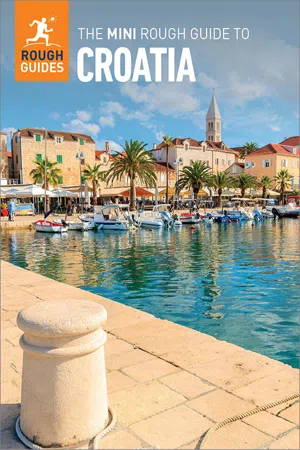
- 144 pages
- English
- ePUB (mobile friendly)
- Available on iOS & Android
eBook - ePub
The Mini Rough Guide to Croatia (Travel Guide eBook)
About this book
Trusted by 375,005 students
Access to over 1 million titles for a fair monthly price.
Study more efficiently using our study tools.
Information
Out and About
Most of Croatia’s tourist industry is concentrated on the Adriatic coast, in Dalmatia and the Istrian peninsula, including the numerous islands. International airports serving the coast include Dubrovnik, Split, Zadar, Rijeka and Pula. A motorway system (www.hac.hr) connects most of the country’s main cities and runs along the coastline to Ploče near Korčula. This is a big improvement on the scenic but often slow and serpentine coastal road, the Jadranska Magistrala (Adriatic Highway). Island-hopping is a great way to experience coastal Croatia; one of the main ferry companies is Jadrolinija, www.jadrolinija.hr.

iStock
St. Mark’s Church in Zagreb, the capital of Croatia
Inland Croatia also has plenty to interest visitors, including the lively capital Zagreb, impressive mountain scenery, castles, spas and the outstanding Plitvice Lakes National Park. From Zagreb, the autocesta (motorway) runs east to Slavonia.
Zagreb
A charming old quarter, a number of museums and leafy parks and a lively nightlife make Zagreb 1 [map] an ideal city-break destination. Many people heading for the coast tend to bypass the capital and in doing so miss out on this compact, lively metropolis, whose younger residents give it a buzz that is particularly evident in its myriad cafés on a balmy evening. Be aware, however, that the city dwellers too tend to head for the coast in the summer months, during which time the hot capital becomes abnormally quiet. The city skyline is set to change dramatically in the coming years, with a number of office skyscrapers approved for construction. In March 2020, the city suffered a major earthquake which left one person dead and 27 more injured; many historical buildings in the city centre also suffered damage.

Donji Grad
Spreading north of Glavni Kolodvor, the central railway station, is Donji Grad (Lower Town). Standing proud in Trg Kralja Tomislava, the square opposite the station, is the equestrian statue of King Tomislav A [map] , the first of the Croatian kings, his commanding figure a symbol of the city and meeting point.
North of the central railway station is a string of neatly tended squares, often filled with students reclining on benches and older citizens idling by the fountains. Trg Kralja Tomislava is home to the Art Pavilion (Umjetnički Paviljon; www.umjetnicki-paviljon.hr), an Art Nouveau building housing temporary exhibitions. At the time of writing, it is closed to the public due to damage caused by the 2020 earthquake.
Zagreb Card
The Zagreb Card represents good value if you plan to spend some time in the city. Choose from 24 or 72 hours. Holders are entitled to free admission to four major museums and the city zoo, reduced admission in many galleries and museums, free public transport, and theatre, restaurant and nightclub discounts. The card is available from the tourist information office on Trg Bana Josipa Jelačića and most Zagreb hotels. See http://zagrebcard.com for more details.
The next park north is Strossmayer Trg, containing the Strossmayer Gallery of Old Masters B [map] (Strossmayerova Galerija; temporarily closed following the 2020 earthquake). It was commissioned by the eponymous Slavonian bishop in the 19th century and has a collection of works by Italian masters including Tintoretto and Veronese. Look out also for the Baška Tablet, said to be the oldest example of Croatian Glagolitic script, brought here from its original home on the Kvarner Gulf island of Krk.

Dominic Burdon/Apa Publications
The Art Pavilion
A few blocks west, in Trg Maršala Tita, is the Museum of Arts and Crafts C [map] (Muzej za Umjetnost i Obrt; www.muo.hr; Tue–Sat 11am–7pm, Sun 10am–2pm), designed by the Austrian architect Hermann Bollé, whose name pops up all over the city, including the Mirogoj Cemetery (for more information, click here). The eclectic collection includes ceramics and furniture, clocks, silverware, glass and religious art. Next-door is the grand, neo-Baroque architecture of the Croatian National Theatre.
Diagonally opposite the museum, facing Rooseveltov Trg, is Zagreb’s most impressive museum; the Mimara D [map] (Muzej Mimara; www.mimara.hr; temporarily closed due to the consequences of the 2020 earthquake), housed in an old grammar school. The artists represented include Raphael, Caravaggio, Rembrandt, Rubens, Van Dyck, Velázquez, Gainsborough, Turner, Delacroix, Renoir, Manet and Degas. There have been persistent mutterings from certain sections of the art world about the dubious authenticity of some of the work, but if you take it on face value the 4,000-strong collection is impressive. The contents were donated to the city by Dalmatian collector Ante Topić Mimara and also include archaeological finds from around the Mediterranean.
A brief detour along Savska cesta will take you to the Nikola Tesla Technical Museum (Tue–Fri 9am–5pm, Sat–Sun 9am–1pm) and its collection of historic machinery including planes and automobiles.
Trg bana Josipa Jelačića
The epicentre of Zagreb life, Trg bana Josipa Jelačića E [map] , is surrounded by grand 19th-century buildings. The statue of the viceroy, Ban Josip Jelačić, erected in 1866 and banished by Tito in 1945, has been returned to its prominent position at the heart of this plaza. Today, the square is the best place to take the pulse of the city.
Kaptol
The Kaptol district breaks away uphill from Trg Bana Josipa Jelačića. Without doubt, the highlight here is the neo-Gothic Zagreb Cathedral F [map] (temporarily closed for restoration) with its twin bell towers, designed by Hermann Bollé. Unfortunately, in March 2020, the cathedral suffered in the earthquake with one of its spires breaking off. Reconstruction is underway at the time of writing. A religious building has stood on the site since the reign of the Croatian kings in the 10th century and it is still a place of devotion for many local residents. Notable features include a series of 13th-century frescoes that have survived the cathedral’s numerous traumas, including a devastating earthquake in the 19th century. The cathedral is also the last resting place of the controversial Croatian clergyman Archbishop Stepinac (d.1960), who was accused of colluding with the Nazi puppet regime during World War II, but is considered a martyr by many Croats. Look out for Ivan Meštrović’s relief of Christ with Stepinac. Until the completion of the Dalmatia tower in Split, this was the tallest building in Croatia.

Shutterstock
Trg Bana Josipa Jelacica, the central square of Zagreb, sets the pace of the city
A short walk west from the cathedral is Dolac Market (Mon–Fri 6.30am–2pm, Sat 6.30am–3pm, Sun 6.30am–1pm), where locals can be seen haggling over the fresh fruit, flowers and vegetables. A sprinkling of bars and restaurants overlook the small market square, providing a good view of the action. If you’re planning on catching a train from Zagreb to Budapest, Vienna or the coast, the market is a good place to stock up on provisions, if you get there before 1pm.
Gornji Grad
The oldest part of the city is Gornji Grad (Upper Town), which still retains some of its historical charm. You can reach it by walking up from the cathedral, but it is more fun to take the funicular from Donji Grad. At the top is the Lotrščak Tower G [map] (Kula Lotrščak; Tue–Fri 9am–7pm, Sat–Sun 11am–7pm), where an art gallery with a modest array of paintings for sale is a prelude to the main attraction – a sweeping view of the city from the observation level, accompanied at noon by loud cannon blasts.
Just north of the tower is one of Zagreb’s most intriguing attractions, the Museum of Broken Relationships (Muzej prekinutih veza; www.brokenships.com; daily June–Sept 9am–9pm, Oct–May 10am–9pm). Stories of love lost and found are told through objects donated by people around the world, and the result is poignant and compelling.
Below Lotrščak Tower, Strossmayer Promenade (Strossmayerovo šetalište) offers similarly fine views of the city spreading across the plain, with its main buildings, including the cathedral, clearly visible. The most intriguing bench from which to savour the vista is the work of modern artist Ivan Kožarić, with the ...
Table of contents
- 10 Things Not To Miss
- A Perfect Tour of Croatia
- Overview
- History and Culture
- Out and About
- Things To Do
- Food and Drink
- Where To Eat
- A–Z Travel Tips
- Where To Stay
Frequently asked questions
Yes, you can cancel anytime from the Subscription tab in your account settings on the Perlego website. Your subscription will stay active until the end of your current billing period. Learn how to cancel your subscription
No, books cannot be downloaded as external files, such as PDFs, for use outside of Perlego. However, you can download books within the Perlego app for offline reading on mobile or tablet. Learn how to download books offline
Perlego offers two plans: Essential and Complete
- Essential is ideal for learners and professionals who enjoy exploring a wide range of subjects. Access the Essential Library with 800,000+ trusted titles and best-sellers across business, personal growth, and the humanities. Includes unlimited reading time and Standard Read Aloud voice.
- Complete: Perfect for advanced learners and researchers needing full, unrestricted access. Unlock 1.4M+ books across hundreds of subjects, including academic and specialized titles. The Complete Plan also includes advanced features like Premium Read Aloud and Research Assistant.
We are an online textbook subscription service, where you can get access to an entire online library for less than the price of a single book per month. With over 1 million books across 990+ topics, we’ve got you covered! Learn about our mission
Look out for the read-aloud symbol on your next book to see if you can listen to it. The read-aloud tool reads text aloud for you, highlighting the text as it is being read. You can pause it, speed it up and slow it down. Learn more about Read Aloud
Yes! You can use the Perlego app on both iOS and Android devices to read anytime, anywhere — even offline. Perfect for commutes or when you’re on the go.
Please note we cannot support devices running on iOS 13 and Android 7 or earlier. Learn more about using the app
Please note we cannot support devices running on iOS 13 and Android 7 or earlier. Learn more about using the app
Yes, you can access The Mini Rough Guide to Croatia (Travel Guide eBook) by Rough Guides in PDF and/or ePUB format, as well as other popular books in Personal Development & Travel. We have over one million books available in our catalogue for you to explore.