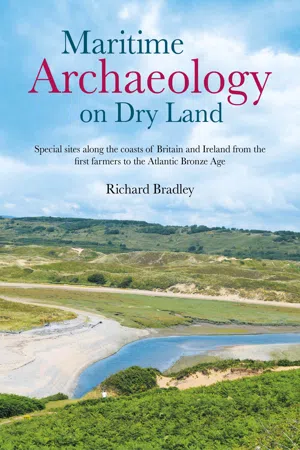
This book is about two islands off the coast of Continental Europe, the seas that surrounded them, and the ways in which they were used over a period of three thousand years. Instead of the usual emphasis on finds in the intertidal zone, it focuses on parts of Britain and Ireland where traces of the prehistoric shoreline survive above sea level. It explores a series of Neolithic and Early Bronze Age sites which were investigated in the nineteenth and early twentieth centuries and have been largely forgotten. These places were very different from the Iron Age ports and harbors studied in recent years. How can we identify these special sites, and what are the best ways of interpreting them? The book considers the evidence for travel by sea between the settlement of the earliest farmers and the long distance movement of metalwork. It emphasizes the distinctive archaeology of a series of coastal locations. Little of the information is familiar and some of the most useful evidence was recorded many years ago. It is supplemented by new studies of these places and the artifacts found there, as well as reconstructions of the prehistoric coastline. The book emphasizes the important role of 'enclosed estuaries', which were both sheltered harbors and special places where artifacts were introduced by sea. Other items were made there and exchanged with local communities. It considers the role played by these places in the wider pattern of settlement and their relationship to major monuments. The book describes how the character of coastal sites changed in parallel with developments in maritime technology and trade. The main emphasis is on Neolithic and Early Bronze Ages uses of the seashore, but the archaeology of the Middle and Later Bronze Age provides a source of comparison.
eBook - ePub
Maritime Archaeology on Dry Land
Special Sites along the Coasts of Britain and Ireland from the First Farmers to the Atlantic Bronze Age
- 184 pages
- English
- ePUB (mobile friendly)
- Available on iOS & Android
eBook - ePub
Maritime Archaeology on Dry Land
Special Sites along the Coasts of Britain and Ireland from the First Farmers to the Atlantic Bronze Age
About this book
Trusted by 375,005 students
Access to over 1.5 million titles for a fair monthly price.
Study more efficiently using our study tools.
Information
Topic
Sciences socialesPART ONE
The sea, the sea
1. Fluid dynamics: a brief introduction
What did ancient people think of the sea? Were they fearful of its power, or confident of the wealth it could provide? Was the ocean an obstacle to movement from one region to another, or was it an open highway compared with travel overland? Its presence was an inescapable fact, but there was more than one way of understanding its significance, and conceptions could have changed over the course of time. Past interpretations might have been as fluid as the element itself (Farr 2006; Clark 2017).
The questions multiply. How was the shoreline understood in the past? Was it always a special place? It must have played a vital role, yet in Britain and Ireland, which are studied in detail in this account, its archaeology raises problems. Some are theoretical and others are far more practical. Many of them are considered here.
This chapter begins with attitudes to the sea and distinguishes between several possibilities in the past. It focuses on the settlement of both islands and the relationship between indigenous communities and the first farmers here and on the Continent. It places a special emphasis on the archaeology of the water’s edge. Part One shows why this is important and how it can be investigated.
A fact and a state of mind
The most important factors were not necessarily physical. The presence of the sea may have been a fact, but its significance might have been interpreted in different ways by different communities, and those who lived in landlocked areas may not have had the same perspective as dwellers on the coast. This is shown by Classical and medieval beliefs which shared a similar perception of geography. In each case people thought that the world extended from a powerful centre to a dangerous perimeter (Rainbird 2007, 4–6). For Hecataeus of Miletus the land was a circular disc, one enormous island with the Mediterranean in its centre and a great sea, Oceanus, around its outer limit (Thomson 1948; Cunliffe 2001a, 3). Beyond that boundary there were only the dead. It meant that places on the Atlantic seaboard were considered both threatening and remote; among them were Britain and Ireland. In the same way, medieval cosmology treated Jerusalem as the centre of the land. It was where the sun rose every morning and where three continents converged (Edson 1997). Again the entire world was a single landmass, Orbis Terrarum, which was completely enclosed by water. The sea was the home of a beast destined to destroy humankind. That is why offshore islands along the coast of Western Europe were settled by hermits and monks. Early monasteries were established there because the ocean was ‘the battleground between Christianity and its demons’ (Mack 2011, 90).
The land ends (Fig. 1)
Place names expressed a similar idea: important parts of the seaboard were on the farthest edges of the world. They were where it was bounded by a seemingly limitless expanse of water (Bradley 2014). The same conception was expressed at four points along the Atlantic coast, two of which share almost the same name: Cabo Fisterra in north-west Spain (Galicia) and Finistère in Brittany. Both can be translated as ‘Land’s End’, and the same description applies to the farthest tip of Cornwall. A fourth example is in Scotland where the Mull of Kintyre is a narrow peninsula, 75 km long, between the west coast and the north of Ireland. Its Gaelic name has the same connotation. Again it reflects the attitude of people who travelled there overland.
Cabo Fisterra was especially significant in this respect since it was an important outpost of Christian Europe at a time when other parts of Iberia were occupied by followers of Islam. It was the final destination of the Camino, one of the main pilgrimage routes of the Middle Ages. It acquired this role because it was where the relics of St James had been washed ashore. His presence on the coast of Spain was celebrated by building a great cathedral at Santiago de Compostela. From there the pilgrims made their way another 100 km to the sea where his remains had been discovered. Then they showed that their journey was over by setting fire to their boots (Brierly 2003).
Such place names record the perception of communities who lived far away, for these locations were not as isolated as their approach would suggest. Parts of the littoral were linked with other regions during the early medieval period. They saw the movement of luxury goods in the first millennium AD (Campbell 2007; Duggan 2018), yet archaeologists have found surprisingly little physical evidence of other connections. Historical sources are more informative. Christian churches on either side of the Channel were dedicated to the same saints (Bowen 1972), and early accounts tell how people settled Galicia from Cornwall and moved between south-west England and Brittany (Fleuriot 1980; Cunliffe 2017, fig. 10.12). Some connections extended even further. An Irish origin myth featured Mil, a soldier who travelled there from Spain (Ní Lionáin 2012). According to John Waddell (2005, 21), he was ‘the ancestral figure of Gaelic Ireland’. Linguistic evidence is informative, too. Breton and Cornish share many features in common, and the same language family includes Welsh, and the Scottish and Irish varieties of Gaelic. But even these connections have their limits, for the national language of Galicia (Galego) is similar to Portuguese, although Celtic place names have been identified in the Iberian Peninsula.
More tangible connections are documented by the distributions of earlier prehistoric artefacts. Two well-known examples illustrate this point. In one case they were associated with the first farmers, and in the other with metalwork. They included some of the places that later generations would call ‘land’s end’ but provide evidence of connections that reached along the entire coastline of Western Europe.
The evidence of jadeite axes and variscite beads
Important issues are raised by two distinctive materials that circulated in the Neolithic period. From 5500 BC jadeite was obtained on Monte Viso and Monte Beigua in the Alps: it was more widely distributed from 4700 BC and the main period of use lasted until about 4000 BC (Pétrequin et al. 2012). The principal products were axeheads, some of which were deposited in rock fissures, rivers, lakes and bogs. Others were set upright in the ground, or placed beside conspicuous outcrops, springs, waterfalls and standing stones. These artefacts travelled over an enormous area, extending as far as the island of Britain. One of the greatest concentrations was in the Morbihan in north-west France where some of these axes were reworked. Few have been found along the coast further to the south, but the characteristic forms of Breton axeheads might have been copied in Iberia. Otherwise the distribution of Alpine products linked three of the areas considered earlier: Brittany, south-west England and the Atlantic coast of Scotland. It also reached far inland (Fig. 2).

Fig. 1 Places along the Atlantic coastline called Land’s End or the equivalent. Information from Bradley (2014).
In contrast to jadeite, variscite originated from mines in the Iberian Peninsula. Its chronology was different as it remained important for a longer period, but again extraction began in the fifth millennium BC (Herbaud & Quarré 2004). It was used to make beads and pendants that were imported to north-west France at the time when the earliest farmers were settling there; other artefacts were distributed along the Mediterranean coast. Both materials illustrate the extent of contacts between areas whose traditional names emphasised their isolation. Finds of jadeite connected north-west France, England and Scotland, and those of variscite linked Brittany with Portugal and Spain.
The evidence of ‘Maritime’ Beakers
The same issues arise in later periods when the movement of raw materials was even more important. Three kinds of metal could be obtained not far from the Atlantic. Copper was extracted in Britain, south-west Ireland, and north-west Iberia; tin was obtained in Galicia, Brittany and Cornwall; and the main sources of gold were in Ireland and northern Spain. The copper could be alloyed with tin, yet their natural distributions were not the same, so it was necessary to take the ores between different places. It is obvious that new relationships were established during the Chalcolithic and Early Bronze Age periods.

Fig. 2 The distribution of Alpine jadeite axes and the routes by which they were carried. The source area is indicated by a star, and the thickness of the lines connecting different regions reflects the intensity of movement between them. Information from Cassen et al. (2020).
Again the distribution of a diagnostic artefact connects areas that must have seemed remote from other parts of Europe. This was a fine ceramic vessel, the Maritime Beaker, whose distribution included several foci along the shores of the Atlantic and the Mediterranean (Harrison 1980, 17–23; Salanova 2002; 2016). Its prototypes were probably made in Portugal, but further to the north the same kind of pottery is recorded in three of the regions mentioned before: Galicia, southern Brittany and the west coast of Scotland. Of course its distribution extends across a far wider area, but, as the name suggests, its presence connected significant places on the coast.
A comment
The extent of such networks is not compatible with notions of marginality. The distribution of jadeite axes followed the Atlantic coast for 1000 km. Variscite beads circulated up to 1200 km from where they were made, and the distribution of Maritime Beakers extended from south to north for 2000 km. The world was a larger place than people might have thought.
Isolation and identity
Although there were contacts between prehistoric communities along the coast, there is no reason to suppose that they shared the same attitudes to the sea. Perhaps they were aware of their geographical remoteness and chose to form connections with a wider world. They did so by exchanging distinctive artefacts with other groups, and in some cases they might have adopted the same practices as their partners in these transactions. That would explain why people who lived so far from one another built the same kinds of monuments. Again the Neolithic period supplies the best examples. While certain styles of architecture had extensive distributions – especially chambered tombs – others linked regions that were a long way apart. It was true of the corbelled passage graves of western Iberia and examples of the same date in Ireland (Schulz Paulsson 2017). It also applies to the striking similarities between open air rock art in north-west Iberia, Ireland and northern Britain (Valdez Tullett 2019). The important point is that similar features have seldom been identified in between those areas. Connections by sea were important, but such links could also be rejected, and that was equally significant.
It is clear that different groups had different attitudes to the sea. For people who occupied inland regions it defined the limit of the world. For others, it was a specialised environment, linked to similar places by the use of boats. There were important distinctions between those who travelled overland, and those whose closest connections were by water. And there were other possibilities. Communities living near the coast might have felt at ease with their surroundings because marine resources were essential to their way of life. Others took a very different view. A good example is Dumnorix, the leader of the Aedui, whom Caesar brought with him to Britain. He was a reluctant traveller. ‘He pleaded all kinds of reasons why he should be left behind in Gaul. For one thing, he claimed, he knew nothing of sailing and was afraid of the sea’ (De Bello Gallico 5.6). That response would be understandable when migrants first encountered an element that was dangerous but also a wonder.
Even when sailors took to the water they would have had more than one option. They could travel along the coast, but others must have chosen to stay out of sight of land (Anderson-Whymark & Garrow 2015). Both choices would be available when conditions at sea allowed, but there was always a third possibility. Perhaps some voyages were undertaken simply because they posed a challenge. Reputations might depend on confronting dangers. It is unlikely that there was ever a single course of action and it could be a mistake to reconstruct every ancient voyage according to a risk assessment.
Between east and west
In practice, the main distinction was between communities along the west coast of Europe and those who lived further to the east. It was already present during the Mesolithic period, but it took on a new significance when the Continent was colonised by farmers (Rowley-Conwy 2004; 2011). For a long time two different strands have been recognised in the archaeological record and now their significance is confirmed by ancient DNA (Cassidy et al. 2016; Brace et al. 2019). At its simplest the contrast is between immigrants whose ancestors came from Central and South-east Europe, and a second group with stronger links to the Mediterranean and Atlantic shorelines. One tradition was associated with a population who could have had little or no experience of the sea. They included people of the Linearbandkeramik (LBK) Culture and its successors. Their western counterparts were those who used Cardial Ware and its equivalents. They were familiar with the coast. The contrast between them extended to their relationships with local hunter gatherers (Fig. 3).
Northern Europe
The information is puzzling and complex (Sørensen & Karg 2014). The LBK expansion was rapid and sustained, and groups of massive longhouses were eventually established across the loess of North-west Europe. They took a similar form over an increasingly large area, but the LBK expansion was checked towards the northern limits of the most fertile land. At first the settlers had only limited contacts with natives in the same parts of Europe. On the other hand, items like the stone adzes associated with early farmers were obtained by foragers in Scandinavia. These imports were deposited in bogs according to a long-established custom. The crucial difference is that the people who lived outside the agricultural frontier were familiar with the sea, but it did not apply to their neighbours. The expansion of agriculture was held in check, while contacts between both populations continued for a long time.
Why was this the case? The usual explanation is that productive land was now in short supply. There was little prospect of growing cereals further to the north and west since the climate was unsuitable. The expansion of agriculture could only resume if local conditions improved (Bonsall et al. 2002; Betti et al. 2020). But another feature might have been equally important. Is it possible that the first farmers were wary of settling the coast or crossing open water? There was every reason why the sea could be treated as a threat. Its level had been rising throughout the postglacial period and significant amounts of productive land had already been submerged (Gaffney et al. 2007). Such changes would have been inexplicable. The ocean might have been interpreted as a living creature, for this was a widely shared belief in the ancient world. Settlers from the south would have known of the problems through their contacts with indigenous communities. Did they share the attitude of Dumnorix who was frightened of the sea? It was only as the population increased and a shortage of good land led to conflict that they overcame their inhibitions. By that stage they must have become familiar with watercraft through their neighbours in Northern Europe. Around 4000 BC the climate did change significantly and new areas could be cultivated for the first time. It was then that Britain and parts of ...
Table of contents
- Front Cover
- Half-Title Page
- Title Page
- Copyright Page
- Dedication
- Contents
- Preface and acknowledgments
- List of figures
- Part One. The sea, the sea
- Part Two. Landing places
- Part Three. Ocean terminals
- Bibliography
Frequently asked questions
Yes, you can cancel anytime from the Subscription tab in your account settings on the Perlego website. Your subscription will stay active until the end of your current billing period. Learn how to cancel your subscription
No, books cannot be downloaded as external files, such as PDFs, for use outside of Perlego. However, you can download books within the Perlego app for offline reading on mobile or tablet. Learn how to download books offline
Perlego offers two plans: Essential and Complete
- Essential is ideal for learners and professionals who enjoy exploring a wide range of subjects. Access the Essential Library with 800,000+ trusted titles and best-sellers across business, personal growth, and the humanities. Includes unlimited reading time and Standard Read Aloud voice.
- Complete: Perfect for advanced learners and researchers needing full, unrestricted access. Unlock 1.5M+ books across hundreds of subjects, including academic and specialized titles. The Complete Plan also includes advanced features like Premium Read Aloud and Research Assistant.
We are an online textbook subscription service, where you can get access to an entire online library for less than the price of a single book per month. With over 1.5 million books across 990+ topics, we’ve got you covered! Learn about our mission
Look out for the read-aloud symbol on your next book to see if you can listen to it. The read-aloud tool reads text aloud for you, highlighting the text as it is being read. You can pause it, speed it up and slow it down. Learn more about Read Aloud
Yes! You can use the Perlego app on both iOS and Android devices to read anytime, anywhere — even offline. Perfect for commutes or when you’re on the go.
Please note we cannot support devices running on iOS 13 and Android 7 or earlier. Learn more about using the app
Please note we cannot support devices running on iOS 13 and Android 7 or earlier. Learn more about using the app
Yes, you can access Maritime Archaeology on Dry Land by Richard Bradley in PDF and/or ePUB format, as well as other popular books in Sciences sociales & Histoire de l'armée et de la marine. We have over 1.5 million books available in our catalogue for you to explore.