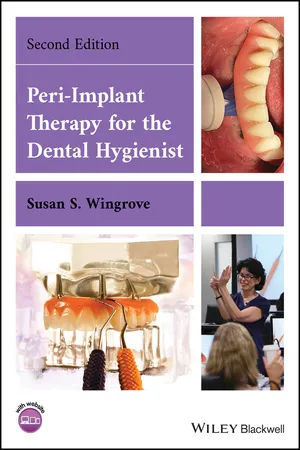
Peri-Implant Therapy for the Dental Hygienist
eBook - ePub

Peri-Implant Therapy for the Dental Hygienist

  1. English
  2. ePUB (mobile friendly)
  3. Available on iOS & Android
eBook - ePub

Peri-Implant Therapy for the Dental Hygienist

About this book

Practical guidance for dental hygienists on how to maintain dental implants in daily practice

The newly revised Second Edition of Peri-Implant Therapy for the Dental Hygienist provides a comprehensive guide to biofilm-focused assessment, maintenance, and home care for the prevention of long-term implant complications. The book offers clinical protocols ranging from single titanium and ceramic implant-borne restorations to the fixed full arch final prosthesis. The text also discusses pre-surgical regenerative procedures, implant placement, and patient communication to support hygienists and other dental professionals in talking to patients about implant dentistry.

The book is a valuable clinically oriented resource guide for dental professionals seeing patients with titanium and ceramic dental implants. This new edition introduces readers to new information on ceramic implant instrumentation and 'Mastering the Arch', as well as detailed information on how to remove, assess, and provide maintenance for full arch prostheses patients. A new companion website provides dental instructor materials, review questions and answers, lesson plans, videos, PowerPoint slides, skills evaluations, and learning objectives. The book includes:

  • Useful clinical photographs, illustrations, and patient cases to demonstrate the concepts discussed throughout the book
  • Researched protocols for assessment, professional in-office maintenance, and biofilm-focused patient home care to meet all the peri-implant therapy challenges
  • Updated classification, guidelines, and treatments for peri-implant disease
  • Technology and resources for prevention of peri-implantitis and complications that can be prevented with early detection and patient awareness

Ideal for dental hygienists and dental hygiene and dental students, Peri-Implant Therapy for the Dental Hygienist is also an essential reference for any dental professional seeking a one-stop resource for maintaining dental implants and managing their complications.

Trusted by 375,005 students

Access to over 1.5 million titles for a fair monthly price.

Study more efficiently using our study tools.

Information

Year
2022
Print ISBN
9781119766186
eBook ISBN
9781119766223
Edition
2
Subtopic
Dentistry

1
Implants 101: History, Implant Design, Parts, and Pieces

  • History
  • Dental implant history timeline
  • Implants
    • Implant design
  • Orthodontic implants/temporary anchoring devices (TADs)
    • Parts and pieces for implants
  • Implant dentistry terminology
  • Summary
  • References
Understand as hygienists a tidal wave of ailing or failing implants may be imminent. It is imperative that hygienists are trained in identifying and treating peri‐implant mucosal inflammation that could affect overall body health (1).
—G. Nogueira‐Filho, DDS, MDent, PhD
Dental hygienists must be ready and be prepared to take on this next, very important challenge in our profession! The 21st century is an important and critical time to be a hygienist. During this exciting time in dentistry, we as hygienists have a critical role in implant therapy. As a hygienist, your role will be to access patients for healthy periodontium prior to placement of implants, to monitor the tissue surrounding the implants, and to maintain the implants through safe, effective implant maintenance. Current studies reveal that infections in the periodontium occur in more than 50% of implants placed (2). Therefore, we as dental professionals will be faced with different dynamics, challenges, and complications.
As a hygienist, the history of implant dentistry makes you aware that implants are not new, but have been evolving for decades. Patients may have concerns that implants are so new that not enough research or development has been done for them to feel comfortable with the procedure. With your knowledge of the history, design, and research done on implants you will be better able to talk with your patients and address these concerns. A fundamental understanding of key terms and statistics associated with implant dentistry will also be a valuable tool to add to your verbal skills when talking with patients about tooth replacement.

History

Believe it or not, the history of dental implants dates back to 600 AD with the ancient Mayans. Dr. and Mrs. Wilson Popenoe found the lower mandible of a young Mayan woman in Honduras in 1931 (Figure 1.1). She was missing some of her lower teeth and they had been replaced with the earliest example of the first dental implants, made from pieces of shell, shaped to resemble teeth. Scientists believe that these shells may have actually worked. Slots were made into the bone and the shells were pounded in like little wedges, without anesthesia!
Similar discoveries were made in Egypt, artifacts that date back to the 1700s. Ivory and the bones of animals were also sometimes used to replace missing teeth. It would be decades after these archeological discoveries before the modern world caught up with the Mayans' and Egyptians' dental technology.
In the late 18th and 19th centuries, the level of dental care went through many changes. Through the letters, journals, and accounts left by our first president, George Washington, we have a well‐documented case history of his lifelong dental problems and the level of dental care available at that time. George Washington started losing his teeth at the age of 24 and by 1789, the year that Washington took his oath of office, he had only one of his original teeth left (Figure 1.2).
Photo depicts Discovery by Dr. and Mrs. Wilson Popenoe, Honduras, 1931.
Figure 1.1 Discovery by Dr. and Mrs. Wilson Popenoe, Honduras, 1931.
Reprinted with permission from Ring (20).
Dr. John Greenwood made a set of dentures for Washington made of hippopotamus ivory and eight real human teeth attached by brass screws. The denture, which was anchored on the one remaining tooth in Washington's mouth, has a hole that fits snugly around the one tooth. Dr. Greenwood was noted to be quite ahead of his time in his dental practice, extracting teeth, and utilizing them in the manufacture of dentures, but he also experimented with implantation.
Unfortunately for Dr. Greenwood, the 18th century's lack of antibiotics and any understanding of germ theory or antisepsis doomed any such experiments to failure. He did make President George Washington several sets of dentures, none made out of wood as often referred to. They were made from gold, ivory, lead, and human and animal teeth (horse and donkey teeth were common components), with springs to help them open and bolts to hold them together.
Photo depicts George Washington's lower denture.
Figure 1.2 George Washington's lower denture.
Courtesy of Rick Blanchette.
In the 18th century, researchers experimented with gold and other metal alloys including lead as implants. Dr. Maggiolo fabricated gold implants that were placed in sockets where teeth had recently been extracted and after a healing period attached a donor tooth. Dr. Harris, a physician, attempted the same procedure with a platinum post, both had poor results.
Dr. Edmunds in 1886 was the first in the United States to implant a porcelain crown mounted on a platinum disc and presented at the First District Dental Society of New York. Other metal alloys with porcelain crowns were experimented with, but these implants did not have a long‐term success rate.
Dr. E.J. Greenfield, pioneer of the endosseous implant, provided many of the basic concepts of nascent field of implantology. He was known for his patented hollow‐cylinder implants made of wire soldered with 24 karat gold. This hollow‐basket design was a similar design that Straumann Implant Company from Switzerland adopted many...

Table of contents

  1. Cover
  2. Table of Contents
  3. Title Page
  4. Copyright Page
  5. Dedication
  6. Foreword
  7. Acknowledgments
  8. About the Author
  9. List of Contributors
  10. About the Companion Website
  11. 1 Implants 101: History, Implant Design, Parts, and Pieces
  12. 2 Implant Therapy: Oral‐Systemic Health, Medical History, and Risk Assessment
  13. 3 What Lies Beneath the Surface? Natural Teeth, Bone, and Implant Surgery
  14. 4 Setting the Stage: Adjunctive Surgical Procedures, Restorative Options, and Treatment Planning
  15. 5 How to Talk to Patients About Implant Dentistry: Risks, Benefits, and Alternatives
  16. 6 AIM for Implant Success: Assess, Identify, and Monitor
  17. 7 Implant Complications: Peri‐Implant Disease, Biofilm, and Corrosion
  18. 8 Biofilm‐Focused Implant Home Care
  19. 9 Professional In‐Office Implant Maintenance and Disease Treatment
  20. Appendix: Terminology and Resources
  21. Index
  22. End User License Agreement

Frequently asked questions

Yes, you can cancel anytime from the Subscription tab in your account settings on the Perlego website. Your subscription will stay active until the end of your current billing period. Learn how to cancel your subscription
No, books cannot be downloaded as external files, such as PDFs, for use outside of Perlego. However, you can download books within the Perlego app for offline reading on mobile or tablet. Learn how to download books offline
Perlego offers two plans: Essential and Complete
  • Essential is ideal for learners and professionals who enjoy exploring a wide range of subjects. Access the Essential Library with 800,000+ trusted titles and best-sellers across business, personal growth, and the humanities. Includes unlimited reading time and Standard Read Aloud voice.
  • Complete: Perfect for advanced learners and researchers needing full, unrestricted access. Unlock 1.5M+ books across hundreds of subjects, including academic and specialized titles. The Complete Plan also includes advanced features like Premium Read Aloud and Research Assistant.
Both plans are available with monthly, semester, or annual billing cycles.
We are an online textbook subscription service, where you can get access to an entire online library for less than the price of a single book per month. With over 1.5 million books across 990+ topics, we’ve got you covered! Learn about our mission
Look out for the read-aloud symbol on your next book to see if you can listen to it. The read-aloud tool reads text aloud for you, highlighting the text as it is being read. You can pause it, speed it up and slow it down. Learn more about Read Aloud
Yes! You can use the Perlego app on both iOS and Android devices to read anytime, anywhere — even offline. Perfect for commutes or when you’re on the go.
Please note we cannot support devices running on iOS 13 and Android 7 or earlier. Learn more about using the app
Yes, you can access Peri-Implant Therapy for the Dental Hygienist by Susan S. Wingrove in PDF and/or ePUB format, as well as other popular books in Medicine & Dentistry. We have over 1.5 million books available in our catalogue for you to explore.