- 76 pages
- English
- ePUB (mobile friendly)
- Available on iOS & Android
eBook - ePub
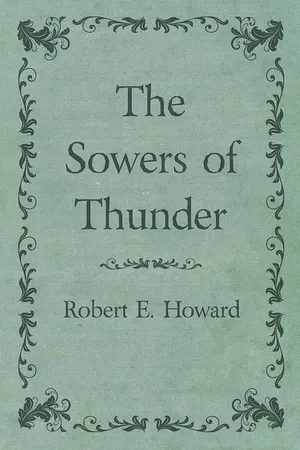
The Sowers of Thunder
About this book
This early work by Robert E. Howard was originally published in the 1932 and we are now republishing it with a brand new introductory biography. 'The Sowers of Thunder' is one of Howard's stories set during the Crusades and is a tale of heroism and tragedy. Robert Ervin Howard was born in Peaster, Texas in 1906. During his youth, his family moved between a variety of Texan boomtowns, and Howard - a bookish and somewhat introverted child - was steeped in the violent myths and legends of the Old South. At fifteen Howard began to read the pulp magazines of the day, and to write more seriously. The December 1922 issue of his high school newspaper featured two of his stories, 'Golden Hope Christmas' and 'West is West'. In 1924 he sold his first piece - a short caveman tale titled 'Spear and Fang' - for $16 to the not-yet-famous Weird Tales magazine. Howard's most famous character, Conan the Cimmerian, was a barbarian-turned-King during the Hyborian Age, a mythical period of some 12,000 years ago. Conan featured in seventeen Weird Tales stories between 1933 and 1936 which is why Howard is now regarded as having spawned the 'sword and sorcery' genre. The Conan stories have since been adapted many times, most famously in the series of films starring Arnold Schwarzenegger.
Trusted by 375,005 students
Access to over 1.5 million titles for a fair monthly price.
Study more efficiently using our study tools.
Information
Chapter 1
The idlers in the tavern glanced up at the figure framed in the doorway. It was a tall broad man who stood there, with the torch-lit shadows and the clamor of the bazaars at his back. His garments were simple tunic, and short breeches of leather; a camel’s-hair mantle hung from his broad shoulders and sandals were on his feet. But belying the garb of the peaceful traveler, a short straight stabbing sword hung at his girdle. One massive arm, ridged with muscles, was outstretched, the brawny hand gripping a pilgrim’s staff, as the man stood, powerful legs wide braced, in the doorway. His bare legs were hairy, knotted like tree trunks. His coarse red locks were confined by a single band of blue cloth, and from his square dark face, his strange blue eyes blazed with a kind of reckless and wayward mirth, reflected by the half-smile that curved his thin lips.
His glance passed over the hawk-faced seafarers and ragged loungers who brewed tea and squabbled endlessly, to rest on a man who sat apart at a rough-hewn table, with a wine pitcher. Such a man the watcher in the door had never seen--tall, deep chested, broad shouldered, built with the dangerous suppleness of a panther. His eyes were as cold as blue ice, set off by a mane of golden hair tinted with red; so to the man in the doorway that hair seemed like burning gold. The man at the table wore a light shirt of silvered mail, a long lean sword hung at his hip, and on the bench beside him lay a kite-shaped shield and a light helmet.
The man in the guise of a traveler strode purposefully forward and halted, hands resting on the table across which he smiled mockingly at the other, and spoke in a tongue strange to the seated man, newly come to the East.
The one turned to an idler and asked in Norman French: “What does the infidel say?”
“I said,” replied the traveler in the same tongue, “that a man can not even enter an Egyptian inn these days without finding some dog of a Christian under his feet.”
As the traveler had spoken the other had risen, and now the speaker dropped his hand to his sword. Scintillant lights flickered in the other’s eyes and he moved like a flash of summer lightning. His left hand darted out to lock in the breast of the traveler’s tunic, and in his right hand the long sword flashed out. The traveler was caught flat-footed, his sword half clear of its sheath. But the faint smile did not leave his lips and he stared almost childishly at the blade that flickered before his eyes, as if fascinated by its dazzling.
“Heathen dog,” snarled the swordsman, and his voice was like the slash of a blade through fabric, “I’ll send you to Hell unshriven!”
“What panther whelped you that you move as a cat strikes?” responded the other curiously, as calmly as if his life were not weighing in the balance. “But you took me by surprize. I did not know that a Frank dare draw sword in Damietta.”
The Frank glared at him moodily; the wine he had drunk showed in the dangerous gleams that played in his eyes where lights and shadows continuously danced and shifted.
“Who are you?” he demanded.
“Haroun the Traveler,” the other grinned. “Put up your steel. I crave pardon for my gibing words. It seems there are Franks of the old breed yet.”
With a change of mood the Frank thrust his sword back into its sheath with an impatient clash. Turning back to his bench he indicated table and wine pitcher with a sweeping gesture.
“Sit and refresh yourself; if you are a traveler, you have a tale to tell.”
Haroun did not at once comply. His gaze swept the inn and he beckoned the innkeeper, who came grudgingly forward. As he approached the Traveler, the innkeeper suddenly shrank back with a low half-stifled cry. Haroun’s eyes went suddenly merciless and he said, “What then, host, do you see in me a man you have known aforetime, perchance?”
His voice was like the purr of a hunting tiger and the wretched innkeeper shivered as with an ague, his dilated eyes fixed on the broad, corded hand that stroked the hilt of the stabbing-sword.
“No, no, master,” he mouthed. “By Allah, I know you not--I never saw you before--and Allah grant I never see you again,” he added mentally.
“Then tell me what does this Frank here, in mail and wearing a sword,” ordered Haroun bruskly, in Turki. “The dog-Venetians are allowed to trade in Damietta as in Alexandria, but they pay for the privilege in humility and insult, and none dares gird on a blade here--much less lift it against a Believer.”
“He is no Venetian, good Haroun,” answered the innkeeper. “Yesterday he came ashore from a Venetian trading-galley, but he consorts not with the traders or the crew of the infidels. He strides boldly through the streets, wearing steel openly and ruffling against all who would cross him. He says he is going to Jerusalem and could not find a ship bound for any port in Palestine, so came here, intending to travel the rest of the way by land. The Believers have said he is mad, and none molests him.”
“Truly, the mad are touched by Allah and given His protection,” mused Haroun. “Yet this man is not altogether mad, I think. Bring wine, dog!”
The innkeeper ducked in a deep salaam and hastened off to do the Traveler’s bidding. The Prophet’s command against strong drink was among other orthodox precepts disobeyed in Damietta where many nations foregathered and Turk rubbed shoulders with Copt, Arab with Sudani.
Haroun seated himself opposite the Frank and took the wine goblet proffered by a servant.
“You sit in the midst of your enemies like a shah of the East, my lord,” he grinned. “By Allah, you have the bearing of a king.”
“I am a king, infidel,” growled the other; the wine he had drunk had touched him with a reckless and mocking madness.
“And where lies your kingdom, malik?” The question was not asked in mockery. Haroun had seen many broken kings drifting among the debris that floated Eastward.
“On the dark side of the moon,” answered the Frank with a wild and bitter laugh. “Among the ruins of all the unborn or forgotten empires which etch the twilight of the lost ages. Cahal Ruadh O’Donnel, king of Ireland--the name means naught to you, Haroun of the East, and naught to the land which was my birthright. They who were my foes sit in the high seats of power, they who were my vassals lie cold and still, the bats haunt my shattered castles, and already the name of Red Cahal is dim in the memories of men. So--fill up my goblet, slave!”
“You have the soul of a warrior, malik. Was it treachery overcame you?”
“Aye, treachery,” swore Cahal, “and the wiles of a woman who coiled about my soul until I was as one blind--to be cast out at the end like a broken pawn. Aye, the Lady Elinor de Courcey, with her black hair like midnight shadows on Lough Derg, and the gray eyes of her, like--” he started suddenly, like a man waking from a trance, and his wayward eyes blazed.
“Saints and devils!” he roared. “Who are you that I should spill out my soul to? The wine has betrayed me and loosened my tongue, but I--” He reached for his sword but Haroun laughed.
“I’ve done you no harm, malik. Turn this murderous spirit of yours into another channel. By Erlik, I’ll give you a test to cool your blood!”
Rising, he caught up a javelin lying beside a drunken soldier, and striding around the table, his eyes recklessly alight, he extended his massive arm, gripping the shaft close to the middle, point upward.
“Grip the shaft, malik,” he laughed. “In all my days I have met no one who was man enough to twist a stave out of my hand.”
Cahal rose and gripped the shaft so that his clenched fingers almost touched those of Haroun. Then, legs braced wide, arms bent at the elbow, each man exerted his full strength against the other. They were well matched; Cahal was a trifle taller, Haroun thicker of body. It was bear opposed to tiger. Like two statues they stood straining, neither yielding an inch, the javelin almost motionless under the equal forces. Then, with a sudden rending snap, the tough wood gave way and each man staggered, holding half the shaft, which had parted under the terrific strain.
“Hai!” shouted Haroun, his eyes sparkling; then they dulled with sudden doubt.
“By Allah, malik,” said he, “this is an ill thing! Of two men, one should be master of the other, lest both come to a bad end. Yet this signifies that neither of us will ever yield to the other, and in the end, each will work the other ill.”
“Sit down and drink,” answered the Gael, tossing aside the broken shaft and reaching for the wine goblet, his dreams of lost grandeur and his anger both apparently forgotten. “I have not been long in the East, but I knew not there were such as you among the paynim. Surely you are not one with the Egyptians, Arabs and Turks I have seen.”
“I was born far to the east, among the tents of the Golden Horde, on the steppes of High Asia,” said Haroun, his mood changing back to joviality as he flung himself down on his bench. “Ha! I was almost a man grown before I heard of Muhammad--on whom peace! Hai, bogatyr, I have been many things! Once I was a princeling of the Tatars--son of the lord Subotai who was right ...
Table of contents
- The Sowers of Thunder
- Robert E. Howard
- Chapter 1
- Chapter 2
- Chapter 3
- Chapter 4
- Chapter 5
- Chapter 6
- Chapter 7
Frequently asked questions
Yes, you can cancel anytime from the Subscription tab in your account settings on the Perlego website. Your subscription will stay active until the end of your current billing period. Learn how to cancel your subscription
No, books cannot be downloaded as external files, such as PDFs, for use outside of Perlego. However, you can download books within the Perlego app for offline reading on mobile or tablet. Learn how to download books offline
Perlego offers two plans: Essential and Complete
- Essential is ideal for learners and professionals who enjoy exploring a wide range of subjects. Access the Essential Library with 800,000+ trusted titles and best-sellers across business, personal growth, and the humanities. Includes unlimited reading time and Standard Read Aloud voice.
- Complete: Perfect for advanced learners and researchers needing full, unrestricted access. Unlock 1.5M+ books across hundreds of subjects, including academic and specialized titles. The Complete Plan also includes advanced features like Premium Read Aloud and Research Assistant.
We are an online textbook subscription service, where you can get access to an entire online library for less than the price of a single book per month. With over 1.5 million books across 990+ topics, we’ve got you covered! Learn about our mission
Look out for the read-aloud symbol on your next book to see if you can listen to it. The read-aloud tool reads text aloud for you, highlighting the text as it is being read. You can pause it, speed it up and slow it down. Learn more about Read Aloud
Yes! You can use the Perlego app on both iOS and Android devices to read anytime, anywhere — even offline. Perfect for commutes or when you’re on the go.
Please note we cannot support devices running on iOS 13 and Android 7 or earlier. Learn more about using the app
Please note we cannot support devices running on iOS 13 and Android 7 or earlier. Learn more about using the app
Yes, you can access The Sowers of Thunder by Robert E. Howard in PDF and/or ePUB format, as well as other popular books in Literature & Historical Fiction. We have over 1.5 million books available in our catalogue for you to explore.