- 116 pages
- English
- ePUB (mobile friendly)
- Available on iOS & Android
eBook - ePub
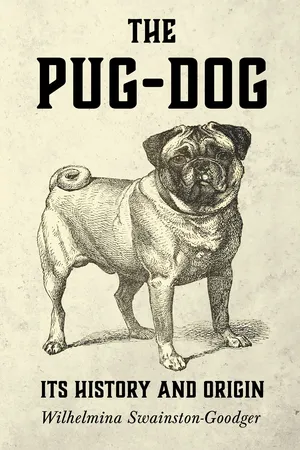
The Pug-Dog - Its History and Origin
About this book
Originally published in 1930, this is a detailed and informative study of the history and origins of the breed. Contents Include; 'Theories as to the Origin of the Breed,' 'China,' 'Holland,' 'England During the 17th and 18th Century,' 'France and Italy,' 'England During the Nineteenth Century,' 'Black and Other Coloured Pug-Dog,' 'The 20th Century Pug-Dog,' 'The Pug-Dog in America,' 'Schedule of Show Points,' and 'Schedule of Post-War Champions'.
Trusted by 375,005 students
Access to over 1.5 million titles for a fair monthly price.
Study more efficiently using our study tools.
Information
Print ISBN
9781406797060
9781443735889
CHAPTER VI
ENGLAND DURING THE NINETEENTH CENTURY
“A Pug did not suit me at all;
The feature unluckily rose up,
And folks took offence
When offering pence
Because of his turning his nose up.”
The feature unluckily rose up,
And folks took offence
When offering pence
Because of his turning his nose up.”
G. T. HOOD: “Lament of a Poor Blind.”
WE have now reached the great century in canine history. Many new breeds came into being and a much greater interest altogether was taken in the canine race.
So far as pugdom was concerned the greatest civil war that was ever known in dogdom was fought, concluding, rather like the Wars of the Roses, in the junction between the two houses of Morrison and Willoughby. Unfortunately, although the war was waged so recently, it is extremely difficult to give accurate dates. All the established facts were shattered by the Mayhew letter, and it seems certain that a mistake of, at least, a matter of twenty years has been made somewhere with respect to the Willoughby strain. But of this more anon.
The century opened badly so far as dogs were concerned. The whole country was agitated with internal industrial strife, and the threatened Napoleonic invasion kept everybody in a state of high nervous tension. People in those days did not realise that the famous Napoleonic star was a “dog star,” and the divorce of Josephine and the separation from the influence of her pug-dogs was the moment from which Napoleon’s fortunes waned, and Elba and St. Helena were to follow.
Not only was no breed of dogs popular at the beginning of the century, but it opened with a distinct and definite attack on the pug-dog.
The author of The Sportsman’s Cabinet, published in 1804, threw down the gauntlet which, unfortunately, was not taken up till many years afterwards.
“It is clear that the pug-dog, from its singularity, affords more doubt in the certainty of its origin than almost any of the species. It is asserted by some, that the genuine breed was introduced to this island from Muscovy, and that they were, originally, the undoubted natives of that country; others assert the pug to have been produced by a commixture between the English bull-dog and the little Dane, calling such races single mongrels, as coming from the mixture of two pure races; but there are other dogs which may, with propriety, be called double mongrels, because they come from a mixture of a pure race, and of one already mixed. The shock-dog, for instance, is a double mongrel, as being produced by the pug and the small Dane. The dog of Alicant is also a double mongrel, as coming from the whelp and small spaniel; and the Maltese, or lap-dog, is a double mongrel produced by the small spaniel with the barbet; the spaniel and the little dane produce the lion-dog,1 which is very scarce. . . .
“For, perhaps, in the whole catalogue of the canine-species, there is not one of less utility, or possessing less the powers of attraction than the pug-dog, applicable to no sport, appropriated to no useful purpose, susceptible of no predominant passion, and in no way whatever remarkable for any extra eminence, he is continued from era to era for what alone he might have been originally intended, the patient follower of a ruminating philosopher, or the adulating and consolatory companion of an old maid.”
This statement, upon which comment is superfluous, was not criticised till Hugh Dalziel, in r888, said that the writer of the above quotation was
“a cantankerous old bachelor, caring for nothing but his pipe, his pointer, and his gun”;
and Rawdon B. Lee, commenting on the quotation in 1894, writes:
“The above is rather rough on the poor little pug, but such an unfair and ungallant description could only have emanated from the brain of a rough sportsman of the old school, whose chief delights would lay in badger drawing, bull baiting and cock fighting. The pug-dog has its uses in society, and possesses credentials as a lady’s dog that cannot be excelled.”
However, the description given in The Sportsman’s Cabinet was accepted and did the breed great harm—much more, in fact, than the petty writers on canine matters who believed it to be amusing to vilify the breed during its popularity in the mid-Victorian era. One is glad, however, to be able to state that no writer on canine matters, whose works have been successful enough to be generally accepted and quoted at the present day, has criticised the pug-dog unfairly.
The writers on the subject, omitting writers on natural history, pure and simple, who have stood the test of time may be taken to be Idstone, G. R. Jesse, Stonehenge (J. W. Walsh), H. Dalziel, Rawdon B. Lee and, of a later day. W. D. Drury, Robert Leighton, James Watson and Edward C. Ash. Sometimes their criticisms may seem unkind, but they can be taken as none the less honest.
One rather amusing incident may be mentioned. Pug-dogs were given two new names at the beginning of the century, and these seem to have held to the breed for a considerable time: they were “the figure-of-eight dog” and “the jug-handled dog.” The former name was, I take it, given to them because of their appearance either with regard to the tightly curled tail, or—which is even more likely—referring to the pug-dog’s peculiar and characteristic walk when advancing towards any one, especially when he entertains pleasurable anticipations such as reciprocated affection, namely, a wriggling motion from side to side describing the semi-circular shape of the figure-of-eight; and the latter name has been explained by T. W. Knox in his Dog Stories and Dog Lore, published in 1887:
“‘Yes,’ replied Mr. Graham, ‘and this peculiar curve of the tail has given the pug the name of Jug-handled Dog.’
“‘How is that?’
“‘Why, there’s been a joke going the rounds of the papers that an enterprising dog-dealer had taken advantage of this peculiarity of the pug to make a handle by which he could be carried; by cutting a hole in the animal’s skin, along his back, and grafting the tail into it until it became firm and the sore healed, it was asserted that a handle was formed by which the dog could be carried on a lady’s arm like a workbag or hand-satchel, picked up to be transported over street crossings, or hung up on a nail or peg whenever desired.’ There have been many absurd stories told about the pug, but this is the worst of all.”
The reason for the great interest shown during the latter half of the nineteenth century in canine matters was due to a small spark struck at Newcastle-upon-Tyne in June 1859, when a gun-maker called Pape, whose shop is still extant in Collingwood Street of that city, offered a prize of some guns to the owner of the best pointer shown. Sixty dogs entered, and it was said that such a collection of dogs had never before been seen together. The excitement created by this show was immense, and dog shows were held in the same year at Birmingham and Edinburgh. Not only was England seized with the new sport of showing dogs, but even the Continent took up the game, and a show was held in Paris in 1865. Edward C. Ash, writing on the subject of these early shows, states:
“In the early show days of Birmingham (1860), the first show in which non-sporting dogs were catered for, was a class for pugs, but there appear to have been no entries. Leeds (1861) also had a class in which a first and second prize were awarded, but not the third. At the 1861 Manchester Show the prize-winner is given: ‘1st, the Female Blondin.’ ”
The popular enthusiasm for these shows led to the founding, by a Mr. S. E. Sherley, of a club for dogs in April 1873, so that shows might be regulated and the points of the various breeds defined.
The founding of this club, The Kennel Club, led to the formation of various clubs for special breeds, and The Pug Dog Club,1 was early in the field. The first of the four British pug-dog clubs2 which have been in existence, and which still retains its place at the present day, was founded in 1882, within ten years of the foundation of “The Kennel Club.”
The first Kennel Club Stud Book shows an entry of sixty-six pug-dogs, and amongst the pedigrees is given that of Cloudy, who will be mentioned hereafter:
“Cloudy, 3756, bred by Lady Churston, by Mayhew’s Click, out of Topsy; Click by Lamb (from Pekin) out of Moss.”
Queen Victoria had a real love for dogs, but her chief affection was for her little dog Dash, a spaniel, and Waldman, a dachshund, whose grave is inscribed at Windsor: “The very favourite dachshund of Queen Victoria, who brought him from Baden, 1872; died, July 11, 1881.”
Dash belonged to her mother, as the following extract from her diary, published by Viscount Esher, in 1912, under the title of The Girlhood of Queen Victoria, for the year 1833, will show:
“Tuesday, 15th January.—I awoke at 7 and got up at 8. At 10 minutes to 9 we breakfasted. At half-past 9 came the Dean till half-past 11. Just before we went out, Mamma’s little dog, a beautiful spaniel of King Charles’s breed, called Dash, and which Sir John gave her yesterday, came and will now remain here.”
She was so fond of this little dog that, after her coronation, C. P. R. Leslie tells us in his Recollections that:
“When the state coach drove up to the steps of the palace, she heard the spaniel barking with joy in the hall, and exclaimed, ‘There’s Dash!’ and was in a hurry to lay aside the sceptre and ball she carried in her hands, and take off the crown and robes to go and wash little Dash.”
But despite her love for Dash and Waldman and her other dogs, the Queen kept a fawn pug-dog in later years, but I cannot trace this dog’s name; and she certainly had a terrible black creature with cropped ears and a white chest and feet, called a black pug-dog, in her kennels in 1854.
Pug-dogs were, as we have seen, extremely scarce at the beginning of the nineteenth century, and the earliest established breeder would appear to have been an innkeeper of Walham Green called Charles (or, more commonly, Charlie) Morrison, who bred the usual Dutch type of pug-dogs in a very small way about 1840. The Dutch type may be taken shortly to be, in comparison with present-day pug-dogs, light, clear, golden fawn, short nosed, with little wrinkle, massive in size, with a clearly defined, but thin, trace and thumb mark.
He was easily superseded by the more vigorous and pushful breeder, Mrs. Laura Mayhew, who commenced with the same type of dogs, but later introduced specimens imported from China. Other breeders of the day, in a minor way, were Mr. H. Gilbert and Mr. W. Macdonald, both of London. As Stonehenge says, the pug-dog
“was exceedingly rare in the middle of the present” (nineteenth) “century, even a moderately good one not being procurable for less than £30, and that at a time when £5 was the average price of a lady’s pet, even of the fashionable kinds.”
Now, the efforts of Mrs. Mayhew excited Charlie Morrison to extend his breeding, and the introduction of Chinese blood into her strain gave his dogs a personality of their own which came to be known as “The Morrison Strain” or, more simply, “Morrison’s.” These efforts on the parts of the breeders started the pug-dog on his road to favour.
The Morrison strain is very important, so I will quote at length from Stonehenge, who was a friend of his:
“According to Mr. Morrison’s statement to me (which, however, he did not wish made public during his life), this strain was lineally descended from a stock possessed by Queen Charlotte, one of which is painted with great care in the well-known portrait of George III. at Hampton Court; but I could never get him to reveal the exact source from which it was obtained. That he himself fully believed in the truth of this story I am quite confident; and I am also of opinion that he never hazarded a statement of which he had the slightest doubt—being in this respect far above the average of ‘doggy’ men. Although he never broadly stated as much, I always inferred that the breed was obtained by ‘back-stair influence,’ and on that account a certain amount of reticence was necessary; but, whatever may be the cause of the secrecy maintained, I fully believe the explanation given by Mr. Morrison of the origin of this breed of pugs, which is as commonly known by his name as that of Lady Willoughby de Eresby by hers. His appeal to the Hampton Court portrait, in proof of the purity of his breed from its general resemblance to the dog in that painting, goes for nothing in my mind, because you may breed up to any type by careful selection; but I do not hesitate to endorse his statement as to the Guelph origin of his strain, because I have full confidence in his truthfulness, from having tested it in various other ways. I need scarcely remark that both strains are derived from the Dutch—‘the Morrison’ coming down to us through the three Georges from William III., and ‘the Willoughby’ being a more recent importation direct from Holland and Vienna. Both strains are equally lively in temperament, moderately tricky and companionable, but their chief advantage as pets is that they are unusually free from smell both in breath and coat.”
Now let us read what Stonehenge has to say with regard to the great rival of the Morrison strain, which afterwards got the name of the “Willoughby” strain.
“During the decade 1840–50, however, several admirers of pugs attempted to breed them from good foreign strains. Foremost among these was the then Lady Willoughby de Eresby, who after a great deal of trouble obtained a dog from Vienna which had belonged to a Hungarian countess, but was of a bad colour, being a mixture of the stone fawn now peculiar to the ‘Willoughby strain,’ and black; but the combination of these colours was to a certain extent in the brindled form. From accounts which are to be relied on, this dog was about twelve inches high, and of good shape, both in body and head, but with a face much longer than would now be approved of by pug-fanciers. In 1846 he was mated with a fawn bitch imported from Holland, of the desired colour, viz., stone fawn in body, with black mask and trace, but with no indication of brindle. She had a shorter face and heavier jowl than the dog, and was altogether in accordance with the type now recognised as the correct ‘Willoughby pug.’ From this pair are descended all the strain named after Lady Willoughby de Eresby, which are marked in colour by their peculiar cold stone fawn, and the excess of black often showing itself, not in brindled stripes, but in entirely or nearly entirely black heads, and large ‘saddle marks’ or wide ‘traces.’ ”
The points to be noted particularly in this statement by Stonehenge are the date at which Lady Willoughby commenced breeding and the origin of her strain. This is important, as it is the evidence of a contemporary writer, and other writers have followed him. So far as the Morrison strain is concerned I think we can accept Stonehenge, but I am going to suggest, for your consideration, that he was entirely wrong with regard to the Willoughby strain.
It will be noted that Stonehenge certainly makes no reference to the Mayhew strain, except stating that Mrs. Mayhew was an exhibitor “of late years,” and if it would not be sacrilege to suggest it in connection with such an established authority, I cannot help suspecting that he has mixed up the early Mayhew strain with that of the Willoughby—though, again, I can trace nothing authoritative, except the statement of Stonehenge, with regard to the pug-dog imported from Vienna. Howe...
Table of contents
- Cover
- Title
- Copyright
- Dedication
- Preface
- Contents
- I. Theories as to the Origin of the Breed
- II. China
- III. Holland
- IV. England during the Seventeenth and Eighteenth Centuries
- V. France and Italy
- VI. England during the Nineteenth Century
- VII. Black and Other Coloured Pug-Dogs
- VIII. The Twentieth-Century Pug-Dog
- IX. The Pug-Dog in America
- Schedule of Show Points
- Schedule of Post-War Champions