eBook - ePub
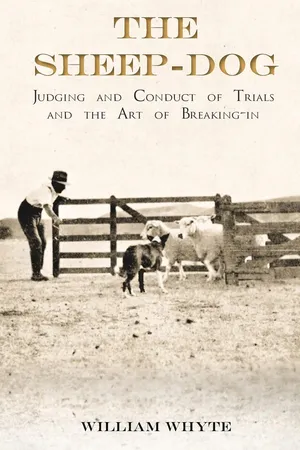
The Sheep-Dog - Judging and Conduct of Trials and the Art of Breaking-in
A Comprehensive and Practical Text-Book Dealing with the System of Judging Sheep-Dog Trials in New Zealand and Type on the Show Bench, and with the General Management and Conduct of Trials
- 222 pages
- English
- ePUB (mobile friendly)
- Available on iOS & Android
eBook - ePub
The Sheep-Dog - Judging and Conduct of Trials and the Art of Breaking-in
A Comprehensive and Practical Text-Book Dealing with the System of Judging Sheep-Dog Trials in New Zealand and Type on the Show Bench, and with the General Management and Conduct of Trials
About this book
This book contains a detailed guide to the sheep-dog, being a handbook on the system of judging sheep-dog trails in New Zealand and the art of breaking-in and working sheep-dogs. "The Sheep-Dog" also contains a wealth of useful and practical information relating to the maintenance of collies, making it of considerable utility to modern owners and breeders alike. Contents include: "Definition of Points", "Judging", "Half-points", "Despatch", "Standardisation", "Judging Command", "Good Style", "Defective Style", "The Standard Classes", "The Perfect Run", "The Rough-haired Collie", "The Bearded Collie", "Judge Replying to Competitors", "Adverse Criticism", "Agitators", etc. Many vintage books such as this are becoming increasingly scarce and expensive. We are republishing this volume now in a modern, high-quality edition complete with a specially commissioned new introduction on dog breeding.
Trusted by 375,005 students
Access to over 1.5 million titles for a fair monthly price.
Study more efficiently using our study tools.
Information
THE STANDARD CLASSES.
For the purpose of my essays, I will now take as a basis the three Standard Classes of the North Island Sheep Dog Trial Association.
CLASS 1.
Head, Pull, Steady, and Drive round Ring.
Distance—About 800 yards.
Time—12 minutes.
Ring—Threequarter chain diameter for cross-bred sheep; one chain for Merinos.
Points—Heading, 17; pull, 17; ring, 4; command, 12; total, 50.
Faults in a dog Going Out.—A dog should follow out to the starting point and not be dragged out on the end of a lead, and while waiting to be started, he should keep in close touch with his master, either at his side or behind him, and not cowering and cringing in the distance, as if his life was in jeopardy. This behaviour is usually indicative of harsh ill-treatment.
Bolting.—This means a dog starting in defiance of his master, when the sheep are being liberated, and before the timekeeper has given the word to start. This error is usually committed by a young dog that has become over-anxious through excessive training for this one particular class of work, or is the fault of a dog that has become so highly-strung through continuous trial work that the sight of the course works him into a state which renders him almost unaccountable for his actions, much the same as a highly-strung racehorse at the starting post.
How to deal with this class of offender calls for much serious discussion. It might be said that he has not actually started his trial, and is therefore not under the judge’s jurisdiction. But against this contention it must be remembered that he has been officially announced and called before the judge to stand his trial, and by his conduct in bolting before his time he has committed a grave breach of the regulations governing his trial. Also, he has held up the whole proceedings, wasting the time of the judge, officials and competitors. When he eventually returns and is given another start, he should, in fairness to other dogs that have gone about their work without all this waste of time, be penalised for his breach of obedience. But it sometimes happens that such a dog will not return until his master has retired from the starting ring. In such circumstances it is usual to call out the next competitor and give the offending dog another run later on, but a judge should keep a note of his previous offence to be debited against him on his second appearance. It was undoubtedly an offence which, if committed by all other dogs, would take up so much time that the trials would occupy weeks instead of days.
There is a rule to prevent waste of time which stipulates that a competitor may be disqualified if five minutes late after his name has been called. Also, it is customary for a judge to fix a time limit in respect of a dog finding the sheep, under which, if a dog has not headed by, say, half the maximum time allowed for any class, he shall be called off under the rule which deals with wasting time and not giving satisfaction.
Refusing to Start.—A dog refusing to start when the official in charge gives the usual signal (not necessarily his handler) commits a fault, for the judge is then looking for the dog in action and does not expect to find him gaping around and at his master’s heels.
False Start.—This means a dog that has not duly considered his master’s instructions and has excitedly dashed off on the wrong side and is called in and restarted. The error is usually trifling and depends on how quickly the dog responds to correction.
It is to be regarded as a very bad fault when a dog, after he has been started, makes off in another driection to that in which his master intended him to go. and after many vain endeavours by the handler to correct him is called in and restarted. How would such a dog get on mustering in all manner of adverse circumstances, when he fails in this manner on the trial field where conditions are so favourable to him?
Going Out.—Slouching out in a slack, half-hearted manner with insufficient energy and not leaving the country behind him as he should is faulty, for it is a waste of time. A quick despatch is of special moment in heading, as the sheep are supposed to be escaping.
Stopping too frequently is a fault that may be committed by a dog which, though possessing plenty of energy, has not got the lay of the country or the locality of the sheep. However, a good dog should not stop and gape about, but scan the country as he travels in the direction set forth by his master. He should run out freely and with confidence in the direction he was cast. To be stopping under the excuse of looking for orders is like the man looking for work and hoping that he will not find it. It is time enough for a dog to stop when his master calls upon him to do so in order to be redirected.
A dog requiring too much urging or directing shows fault. He is either lazy, indifferent or uneducated to the task he has been sent out to perform, and the difficulty and the noise in driving and directing him tend to disturb and frighten the sheep.
Going out Too Straight.—This indicates that a dog is in his wrong class. If you wanted to chase sheep away, you would launch a huntaway straight at them, for to go straight to his task is either the nature of the huntaway, or he is trained to do so. A dog running out too straight to head sheep tends to frighten them away, no matter how good his intentions may be to cast when near them. Some people will maintain that to head, a dog should run straight through fern tracks, down rocky ridges or through rough bush tracks. Granted, but so will the natural casting dog adapt himself to these extraordinary conditions and cast out whenever the opportunity is favourable. It is inherent in the natural heading dog to take a cast.
Another fault of a dog being trained to run in too straight a line is presented under the following conidtions: Suppose you intended your dog to head on the right, but hunted him straight with the intention of casting him when nearing the sheep. If the dog got out of your hearing or sight for a while, he would be just as likely to look for and expect to find the sheep on the right, and might turn out scouring the country in that direction looking for the sheep, and when you did sight him in the distance, your casting whistle would mean to him a cast on either side, unless he could also discern your guiding hand, given in conjunction with the whistle; whereas a dog that has been trained to cast and is hunted definitely to the right or left, has a better understanding as to which side or locality to look for his sheep, and if he has been cast out to the right, he naturally keeps his eye on the country on the left, knowing that it is in that direction he is likely to find the sheep. If he is coming in on his cast, a casting whistle has to him the more definite meaning to cast out still more to the right or the side he was hunted out on; or, if he was casting too widely, he would understand better that a whistle-in meant to come in to the left; whereas the dog that was hunted straight would not know on which side to find or head his sheep unless he could definitely pick up his master’s guiding hand, for a whistle-in or whistle-out would otherwise be confusing to him.
Why crossing head is considered a serious fault.—In starting out mustering, it cannot be expected that a dog will understand in advance the work intended of him that day, but he should be ever ready to obey the directions of his master who, if he sees sheep that require heading, uses strategy in deciding the best side on which to hunt his dog. He takes into consideration the surrounding conditions and lay of the country, and hunts on the side where he can gain an advantage. That is to say, supposing the sheep were stringing to the left, making to get through a saddle or round a spur, he would hunt his dog to the left. It would likely be the shorter route to head from, and if the sheep sighted the dog when going up the hill his cast would tend to stop them, as he would be making in the direction in which they intended to escape. It would furnish the dog with an opportunity of cutting them off, and give him more room to control his charge; whereas if he crossed his head it would be putting him to the disadvantage of having a greater distance to travel, and would probably result in giving the sheep a clear get-a-way, or put-a-way, in the direction in which they wished to escape.
Crossing his line.—A dog should not come in on or cross his line, for by doing so he is not only showing lack of command and inconsistent cast, but by placing himself between his master and the sheep is tending to acquaint the latter of his presence, and if the sheep are timid this will naturally disturb and stampede them.
The direction of this imaginary line is not fixed, but varies according to the travel of the sheep, and is always a straight line between the man and the sheep. His attitude may not disturb the sheep at the trial, for by the handling they have received in the course of mustering, drafting and driving to the trials, at the holding yard and in driving out to the starting flag, they have become semi-docile. But such would not apply to sheep that were for months left undisturbed in their natural mountain haunts, where the sagacity of a good sheep dog would lead him to head off the sheep with a cast that would not disturb them or acquaint them of his presence until he had reached a point of vantage.
Heading out of sight.—It sometimes happens, when sheep are liberated, that they immediately make off over the hill and out of sight, and dogs are handicapped when such an incident occurs. A dog has to take his chance of this, for it is not always easy to get a convenient course with sufficient room on the top to guard against extraordinary circumstances. But if the grounds are otherwise good, much can often be done by the good management of the ground stewards in arranging that as the respective lots of sheep are liberated, one of the stewards should show himself on the top of the hill where the sheep are likely to escape, and once the sheep sight him he should immediately retire. This will have the effect of retarding the escape of the sheep and give every competitor an equal chance. It is not sound argument to maintain that it is as fair to one as to the other and that there should be no intervention on the part of the stewards, as suggested, for that would only introduce the element of chance, and you do not intentionally run dog trials as a game of chance. It cannot be contended that it is as fair to the dog whose sheep immediately bolt over the hill and away, through no fault of his, as to the dog that has the luck to get his sheep in a nice, handy position. There are many little unforeseen circumstances that might handicap a dog on the best of grounds and that cannot be guarded against, so it behoves the ground stewards to minimise this as far as possible and avoid the element of chance.
If a dog continues his cast or his re-cast correctly before being lost to view, then the judge should give him the benefit of a good head. A judge is influenced to a certain extent by the way the dog brings the sheep into sight. If the sheep were only over the brow and the dog came back with them rashly (though he had entered the pulling stage), it should be accepted as serious evidence of a rash head.
If the sheep had gone over the hill travelling in a right-hand direction, and the dog was running on the right, and ran his cast in till he disappeared on or near the line the sheep were last seen, then it is reasonable for a judge to assume that the dog will cross his head. Taking the sheep’s line of travel and the dog’s line of running, there is provided a clear indication that, if continued, the dog is going to cross. Or, say the sheep had run straight over the hill, and the dog ran his cast in (as before mentioned), he is still indicating a desire to cross, for if the sheep had continued their line of travel and were some chains away, the dog’s line would eventually bring him in behind the sheep.
But a judge must always fix a more lenient standard of penalty for what he suspects is an out-of-sight cross, and up to a certain point give the dog the benefit of the doubt, for there is always the possibility that he may have recovered at the last moment. However, he had already incurred a penalty by the way in which he went about it, for coming in on his line as he did was faulty, tending to create trouble by frightening the sheep still further away. A judge must also consider that the dog heading out of sight is considerably handicapped, compared with the dog that crosses his head in full view of his master; but it is usually the dog’s slow or unmethodical style of going out that causes the sheep to drift out of sight.
It is an obvious fault for a dog to miss the sheep and run on over the hill out of sight. In the event of a dog going to the letting-out yard, the stewards there should have a mandate from their club how to deal with such cases and strictly adhere to it throughout the trial, not making fish of one and flesh of another. They will have to decide either to hunt away every dog immediately he comes to the yard, or not interfere beyond protecting the sheep under their charge, leaving any such dog to be called or whistled back by his master to the sheep that were liberated for him.
Running Head.—A dog should not be penalised on this account if the sheep were standing until he was nearing them, and then ran off through no fault of the dog, who, moving speedily on a good cast, did all that could reasonably be expected of him and headed the sheep in good style in the circumstances. But if the dog had caused the run by coming in too close, then it was a fault.
It is a fault for a dog to cast out widely from his master and then run his cast off by coming in too close or straight when sighting or nearing his sheep, for his early cast has been so much wasted running, as it was neutralised at the other end, and it was inconsistent. If he had continued his wide cast in a consistent manner by heading cleanly and widely and in good time, it might be regarded as but a trifling error or lapse. Though he gave himself a little extra running, it was consistent, and denoted safe heading or a very good fault. A dog that ran out rather straight and then cast out far too wide on his sheep would not be so consistent, for he was too straight in one stage of his work, and too wide in another.
To follow a zig-zag, erratic line is a bad fault, for the dog is not complying with directions and is wasting time, which is a very serious matter if the sheep are escaping, and indicates that the dog objects to going the distance; also, the extra amount of noise from his master’s directions, and the detrimental position of the dog’s line will tend to disturb and frighten away the sheep.
Dog Setting Sheep when he Sights or before he Heads them.—This fault varies from trifling to very serious, according to the delay. It is usually when the sheep are standing that this class of dog sets them, and it will generally be found that he is of the excessively strong-eyed calibre that will dive straight at the sheep, like a wolf on the fold, immediately they move.
It is a bad fault for a dog to get too far off his course. It is waste of time and he is not proceeding according to directions. Such a dog tends to drift or get lost in rough country, and does not appear to possess the gift of going out on the blind. It is no excuse if he has sighted sheep in some distant paddock, for if you were mustering a block it is not necessary to shift the sheep from the adjoining country to give a dog a chance; but, of course, where every point tells and time is very limited, it is incumbent on the ground stewards to see that there are no sheep within a reasonable distance of the course to interfere with the run.
It is a fault for a dog to short-head his sheep, that is to say, not to go sufficiently round, but to stop on the shoulder. This is a point that requires careful discrimination and one in regard to which the theorist can easily be mistaken. Supposing the sheep are travelling across a face to the right and that is the side the dog is heading on, he is quite right in stopping just on or a little past the head—what is called the balance of the sheep,—for if he were to continue round past that point it would have the tendency to cut the sheep away behind him in the direction in which they were heading and necessitate the dog doubling back and heading them a second time. It is in the nature of sheep, if a dog passes their heads going the opposite way, to continue on. It will be noted that, if a man walks down a drafting race, the sheep run forward. But, if a dog had been heading from the left, he would be faulty in his work if he had stopped short. He should sweep well round to the head. When the sheep are standing, a dog should always carry on well round to the head, and in all cases continue at full speed until in command of the sheep and then stop abruptly. It is a fault for a dog to slow down and drag round to the head.
It is a fault for a dog to over-run his head, that is to say, when he has swept round to the point of balance, to continue and “skite” away past, for it is a waste of movement. He has practically passed the controlling point and left the door open for the sheep to escape.
It is a bad fault for a dog to head too closely on his sheep, for it tends to excite and frighten them and creates trouble by making it harder for him to control his charge.
It is also a weakness for a dog to head with too wide a range. It represents a waste of ground and denotes slackness.
It is a very bad fault for a dog to bark and head rashly. The reason is obvious, for they are the very opposite of the tactics that are required to keep the sheep steady and undisturbed at this stage. It is a very bad introduction calculated to destroy the feeling of confidence which should exist between the sheep and their supposed guardian.
A dog should not run his heading into his pull, especially if the sheep are standing. The same tactics apply when the sheep are running, unless they were extremely desperate in their endeavours to escape. Then the dog could be excused for coming on as he headed, but this is a m...
Table of contents
- Cover
- Title
- Dog Breeding
- Contents
- Preface
- Definition of Points
- Judging
- Half-points
- Despatch
- Standardisation
- Judging Command
- Good Style
- Defective Style
- The Standard Classes
- The Perfect Run
- The Rough-haired Collie
- The Bearded Collie
- Judge Replying to Competitors
- Adverse Criticism
- Agitators
- Advice to Junior Members of Committees
- Sheep an Important Factor
- How to Conduct a Meeting
- Advice to Young Competitors
- Sheep Dogs Past and Present
- Propaganda
- Training
- Selecting a Pup
- Temperament
- Instinct
- Early Tutorship
- Preparation
- Starting the Pup on Sheep
- The All-round Dog
- Working a Dog
- Comments and Hints for Beginners
- Generalities
- General Treatment of Dogs and their Ailments
- Poisons and their Antidotes
- Estimating the Age of a Dog by appearance of his Teeth
Frequently asked questions
Yes, you can cancel anytime from the Subscription tab in your account settings on the Perlego website. Your subscription will stay active until the end of your current billing period. Learn how to cancel your subscription
No, books cannot be downloaded as external files, such as PDFs, for use outside of Perlego. However, you can download books within the Perlego app for offline reading on mobile or tablet. Learn how to download books offline
Perlego offers two plans: Essential and Complete
- Essential is ideal for learners and professionals who enjoy exploring a wide range of subjects. Access the Essential Library with 800,000+ trusted titles and best-sellers across business, personal growth, and the humanities. Includes unlimited reading time and Standard Read Aloud voice.
- Complete: Perfect for advanced learners and researchers needing full, unrestricted access. Unlock 1.5M+ books across hundreds of subjects, including academic and specialized titles. The Complete Plan also includes advanced features like Premium Read Aloud and Research Assistant.
We are an online textbook subscription service, where you can get access to an entire online library for less than the price of a single book per month. With over 1.5 million books across 990+ topics, we’ve got you covered! Learn about our mission
Look out for the read-aloud symbol on your next book to see if you can listen to it. The read-aloud tool reads text aloud for you, highlighting the text as it is being read. You can pause it, speed it up and slow it down. Learn more about Read Aloud
Yes! You can use the Perlego app on both iOS and Android devices to read anytime, anywhere — even offline. Perfect for commutes or when you’re on the go.
Please note we cannot support devices running on iOS 13 and Android 7 or earlier. Learn more about using the app
Please note we cannot support devices running on iOS 13 and Android 7 or earlier. Learn more about using the app
Yes, you can access The Sheep-Dog - Judging and Conduct of Trials and the Art of Breaking-in by William Whyte in PDF and/or ePUB format, as well as other popular books in Technology & Engineering & Zoology. We have over 1.5 million books available in our catalogue for you to explore.