- 124 pages
- English
- ePUB (mobile friendly)
- Available on iOS & Android
eBook - ePub
Violin Technique - Some Difficulties and Their Solution
About this book
Originally published in 1930, this little book is not an exposition of the art of violin-playing, nor does it claim to teach a system of technical study. The authors aim was to help students and less experienced teachers through some of the more frequent problems from which they will, almost inevitably, be faced. Many of the earliest books, particularly those dating back to the 1900s and before, are now extremely scarce and increasingly expensive. Hesperides Press are republishing these classic works in affordable, high quality, modern editions, using the original text and artwork. Contents Include: Posture and the Holding of the Instrument 'Bow Measurement' On Bowing Generally Intonation Various Difficulties Playing of Chords and Chord Passages Shifting and the Portamento The Playing of Octaves Double-Stopping Harmonics 'Artificial' Harmonics Vibrato Tenths and Fingered Octaves Memorizing, Playing From Melody Conclusion, Inspiration, A Repertoire Always Ready
Trusted by 375,005 students
Access to over 1.5 million titles for a fair monthly price.
Study more efficiently using our study tools.
Information
Subtopic
MusicIX
DOUBLE-STOPPING
IN discussing the subject of double-stopping it is necessary to deal further with the delicate question of purity of intonation. At the risk of repeating myself to some extent I shall emphasize here certain points that are of vital importance in the art of violin playing.
In double-stopping, as in playing generally, purity of intonation can come only through a habit of concentrated listening. Fingers cannot learn to play in tune, but they will readily become obedient servants to the ear and follow its commands, or, to put it more exactly, they will become readily responsive to the demands of the musical intelligence which controls them. Playing with pure intonation is the direct result of true mental hearing—that is, having a clear mental conception of the note before playing it. The clearer and more definite this mental conception is, the more certain will intonation be. Therefore, practice for intonation must be first of all an exercising of the hearing faculty. The simplest exercises will serve, and indeed are best, for this practice in concentrated listening. Passages that are technically difficult must be analysed and reduced to simple details, and then practised in these small fragments before they can be built up again to be played with pure and certain intonation.
When practising for intonation, and especially in double-stopping, a student needs to be warned against discouragement when things seem to be getting worse instead of better. Actually this is a healthy sign! It means that he is listening with concentration and critically, and that the work is therefore being well done. But he will need some careful direction at this point, or he may be confused by what he does not understand. In the tempered scale of a keyed instrument, any particular note is, of course, always precisely the same pitch, whatever the key. In just intonation a note will vary in pitch with changes of key. The note F#, for instance, is not absolutely the same pitch in the key of D as in the key of A. And even in the same key a note will vary to some extent through psychological influence. For instance, F# in the key of G has a certain frequency. If we play a major third containing that note (Ex. 1) the F# has its true frequency. If we play the note in a
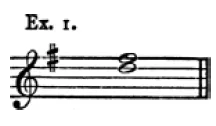
succession of single notes (Ex. 2) the ear demands that, as leading
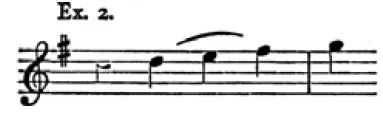
note, it shall be slightly sharper than its true frequency. That is what I mean by psychological influence, and we are faced with the above curious anomaly, which may puzzle and distress the student who is not forewarned. In his enthusiasm and thoroughness he might set himself to devise exercises in double-stopping, and he might hit upon some such simple and logical example as shown in Ex. 3. Ascending to the tonic, he would instinctively make the
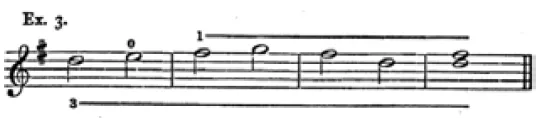
leading note very sharp. Then, dropping to the D and playing the third, he would find the two notes not in tune together. He would perhaps blame himself and his imagined imperfection of hearing, instead of realizing that every keen-eared musician would have the same difficulty to contend with, and that the difficulty had arisen, not on account of dullness in himself, but because his hearing had been true!
This brings up what will now be an obvious fact, that there is no absolutely exact spot on the finger-board for any one note. A beginner must work as though there were such an exact spot, and must diligently practise to find it, for it is, of course, necessary to learn approximate intonation—merely to play ‘in tune’—before the finer art of pure intonation can gradually be acquired.
Realizing the variableness of pitch in just intonation, a student might easily feel despondent of ever being able to achieve purity in this respect. Let him put his mind at ease! A musically sensitive ear is an almost infallible guide, and that which seems to be a physical impossibility becomes comparatively quite easy when controlled entirely by the musical intelligence and imagination. All we have to do, therefore, is to train the ear. By the ear I mean not only the critical hearing faculty, but also the musical imagination, through which a clear conception of a note is formed before the note is played. Then we must trust this sensitive intelligence, and it will lead us towards perfection. Under conditions that make just intonation practicable—as in a string quartet, for instance—we may have beauty and expressive power of tone that can never be achieved with the tempered scale. Under such conditions finely trained artists will play naturally and easily in just intonation—more easily in fact than they will adapt their playing to the tempered scale when playing with piano accompaniment.
Double-stopping may be quite easy to play, or it may be extremely difficult by reason of big stretches and strained positions of hand and fingers. This kind of difficulty can be overcome only by much intelligent hard practice and development of the hand and fingers. But except where this physical effort is necessary, double-stopping should not present great difficulty.
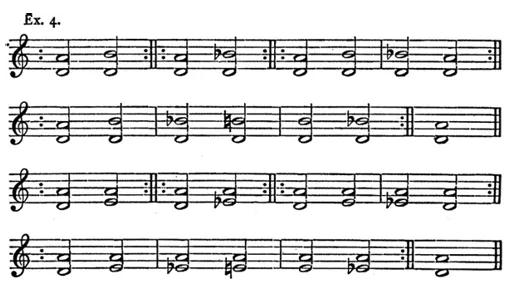
Like all other technical matters it must develop from the simplest and easiest beginnings. The easiest possible combination of two notes is two adjacent open strings. This is not, strictly speaking, a stop at all, but it is our starting point. The next step will be an open string and one stopped note, and we might devise for the beginner an exercise such as Ex. 4. This should be practised also on the A and E strings and on the G and D:
After exercising the first finger with an open string, the second finger may be used in some such way as this:

leadi...
Table of contents
- A HISTORY OF THE VIOLIN
- PREFACE
- INTRODUCTION
- I
- II
- III
- IV
- V
- VI
- VII
- VIII
- IX
- X
- XI
- XII
- XIII
- XIV
- CONCLUSION
Frequently asked questions
Yes, you can cancel anytime from the Subscription tab in your account settings on the Perlego website. Your subscription will stay active until the end of your current billing period. Learn how to cancel your subscription
No, books cannot be downloaded as external files, such as PDFs, for use outside of Perlego. However, you can download books within the Perlego app for offline reading on mobile or tablet. Learn how to download books offline
Perlego offers two plans: Essential and Complete
- Essential is ideal for learners and professionals who enjoy exploring a wide range of subjects. Access the Essential Library with 800,000+ trusted titles and best-sellers across business, personal growth, and the humanities. Includes unlimited reading time and Standard Read Aloud voice.
- Complete: Perfect for advanced learners and researchers needing full, unrestricted access. Unlock 1.5M+ books across hundreds of subjects, including academic and specialized titles. The Complete Plan also includes advanced features like Premium Read Aloud and Research Assistant.
We are an online textbook subscription service, where you can get access to an entire online library for less than the price of a single book per month. With over 1.5 million books across 990+ topics, we’ve got you covered! Learn about our mission
Look out for the read-aloud symbol on your next book to see if you can listen to it. The read-aloud tool reads text aloud for you, highlighting the text as it is being read. You can pause it, speed it up and slow it down. Learn more about Read Aloud
Yes! You can use the Perlego app on both iOS and Android devices to read anytime, anywhere — even offline. Perfect for commutes or when you’re on the go.
Please note we cannot support devices running on iOS 13 and Android 7 or earlier. Learn more about using the app
Please note we cannot support devices running on iOS 13 and Android 7 or earlier. Learn more about using the app
Yes, you can access Violin Technique - Some Difficulties and Their Solution by Sydney Robjohns in PDF and/or ePUB format, as well as other popular books in Media & Performing Arts & Music. We have over 1.5 million books available in our catalogue for you to explore.