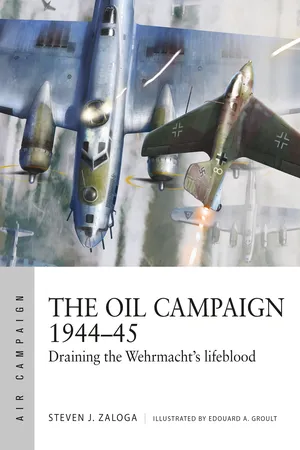
A new illustrated history of one of the key air campaigns of late World War II – the American effort to cripple Germany's oil production, and grind its armed forces to a halt.
With retreating German forces losing their oilfields on the Eastern Front, Germany was reliant on its own facilities, particularly for producing synthetic oil from coal. However, these were within range of the increasingly mighty Allied air forces. In 1944 the head of the US Strategic Air Forces, General Carl Spaatz was intent on a new campaign that aimed to cripple the German war machine by depriving it of fuel.
The USAAF's Oil Campaign built up momentum during the summer of 1944 and targeted these refineries and plants with its daylight heavy bombers. Decrypted German communications made it clear that the Oil Campaign was having an effect against the Wehrmacht. Fuel shortages in the autumn of 1944 forced the Luftwaffe to ground most of its combat units except for fighters involved in the defense of the Reich. Fuel shortages also forced the Kriegsmarine to place most of its warships in harbor except for the U-boats and greatly hampered German army campaigns such as the Battle of the Bulge in December 1944–45.
This fascinating book packed with key photos and illustrations examines the controversies and debates over the focus of the US bombing campaign in the final year of the war, and the impact it had on the war effort overall.
eBook - ePub
The Oil Campaign 1944–45
Draining the Wehrmacht's lifeblood
- 96 pages
- English
- ePUB (mobile friendly)
- Available on iOS & Android
eBook - ePub
About this book
Trusted by 375,005 students
Access to over 1.5 million titles for a fair monthly price.
Study more efficiently using our study tools.
Information
THE CAMPAIGN
Collapsing the German war economy
Mission 353: May 12, 1944
The Eighth Air Force had to wait until Friday, May 12 for sufficiently clear weather to conduct the first attack on German synthetic fuel plants. The attack included 886 bombers from all three bomber divisions, hitting 13 separate fuel facilities. Escort would be provided by 735 Eighth and 245 Ninth Air Force fighters.

A post-strike image of the Braunkohle-Benzin AG plant in Bohlen after the May 12, 1944 raid.
By now, escort tactics were being honed to a fine art. Since the fighters flew at higher cruise speeds than the bombers, it was uneconomical to have them fly directly alongside the bombers. Instead, fighter groups were assigned to three phases of the mission. In the initial penetration phase, shorter-ranged fighters escorted the bombers to the German frontier. At this point, the first group of fighters returned to base after being replaced by a larger numbers of fighter groups to conduct escort during the target attack. As the bombers withdrew, the target support fighters were then free to attack targets of opportunity in Germany before returning to base, while a third batch of fighter groups provided escort to the bombers during the withdrawal phase.
On the Luftwaffe side, Generalmajor Josef Schmid, commander of 1.Jagdkorps, finally managed to convince Generaloberst Hans-Jürgen Stumpff, the head of Luftflotte Reich, to centralize all of the divisional fighter direction centers under his I.Jagdkorps. This primarily involved subordinating the 7.Jagddivision in southern Germany that had previously been autonomous. The aim of this was to centralize the deployment of Gefechstverbanden, massed fighter forces, to strike the American bombers in unison. In addition, Schmid received permission to use single-engine “Wilde Sau” (wild boar) night-fighters in the day battle. JaFü Ostmark out of Austria added three Gruppen of fighters to the air battles that day.
As a result, the Luftwaffe response on May 12 was the first time that a concentrated effort by the entire Reich force was achieved. A total of 515 fighters took part including 40 twin-engine fighters. In the first wave, 419 fighters reached the bomber stream. Of these, I.Jagdkorps totaled 333 sorties with 266 fighters seeing combat. May 12 was in many ways the swansong of the Reich fighter force. It was the largest single concentration of German Reich defense fighters during the entire air campaign.
Luftwaffe radar stations along the Dutch coast had monitored the formation of the bomber force as they assembled over England. Mission 353 arrived over Dutch coast around 1235. However, Luftflotte Reich abstained from contesting the attack near the coast except for Flak. The plan was to attack the bombers only after they were inside Germany. Around noon, Luftflotte Reich sent instructions to the divisional centers to prepare to dispatch their Gefechtsverbanden, with the heaviest concentration in the vicinity of Frankfurt.

A remarkable view as a Me 410B-2/U4 of ZG 26 flies past a B-17G during an air battle over the Brüx synthetic fuel plant on May 12, 1944. This photo was taken from the radio compartment window of the B-17G-BO Flying Fortress named “Lady Godiva” of the 562nd Bomb Squadron, 388th Bomb Group.
Mission 353 included a diversionary attack on Cologne 1310, but this did not fool the Germans and attracted few German fighters. The Cologne attack was noteworthy in that it was the combat debut of the secret GB-1 guided glide bomb by the 41st Combat Wing. These new guided-weapons were a disappointing flop.5
Since 3.Jagddivision was closest to the “bomber Autobahn,” they were instructed to form the lead Gefechtsverband. Oberst Walter Oesau, one of the top Luftwaffe aces and commanding officer of JG 1, had been shot down and killed the day before by USAAF escort fighters. As a result, the initial Gefechtsverband was led by Oblt. Rüdiger von Kirchmayr, commander of 5./JG 1. The fighters of JG 1 were reinforced by Gefechtsverband Dachs (Badger) consisting of II./JG 27 and II./JG 53.
The usual practice at this time was to attack the bombers with the better-armed Fw 190 fighters and to use the lighter Bf 109 fighters against the American escort fighters. As a result, III./JG 1 attempted to intercept the escorting P-47 fighters of the 78th Fighter Group while the other two Gruppen headed for the B-24 bombers of the 2nd Bomber Division. The initial contact began around 1320 over the Eifel region near Bonn. The German fighters were hit by the escort fighters before they reached the bombers, and 11 Bf 109 fighters were lost in this melee. Only the II./JG 1 managed a head-on attack. JG 1 claimed 4 B-24s and 1 P-47 shot down, plus 4 B-24 “shot out of formation.”
The Luftwaffe had a complicated point scoring system for fighter claims against 4-engine bombers. The most obvious was “shot down” (Abschüße). The other two categories were “shot out of formation” (HSS/Herausschüsse) and destruction of a damaged straggler (e.V./endgültige Vernichtungen).
The heaviest concentration of German fighters occurred in the vicinity of Frankfurt-Wiesbaden-Andernach. The 1.Jagddivision Gefechtsverband was led by Major Friedrich-Karl ”Tutti” Müller, commander of JG 3. This formation consisted of three Gruppen of Bf 109 and one of Fw 190 of JG 3. They were reinforced by some single-seat night-fighters of JG 302. In the vicinity was the 2.Jagddivision Gefechtsverband consisting of two Gruppen of Fw 190 and one of Bf 109 from JG 11.
The six Gruppen found the 3rd Bomb Division west of Frankfurt and began head-on attacks with five Gruppen starting at 1328. There was a critical gap in USAAF escort coverage of about 15 minutes between the time that the penetrating support escorts headed home and the target support escorts arrived. The absence of escort fighters permitted the German fighters to concentrate on the bombers. The 3rd Bomb Division was the most severely hit, especially the 96th and 452nd Bomb Groups. In the space of less than 15 minutes, JG 3 claimed 24 B-17s shot down and 13 “shot out of formation.” The fighters from JG 11 claimed 12 B-17 and two more “shot out of formation”. In total, the 3rd Bomb Division lost 41 bombers, by far the heaviest casualties of any of the divisions taking part in Mission 383.
The melee near Frankfurt also included an example of an “ace-on-ace” fighter duel. Maj. Günther Rall had taken over command of II./JG 11 in April 1944. He was an experienced Russian front veteran and would survive the war as the third-highest ace with 275 kills. But he had no experience fighting with the USAAF. That morning, he led the Stab Schwarm (headquarters flight) that was on patrol at about 11,000 meters to deal with the American escort fighters. Below him, he spotted the P-47 Thunderbolts of 56th Fighter Group, led by fighter ace Col. Hub Zemke. Rall’s flight dove on the Americans, and Rall shot down one of Zemke’s wingmen. A neighboring flight of P-47s intervened and chased after Rall from 8,000 meters to tree-top level. His Bf 109 suffered several hits including a round that shattered his hand. He bailed out at 500 meters. After an extensive hospital stay, he returned to flight duty late in 1944. He was lucky; all three other pilots of Stab Schwarm were shot down and killed that day. In total, JG 11 lost 11 Bf 109 fighters including the aircraft of Hptm. Rolf Hermichen, a top ace and commander of I./JG 11.
The 3rd Bomb Division began its attacks around 1400 starting with raids on the synthetic plants in Zwickau and Chemnitz. The deepest target for the 3rd Bomb Division was the Sudetenländische Treibstoffwerke AG at Brüx in the Czech lands. This was hit by 140 bombers dropping 310 tons of bombs.
The 1st Bomb Division bombed the I.G. Farbin AG synthetic fuel plant at Merseburg-Leuna around 1430 totaling 224 bombers. Collateral damage included the top-secret building at Merseburg-Leuna producing heavy water for the German nuclear program. The 92nd and 93rd Combat Wings with 87 bombers hit the Wintershall AG synthetic fuel plant at Lützkendorf. The division lost two bombers.
Starting at 1500, the 14th and 96th Combat Wings of the 2nd Bomb Division totaling 115 bombers attacked the Braunkohle-Benzin AG synthetic fuel plant at Zeitz. A total of 99 bombers hit the neighboring Böhlen plant. During the 2nd Bomb Division attacks raids, 3 B-24s were lost, and 5 damaged beyond repair. Casualties were 7 wounded and 33 missing.
Besides the large-scale Luftwaffe fighter activity, the fuel plants were well defended by Flak. Total Flak activity on May 12 was 399 heavy batteries firing 32,000 rounds and 63 light batteries firing 16,770 rounds.
Overall, the 1.Jagdkorps claimed 36 bombers and 11 fighters shot down by Luftwaffe fighters plus 20 more bombers shot down by Flak. Actual USSTAF casualties for the day were 46 bombers and 14 fighters. The I.Jagdkorps losses were 78 fighters shot down or damaged in the air beyond repair (44+34) and 17 destroyed on the ground. Escorting P-38s claimed 2 German fighters, the P-47s claimed 26, and P-51s claimed 33 in the air and 5 on the ground.
The May 12 raids on the hydrogenation plants had been very effective. The Zeitz plant was hardest hit and lost 16 weeks of output. The Brüx and Tröglitz plants were shut down and lost seven weeks output while the Böhlen and Leuna plants lost half or more of their capacity.
The Luftwaffe clearly understood the significance of Mission 353. The Luftwaffe staff had already warned about the consequences of an attack on the synthetic fuel plants. The only mystery was why the Allies had waited so long. Armament minister Albert Speer later noted that “I shall never forget the day the technological war was decided. Until then, we had managed to produce as many weapons as the Wehrmacht needed, in spite of their considerable losses. But with the attack of the 935 daylight bombers of the American Eighth Air Force upon several fuel plants in central and eastern Germany, a new era i...
Table of contents
- Cover
- Title Page
- Table of Contents
- Introduction
- Chronology
- Attacker’s Capabilities
- Defender’s Capabilities
- Campaign Objectives
- The Campaign
- Analysis
- Further Reading
- eCopyright
Frequently asked questions
Yes, you can cancel anytime from the Subscription tab in your account settings on the Perlego website. Your subscription will stay active until the end of your current billing period. Learn how to cancel your subscription
No, books cannot be downloaded as external files, such as PDFs, for use outside of Perlego. However, you can download books within the Perlego app for offline reading on mobile or tablet. Learn how to download books offline
Perlego offers two plans: Essential and Complete
- Essential is ideal for learners and professionals who enjoy exploring a wide range of subjects. Access the Essential Library with 800,000+ trusted titles and best-sellers across business, personal growth, and the humanities. Includes unlimited reading time and Standard Read Aloud voice.
- Complete: Perfect for advanced learners and researchers needing full, unrestricted access. Unlock 1.5M+ books across hundreds of subjects, including academic and specialized titles. The Complete Plan also includes advanced features like Premium Read Aloud and Research Assistant.
We are an online textbook subscription service, where you can get access to an entire online library for less than the price of a single book per month. With over 1.5 million books across 990+ topics, we’ve got you covered! Learn about our mission
Look out for the read-aloud symbol on your next book to see if you can listen to it. The read-aloud tool reads text aloud for you, highlighting the text as it is being read. You can pause it, speed it up and slow it down. Learn more about Read Aloud
Yes! You can use the Perlego app on both iOS and Android devices to read anytime, anywhere — even offline. Perfect for commutes or when you’re on the go.
Please note we cannot support devices running on iOS 13 and Android 7 or earlier. Learn more about using the app
Please note we cannot support devices running on iOS 13 and Android 7 or earlier. Learn more about using the app
Yes, you can access The Oil Campaign 1944–45 by Steven J. Zaloga,Edouard A. Groult in PDF and/or ePUB format, as well as other popular books in History & Military & Maritime History. We have over 1.5 million books available in our catalogue for you to explore.