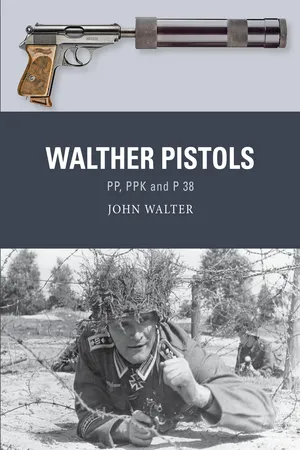
While the PP and PPK were intended for police work, the Walther P 38 was produced for the Germany military; all three pistols have garnered a formidable international reputation since the 1930s.
The innovative Walther PP (Polizeipistole), a double-action semi-automatic pistol intended for the law-enforcement market, became available in 1929 and went on to arm the police of several European countries in the 1930s. Its smaller cousin the PPK, more readily concealed for undercover work but with reduced magazine capacity, was produced from 1931. Intended to replace the P 08 Luger, the Walther P 38 was issued from 1940 and equipped the armed forces of Germany and other countries during and after World War II, but never entirely replaced the Luger in German service.
All three pistols went on to have lengthy and varied service across the world after 1945. Both the PP and the PPK remain in production today, while the P 38 re-emerged as the P1 and equipped West German forces from 1963 until 2004, when it was replaced by the P8.
In this study, noted authority John Walter assesses the origins, development, use and legacy of these three high-profile semi-automatic pistols, alongside other Walther variants, such as the tiny .25 ACP Modell 9.
- 80 pages
- English
- ePUB (mobile friendly)
- Available on iOS & Android
eBook - ePub
About this book
Trusted by 375,005 students
Access to over 1.5 million titles for a fair monthly price.
Study more efficiently using our study tools.
Information
USE
The PP, PPK and P 38 in service
The Polizei-Pistole was the first handgun of its type to be successful not only commercially but also in a military context. There can be no doubt that the Walther family’s amicable relationship with high-ranking members of the NSDAP (Nationalsozialistische Deutsche Arbeitpartei; National Socialist German Workers’ Party) proved beneficial, but success was also due to good-quality manufacture and advanced design, particularly of the trigger and safety systems, which allowed Polizei-Pistolen to be carried with a cartridge in the chamber, to be fired simply by pulling through on the trigger without the need to release the safety catch. This could mean the difference between life and death in battlefield combat or for a policeman encountering a miscreant in a back-alley.

The ‘eagle/N’ proof marks date 7.65mm Heeres-Pistole no. 3259, the commercial exposed-hammer predecessor of the P 38, to 1940. (Morphy Auctions, www.morphyauctions.com)
THE PP AND PPK IN GERMAN SERVICE TO 1945
Polizei-Pistolen were widely favoured by police, paramilitary and military authorities alike. Their compact dimensions suited them to airmen and tank crews in particular, but many Heer (Army) officers, as a rule, acquired examples privately.
The German political formations began to buy Polizei-Pistolen as early as 1935–36, when PPs and PPKs were numbered in a single cumulative block. In 1938, however, the series was split when serial number 1000000 was reached. Numbering then recommenced at 100001P and 172001K though it seems that PPK stragglers, perhaps already complete, had serial numbers running as high as 100700 without a suffix.
A few PPKs in two different serial-number blocks had been given ‘W’-suffix numbers, the purpose of which is no longer clear, and some PPKs issued to the RSHA (SS) had the ‘K’ suffix below the serial number. Production continued until the end of World War II, when PPK serial numbers had reached the low 430000 block and continued with an ‘A’ suffix. The highest known serial numbers are 431115K and 433521A for the PPK, compared with 399990P for a standard Polizei-Pistole.
Fritz Walther’s success at the expense of his rivals had been assured when the PPK became the Ehrenwaffe des Politischen Leiters (‘presentation weapon of the political leadership’). The RZM mark lay on the left side of the slide, immediately ahead of the safety-catch thumbpiece. This required a special marking die, as the lettering had to be condensed to accommodate the RZM mark. Pistols delivered after February 1938 had special brown plastic grips, on which a displayed eagle, grasping an enwreathed swastika, looks to its left. Most of these pistols are numbered after 172001K, but purchases continued even after production for the German armed forces had been prioritized. PPKs with Parteileiter (‘Party leader’) grips bearing low serial numbers are either fakes or were subsequently embellished by their owners.
Ironically, because the Walther company could only produce a comparatively limited number, demand for Polizei-Pistolen soon outstripped supply, and in doing so assured the success of competitors such as the Mauser HSc and Sauer 38H.
MARKS FOUND ON THE PP AND PPK
In terms of proof marks, Polizei-Pistolen originally bore the commercial crown over N (‘crown/N’) nitro proof mark, until this was replaced by law – with effect from 1 April 1940 – by an ‘eagle/N’ proof mark. Serial numbers suggest that virtually all pistols below 143500P and 242165K display a ‘crown/N’; that the official changeover occurred somewhere in the region of 162000P and 255000K; and that almost all pistols numbered above 184300P and 261000K have the ‘eagle/N’ proof mark.
Turning to property and unit marks, Polizei-Pistolen usually bear a large eagle-and-swastika mark accompanied by ‘C’ or ‘F’, the swastika being stylized into a circle. Police-unit marks are much more rarely found on Walthers than on the P 08 and its accessories. A few examples applied in accordance with regulations published for the Prussian police in 1932 have been reported, such as ‘L.St.’ and ‘S.An.’ for Landjägerei Stettin and Schutzpolizei Aachen respectively, but Bavarian police marks such as ‘P.D.M.’ or ‘P.D.N.’ – Polizei Direktion München (Munich Police Department) and Polizei Direktion Nürnberg (Nuremberg Police Department) respectively – are more common. Pistols used in Berlin often displayed a mark now usually termed a ‘rosette’, while ‘Rplt.’, for Rigspolitiet (state police), indicated use in Denmark after the end of World War II. Walthers used in Norway are usually marked ‘Politi’.
Other marks include: ‘C.P.B.’ on PPKs purchased on behalf of the Commerz- und Privatbank; ‘DRP’ or ‘D.R.P.’, usually on the grip straps of PPs and PPKs serving with the Deutsche Reichspost (postal service); and ‘NSKK’ or ‘N.S.K.K.’, on PPs and PPKs used by the NSKK (Nationalsozialistisches Kraftfahrkorps; state transport service). NSKK Polizei-Pistolen are particularly rare. Many of them had a special slide-inscription die in which the standard Walther legend was narrowed to make room for the NSKK eagle Hoheitsabzeichen (national emblem). Observed serial numbers currently range from 779066 to 200733P. ‘RB’ is widely associated with pistols acquired for the Reichsbank, but will be found only on their boxes.. ‘RBD’ is found on PPs and a few PPKs acquired by the Reichsbahndirektionen (state railway network), often accompanied by the depot name in full, e.g. Halle, Münster or Stuttgart. ‘R.F.V.’ is found on PPs and PPKs acquired by the Reichsfinanzverwaltung (state treasury), though these are sometimes mistakenly identified with the Reichsförstverwaltung (forestry service). ‘R.J.’ is found on Polizei-Pistolen used to arm court-guards and prisoner escorts under the aegis of the Reichsjustizministerium (ministry of justice). ‘RZM’, encircled, denotes the Reichszeugmeisterei (state material control office), which accepted PPs and PPKs for all the groups affiliated with the NSDAP (National Socialist German Workers’ Party). ‘RRZ’ may be found on Polizei-Pistolen issued to personnel of the Reischsrundfunkzentrale (state radio service). ‘S.A.’ or, more rarely, ‘S.A. der N.S.D.A.P.’ identifies SA (Sturm Abteilung; assault detachment) pistols which may also have an inventory mark on the front-grip strap, or the name of the SA-Gruppe in full – e.g. ‘SA der NSDAP’ over ‘Gruppe Thüringen’.
To conclude with inspectors’ marks, police eagle-and-swastika marks are usually accompanied by a letter – ‘C’ or ‘F’ on Walthers – which proved, despite many claims to the contrary, to be the principal inspector’s mark. Inspector ‘C’ accepted PPs numbered below about 350000P and PPKs below 410000; inspector ‘F’ then replaced ‘C’, continuing to approve pistols numbered as high as 375000P and 430000K. The mark of the principal Waffenamt (weapons agency) inspector supervising the Zella-Mehlis sub-bureau, whose personal number was 359, will be found beneath tiny stylized eagle marks on Polizei-Pistolen accepted for military service.

The Walther family’s close ties with the NSDAP assured that the PPK was adopted as the Ehrenwaffe des Politischen Leiters. This pistol – no. 829787, shown with its original Anuschat-style AKAH (Albrecht Kind GmbH) holster – dates from 1935. The eagle-and-swastika motif on the grips and the RZM mark on the left side of the slide characterize this pattern, though many otherwise-standard pistols will be found with Parteileiter (‘Party leader’) grips subsequently fitted by their owners. (Amoskeag Auctions, www.amoskeagauction.com)
Presentation Polizei-Pistolen
Some pistols, usually from pre-war production, were specially finished; some were nickel-plated, others were matt-chromed, and a few were even etched or engraved for special presentation. Gold plating and inlaying, gilding and silver finishing were also occasionally used, although the vast majority of pistols were quite standard. A few even had experimental grey phosphate finishes.
Walther PPs and PPKs were among the most popular of the many pistols presented by or to high-ranking military and NSDAP officials. This was at least partly due to the adoption of the PPK as the Ehrenwaffe des Politischen Leiters, but also to links between individual members of the Walther family and the NSDAP. An ornate pistol bearing ‘Ehrengabe der Familien Walther’ (‘honorary gift from the Walther families’) on the left side of the slide was presented to Adolf Hitler in 1939, in celebration of his 50th birthday. On 30 April 1945, Hitler swallowed a cyanide capsule and shot himself with a PPK, but the birthday-gift pistol was subsequently found in his Munich flat.
German police encounter a looter, summer 1944

In a German city reduced to rubble by Allied bombing, two policemen confront a looter absconding with a valuable painting. The Ordnungspolizei (uniformed police) man fires his Walther P 38 at the looter, while his Kriminalpolizei (plainclothes police) colleague shelters behind a wall while reloading his PPK. The looter has responded by firing a Luger in the direction of his adversaries.
Walthers were conferred on individual recipients by men such as Heinrich Himmler and Fritz Sauckel. Though some of the surviving pistols are in comparatively poor condition, they all show evidence of high-quality engraving and extensive use of gold-plating.
A common error is the ‘factory engraving’ attribution of all PPs and PPKs. Within the Zella-Mehlis factory, however, the engraving department was not only minuscule but also dealt principally with hunting rifles. Engraving work on pistols was customarily subcontracted to local craftsmen, the 1939 edition of the Deutsches Reichs-Adressbuch listing Friedrich and Wilhelm Schilling in Suhl and Franz and Otto Zöller in Zella-Mehlis among others. Small batches of pistols, unhardened, were set aside for the purpose. Consequently, dates of production ...
Table of contents
- Cover
- Title Page
- Table of Contents
- Introduction
- Development
- Use
- Impact
- Conclusion
- Bibliography
- eCopyright
Frequently asked questions
Yes, you can cancel anytime from the Subscription tab in your account settings on the Perlego website. Your subscription will stay active until the end of your current billing period. Learn how to cancel your subscription
No, books cannot be downloaded as external files, such as PDFs, for use outside of Perlego. However, you can download books within the Perlego app for offline reading on mobile or tablet. Learn how to download books offline
Perlego offers two plans: Essential and Complete
- Essential is ideal for learners and professionals who enjoy exploring a wide range of subjects. Access the Essential Library with 800,000+ trusted titles and best-sellers across business, personal growth, and the humanities. Includes unlimited reading time and Standard Read Aloud voice.
- Complete: Perfect for advanced learners and researchers needing full, unrestricted access. Unlock 1.5M+ books across hundreds of subjects, including academic and specialized titles. The Complete Plan also includes advanced features like Premium Read Aloud and Research Assistant.
We are an online textbook subscription service, where you can get access to an entire online library for less than the price of a single book per month. With over 1.5 million books across 990+ topics, we’ve got you covered! Learn about our mission
Look out for the read-aloud symbol on your next book to see if you can listen to it. The read-aloud tool reads text aloud for you, highlighting the text as it is being read. You can pause it, speed it up and slow it down. Learn more about Read Aloud
Yes! You can use the Perlego app on both iOS and Android devices to read anytime, anywhere — even offline. Perfect for commutes or when you’re on the go.
Please note we cannot support devices running on iOS 13 and Android 7 or earlier. Learn more about using the app
Please note we cannot support devices running on iOS 13 and Android 7 or earlier. Learn more about using the app
Yes, you can access Walther Pistols by John Walter,Adam Hook,Alan Gilliland in PDF and/or ePUB format, as well as other popular books in History & Military & Maritime History. We have over 1.5 million books available in our catalogue for you to explore.