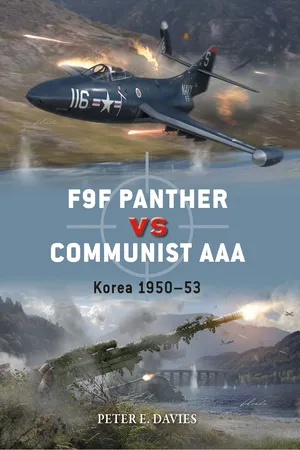
A detailed look at the deadly battle between US Navy F9F Panther jet fighter-bombers and communist anti-aircraft artillery (AAA) defenses that proliferated throughout the Korean War.
The F9F Panther was one of the many fighters converted for ground-attack duties, following an established US tradition. Originally designed as a jet fighter, in April 1951 it became the first jet to launch from a carrier with bombs loaded, using them to destroy a crucial railway bridge at Songjin. The Panther's four 20 mm guns were considered to be very effective for flak suppression and these aircraft were used as escorts for propeller-driven AD Skyraider and F4U Corsair attack aircraft. However, later in 1951, flak damage to Panthers increased as the Chinese established better AAA weapons to defend key transport routes. The communist AAA crews had heavy guns of 37 mm caliber and above. Gunners could use optical height finders, predictors and in many cases radar control. They learned to conceal their weapons in civilian buildings, use wires to bring aircraft down, and set up false targets as "flak traps."
Both opponents' tactics and gunnery are explored in depth in this study of the F9F Panthers and of their adversaries. Containing full-color illustrations including cockpit scenes and armament views, this innovative volume also includes a detailed analysis of the US Navy Panthers' loss rates and their causes.
- 80 pages
- English
- ePUB (mobile friendly)
- Available on iOS & Android
eBook - ePub
About this book
Trusted by 375,005 students
Access to over 1.5 million titles for a fair monthly price.
Study more efficiently using our study tools.
Information
COMBAT
For the F9F’s first combat deployment, with VF-51 and VF-53 in CVG-5 embarked in Valley Forge, 28 Panthers and 40 pilots were available to TF 77. The units’ preparation for combat was minimal as Lt Don Engen recalled. “In terms of tactics, We had the ‘Thach weave’ and the ‘fluid four’. We knew we had something that nobody had had before which was speed and power, so we tried to devise tactics to use these. Our only ‘targets’, however, prior to entering combat were either prop airplanes from the air group or other Panthers. We were always attacking somebody who had either less or equal performance to us.
“Once on cruise, we kept running into the mindset where senior personnel within the ship’s company were afraid of us flying in case we could not get back aboard. This meant we were actually flying just four hours a month, and that’s dangerous when conducting operations at sea.”
CVG-5 entered combat on July 3 when it attacked airfields around Pyongyang in conjunction with Fleet Air Arm Fireflies and Seafires from Triumph. Twenty-eight AD-4 Skyraiders (from VA-55) and F4U Corsairs (from VF-53 and VF-54) took part, while the Panther squadrons weighed in with their first combat sorties led by the Commander Air Group (CAG), Cdr Harvey Lanham, with Lt Engen as his section leader. The latter recalled, “Aside from CAG Lanham’s four jets, [Lt Cdr] Dave Pollock [CO of VF-51] had four airplanes and so did [Lt Cdr] Bill Lamb [CO of VF-52]. It was a wild melée. There were lots of targets, and we did the first pre-emptive strike in Korea. Although I was chasing a Yak and I just about had him boresighted, Harvey called me back.”
The F9F pilots’ main purpose that day was to strafe enemy aircraft on several airfields and fend off any aerial opposition. Seventeen NKPAF aircraft were destroyed in revetments on the ground in two attacks on the 3rd and in follow-up raids on July 4. Lt Engen flew F9F-3s BuNos 123069 and 123023, and his logbook for the 3rd includes the brief entries “Sweep on Pyongyang. 1 Yak and 1 DC-3” for the morning mission and “1 Yak and 5 freight cars” in the afternoon. The squadron would fly 436 fighter sweeps during its 1950 war cruise.
F9F-5 PANTHER GUN ARMAMENT

1. Detachable nose cone
2. Gun ports and blast shields
3. Forward gun support
4. AN/ARN-6 radio compass mounting
5. Electronics units
6. Left M3 20mm cannon
7. Left 20mm ammunition box
8. Right 20mm ammunition box
9. Electrical leads
10. Battery
11. Left ammunition tracks
12. Lower nose compartment
13. Mk 6 Mod 0 gun/weapons sight
14. Bulletproof windshield
15. Grumman ejection seat
16. Canopy slide mechanism
17. Air brakes (retracted)
18. Boarding ladder (retracted)
19. Forward armor plating
20. Aft seatback armor plating
The US Navy’s first aerial success with jets also came on July 3. VF-51’s Lt(jg) Leonard H. Plog and his wingman were strafing an airfield when they saw a Yak-9P piston-engined fighter taking off. When Plog moved in for a stern attack as the Yak climbed to 350ft, another Yak-9P made an unsuccessful firing pass at him from his left side. A third Yak-9P then appeared and moved in on CAG Lanham and his wingman, Lt Bill Gormley. Ens “Little” Ed Brown quickly closed in on the Yak and severed its tail section with 20mm fire from very short range, while Plog, in F9F-3 BuNo 123071, pursued his target “on the deck” and shot the right wing off the NKPAF fighter with a short burst of 20mm fire. As Lt Engen pointed out:
Those four 20s were like a can opener. You loaded them with armor-piercing tracer, HEI [high explosive incendiary] and antipersonnel rounds. That combination could blow up locomotives and sink ships. When the four 20s hit in a focus point, things happened.
The pilots flew fairly flat strafing runs, giving them a longer time to sight their targets. They also discovered that the F9F yawed at high speed, spoiling accurate strafing. Improvements came from using the speed brakes to slow down, but this reduced hydraulic pressure and the guns stopped firing.
Brown and Plog used up their ammunition on aircraft hidden in haystacks, vehicles, the control tower, and a fuel dump, returning in the afternoon for another strike. Plog reported that “anti-aircraft fire was minimal on both strikes.” He noticed that the gunners took a long time to adjust to the higher speeds of the unfamiliar jets, so that their shells were detonating up to 1,500ft behind them.
These early “group grope” missions established a routine that applied for the rest of the war, but required careful timing. Attack squadron Skyraiders and Corsairs left the carrier first, followed by the jets, which caught them up just before the target, provided cover over it, and protected their withdrawal. The F9Fs’ shorter endurance limited the time ADs and F4Us could spend attacking their targets.
Although the Panther’s quartet of 20mm cannon were at first the aircraft’s only weapon, they could be extremely effective for both flak suppression and the destruction of ground targets. On VF-191’s first combat cruise, embarked in Princeton, two jets hit K-27 Yonpo airfield on December 21, 1950. Post-strike assessment reported “70 cases of rockets were exploded by strafing. One gun emplacement was damaged. Strafing caused 14 fires among oil and gas drums.” The following day, former Blue Angels pilot Lt J. H. Robcke led a section of F9F-2s to a village, where “50 to 60 drums of oil were strafed and destroyed.”
For the first few months of operations over Korea, TF 77’s carrier-based aircraft primarily flew armed reconnaissance sorties as CVG-5 pioneered the use of jets operating alongside propeller-driven aircraft. Eventually, F9Fs would range from the east coast north of the town of Hamhung – where VF-23’s flak-suppressing Panthers would silence 85mm guns at marshaling yards on August 3, 1952 – to Kwangju, on the western side of North Korea, and north to Namwon and Kaesong.
Some missions could be pre-planned, but often pilots were given routes and told to find likely targets. Manhandling two or three large 1:250,000 L-552 maps in the cockpit in fast, low-altitude flight became a daily challenge. Known flak sites were marked on the L-552s. Attacks on fixed sites like airfields, bridges, and power stations could be briefed in detail, but pilots also strafed targets of opportunity, including vehicles, trains (the weight of fire from four 20mm cannon could explode a locomotive’s boiler), boats, troop concentrations, and even ammunition-bearing camel caravans.
The KPA soon became adept at using natural terrain and foliage to camouflage its parked up vehicles and supplies during the hours of daylight. Pilots had to fly as low as possible to see beneath such disguises, risking AAA at close quarters or possibly striking high ground while attempting to avoid gunfire.
Armed reconnaissance missions often yielded outstanding results in the early months of the war, when AAA defenses were light. For example, seven VF-51 Panthers were on a mission along the eastern Korean coast on July 18, 1950 when they “discovered” the Wonsan oil refining plant, capable of producing 500 gallons of petroleum daily. Later that same day, a TF 77 strike group reduced it to rubble.

F9F-2B BuNo 123443 from VF-112 floats on the water following an unsuccessful launch from Philippine Sea off Mokpo-Kwang-Ju on August 7, 1950. Its pilot, Cdr Ralph Weymouth (CAG of CVG-11), can be seen standing in the cockpit of his jet awaiting rescue. This aircraft, which had suffered an engine failure seconds after departing its carrier, was the first of three Panthers lost during the deployment. (US Navy)
Lt Don Engen flew some of the first road reconnaissance missions undertaken by Panthers. “We would send two F9Fs along a road for 150 miles, two more F9Fs on another road and two to cover a rail line. With the elimination of the NKPAF, there was no air opposition. We had the skies all to ourselves. We set about trying to interdict transportation to the maximum extent. Once we finished with the airplanes on their airfields, we went after ships, then trains. We were always going after trains.”
Sections of F9Fs flew with one aircraft at an altitude of 50–100ft and a second following higher so that it could immediately attack targets found by the “low” jet. Lt Engen’s regular wingman, Ens John Nyhuis, became the first F9F pilot to fall victim to ground fire when, on August 12, 1950, his jet was hit by 40mm AAA while the pair were strafing a train. The Panther crashed shortly thereafter, and no trace of Nyhuis was ever found.
B-26 and B-29 bombers destroyed many bridges and stretches of railway track, but the resourceful KPA soon bridged gaps in the supply lines by using human porters, often Chinese conscripts. Panthers and other fighter-bombers were tasked with trying to interdict such stretches of the logistical network with armed reconnaissance sorties. During its first fortnight of action, CVG-5 flew nearly 600 sorties – many of them against supply lines.
CVG-5 had the dubious distinction of suffering the first ditching by a US Navy jet involved in Korean War operations when an F9F-3 from VF-51 had a “cold shot” (insufficient pressure in the catapult to achieve a safe launch speed) on July 16, 1950. The Panther’s wingtip and undercarriage clipped the water, cartwheeling the jet to an abrupt halt. The stunned pilot was quickly rescued by the carrier’s HO3S-1 plane guard helicopter. During the third “cold shot” of the cruise, on August 12, the VF-51 pilot involved was able to raise his gear before the jet “skimmed” into the sea. He duly climbed out while the F9F remained afloat.
Five days earlier, Philippine Sea, which had only been on station for 48 hours, also lost an F9F-2B (from VF-112) when it suffered an engine failure moments after launching. Its pilot, CVG-11 CAG Cdr Weymouth, was quickly rescued. The ordnance-carrying capabilities of CVG-11’s two F9F-2B squadrons were urgently needed to help save embattled UN forces trapped in a small area around Pusan.
Traveling mostly at night, communist troops had advanced southward totally undetected until they were finally spotted by US Navy photo-reconnaissance aircraft attempting to complete their flanking m...
Table of contents
- Cover
- Title Page
- Table of Contents
- Introduction
- Chronology
- Design and Development
- Technical Specifications
- The Strategic Situation
- The Combatants
- Combat
- Statistics and Analysis
- Aftermath
- Further Reading
- eCopyright
Frequently asked questions
Yes, you can cancel anytime from the Subscription tab in your account settings on the Perlego website. Your subscription will stay active until the end of your current billing period. Learn how to cancel your subscription
No, books cannot be downloaded as external files, such as PDFs, for use outside of Perlego. However, you can download books within the Perlego app for offline reading on mobile or tablet. Learn how to download books offline
We are an online textbook subscription service, where you can get access to an entire online library for less than the price of a single book per month. With over 1.5 million books across 990+ topics, we’ve got you covered! Learn about our mission
Look out for the read-aloud symbol on your next book to see if you can listen to it. The read-aloud tool reads text aloud for you, highlighting the text as it is being read. You can pause it, speed it up and slow it down. Learn more about Read Aloud
Yes! You can use the Perlego app on both iOS and Android devices to read anytime, anywhere — even offline. Perfect for commutes or when you’re on the go.
Please note we cannot support devices running on iOS 13 and Android 7 or earlier. Learn more about using the app
Please note we cannot support devices running on iOS 13 and Android 7 or earlier. Learn more about using the app
Yes, you can access F9F Panther vs Communist AAA by Peter E. Davies,Jim Laurier,Gareth Hector in PDF and/or ePUB format, as well as other popular books in History & 20th Century History. We have over 1.5 million books available in our catalogue for you to explore.