In March 1941, an anti-German coup in the Kingdom of Yugoslavia prompted Hitler to order an invasion using allied Italian, Hungarian, Bulgarian and Romanian forces. Operation Marita was an invasion of Yugoslavia and simultaneously Greece.
At the same time, the constituent region of Croatia broke away from Yugoslavia and joined the Axis powers. Royal Yugoslav armed forces, despite advancing against the Italians in Albania were forced to surrender after 11 days' fighting and some 1,000 soldiers, airmen and sailors escaped to British-occupied Egypt to form Free Yugoslav units. From there, guerrilla resistance to the Axis occupiers broke out and continued with increasing strength until the end of the war under Mihailovic's royalist 'Chetniks' and Tito's Communist 'Partisans' (both supported by Britain).
However, hostilities between the two movements eventually led to the Chetniks entering into local agreements with Italian occupation forces and Britain switching its support entirely to the Partisans. The advance of the Red Army increased Partisan strength and, during 1944–45, they created what could be described as a lightly equipped conventional army.
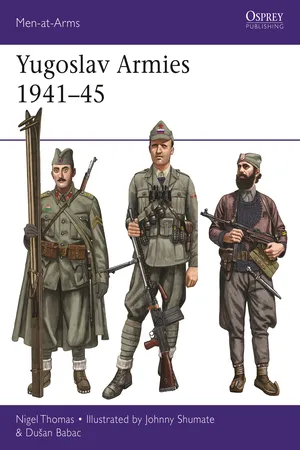
Featuring meticulously-drawn illustrations of different insignia, uniforms and equipment from each faction, this volume describes, in detail, both the political and military implications of the war and how it was fought, setting the scene for the subsequent rise of Tito to power within Yugoslavia.
- 48 pages
- English
- ePUB (mobile friendly)
- Available on iOS & Android
eBook - ePub
Yugoslav Armies 1941–45
About this book
Trusted by 375,005 students
Access to over 1.5 million titles for a fair monthly price.
Study more efficiently using our study tools.
Information
PLATE COMMENTARIES

1: Kapetan I kl., Infantry – Mech Bn
2: Armijski djeneral
3: Kaplar, Infantry
A: YUGOSLAV ARMY, APRIL 1941
A1: Kapetan I klase, Infantry – Mechanized Battalion
This officer wears an M1939 šajkača field cap with dark red infantry piping, and M1939 officers’ badge. The M1922 officer’s greatcoat has branch-colour buttoned ‘spearhead’ collar patches; branch-colour edge-piping to the collar, front and cuffs; and shoulder straps of rank on branch-colour underlay, displaying the Mechanized Bn branch badge introduced July 1940 (see Chart 1, Yugoslav Army rank insignia, 9 August 1923–18 April 1941, item 8). He wears an M1937 belt with a single cross-brace and the suspension strap for the M1939 dress dagger. His field equipment comprises an M1922 Adrian helmet, binoculars, and (obscured here) a holstered pistol and a mapcase.
A2: Armijski djeneral
The officer’s M1939 peaked (visored) cap has light blue general officers’ piping at the crown seam and band edges, and the M1939 officers’ capbadge (though many generals preferred to wear the M1922 stiffened, peaked šajkača ). The dolman undress jacket worn over his tunic has gold collar patches and light blue collar- and cuff-piping, with both sleeve- ranking and shoulder straps (see Chart 1, Yugoslav Army rank insignia, 9 August 1923–18 April 1941, item 2). The M1922 officers’ field tunic has a light blue standing collar; note the generals’ 2 broad red seam-stripes on the breeches, and the gold-braided šajkača tucked under his belt, which he wears with both support straps. At his throat, note the Order of the White Eagle with Swords.
A3: Kaplar, Infantry
This lance-corporal wears an Adrian helmet in greenish-grey with a Yugoslav frontal plate. His greenish-grey M1924 koporan field tunic shows large branch-colour collar patches, and the single silver rank-star on the shoulder straps. His matching trousers are worn with puttees and ankle boots. He carries M1924 field equipment with 2 rifle ammunition pouches on the M1933 belt, a slung M1924 waterbottle, and (obscured here) the M1924 ‘breadbag’ haversack and M1927 gasmask. The standard rifle was initially the M1924 7.92mm Mauser made by FN Herstal, but later the virtually identical ‘M24’ licence-built at the Kragujevac arsenal.

1: Podnarednik, 3rd Bn, 1st Mtn Inf Regt
2: Redov, Guards Cavalry Bde
3: Narednik vodnik III kl., AA Artillery
B: YUGOSLAV ARMY, APRIL 1941
B1: Podnarednik, 3rd Battalion, 1st Mountain Infantry Regt
This corporal wears the M1922 šajkača with M1934 NCO cockade. His M1932 mountain tunic, with 4 external pockets and horizontal cuff-flaps, has infantry collar patches with a brass battalion number and a silver NCOs’ button, and shoulder straps with the brass horn branch badge (but no regimental number in wartime). On his right breast is the coloured enamel mountain qualification badge, and on both sleeves 2 M1932 yellow rank chevrons. He has windproof ‘plus-four’ trousers, long and short socks and climbing boots. A cloak hangs from a back-strap over the same field equipment as A3, and note skis and ski-stic...
Table of contents
- Cover
- Title Page
- Table of Contents
- Introduction
- The Yugoslav Army in 1941
- The April War, 6–18 April 1941
- Royal Yugoslav Forces in the Middle East, 1941–45
- Yugoslav Army in the Homeland, 1941–45
- Yugoslav People’s Liberation Army, 1941–45
- Select Bibliography
- Plate Commentaries
- eCopyright
Frequently asked questions
Yes, you can cancel anytime from the Subscription tab in your account settings on the Perlego website. Your subscription will stay active until the end of your current billing period. Learn how to cancel your subscription
No, books cannot be downloaded as external files, such as PDFs, for use outside of Perlego. However, you can download books within the Perlego app for offline reading on mobile or tablet. Learn how to download books offline
Perlego offers two plans: Essential and Complete
- Essential is ideal for learners and professionals who enjoy exploring a wide range of subjects. Access the Essential Library with 800,000+ trusted titles and best-sellers across business, personal growth, and the humanities. Includes unlimited reading time and Standard Read Aloud voice.
- Complete: Perfect for advanced learners and researchers needing full, unrestricted access. Unlock 1.5M+ books across hundreds of subjects, including academic and specialized titles. The Complete Plan also includes advanced features like Premium Read Aloud and Research Assistant.
We are an online textbook subscription service, where you can get access to an entire online library for less than the price of a single book per month. With over 1.5 million books across 990+ topics, we’ve got you covered! Learn about our mission
Look out for the read-aloud symbol on your next book to see if you can listen to it. The read-aloud tool reads text aloud for you, highlighting the text as it is being read. You can pause it, speed it up and slow it down. Learn more about Read Aloud
Yes! You can use the Perlego app on both iOS and Android devices to read anytime, anywhere — even offline. Perfect for commutes or when you’re on the go.
Please note we cannot support devices running on iOS 13 and Android 7 or earlier. Learn more about using the app
Please note we cannot support devices running on iOS 13 and Android 7 or earlier. Learn more about using the app
Yes, you can access Yugoslav Armies 1941–45 by Nigel Thomas,Dusan Babac,Johnny Shumate in PDF and/or ePUB format, as well as other popular books in History & 20th Century History. We have over 1.5 million books available in our catalogue for you to explore.