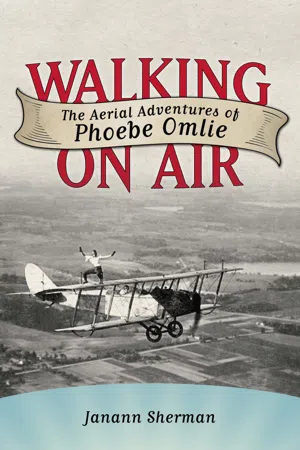
Aviation pioneer Phoebe Fairgrave Omlie (1902–1975) was once one of the most famous women in America. In the 1930s, her words and photographs were splashed across the front pages of newspapers across the nation. The press labeled her "second only to Amelia Earhart among America's women pilots, " and First Lady Eleanor Roosevelt named her among the "eleven women whose achievements make it safe to say that the world is progressing." Omlie began her career in the early 1920s when aviation was unregulated and open to those daring enough to take it on, male or female. She earned the first commercial pilot's license issued to a woman and became a successful air racer. During the New Deal, she became the first woman to hold an executive position in federal aeronautics. In Walking on Air, author Janann Sherman presents a thorough and entertaining biography of Omlie. In 1920, the Des Moines, Iowa, native bought herself a Curtiss JN-4D airplane and began learning how to fly and perform stunts with her future husband, pilot Vernon Omlie. She danced the Charleston on the top wing, hung by her teeth below the plane, and performed parachute jumps in the Phoebe Fairgrave Flying Circus. Using interviews, contemporary newspaper articles, archived radio transcripts, and other archival materials, Sherman creates a complex portrait of a daring aviator struggling for recognition in the early days of flight and a detailed examination of how American flying changed over the twentieth century.
- 196 pages
- English
- ePUB (mobile friendly)
- Available on iOS & Android
eBook - ePub
About this book
Trusted by 375,005 students
Access to over 1.5 million titles for a fair monthly price.
Study more efficiently using our study tools.
Information
Chapter One
Aviation pioneer Phoebe Fairgrave Omlie was once one of the most famous women in America. In the 1930s, her words and photographs were splashed across the front pages of newspapers across the nation. The press called her “second only to Amelia Earhart Putnam among America’s women pilots,” and First Lady Eleanor Roosevelt named her among the “eleven women whose achievements make it safe to say that the world is progressing.”
Phoebe Fairgrave began her career in the early 1920s when aviation was unregulated and wide open to those daring enough to take it on, male or female. She bought a plane, established her own flying circus, and did stunts for the movies. She later earned the first commercial pilot’s license issued to a woman and became a successful air racer. During the New Deal, she became the first woman to hold an executive position in federal aeronautics. For twenty years, she was centrally involved in the development of commercial and private aviation policy and production.
Yet somehow she got lost to history.
She was forgotten partly because of the long shadow of Amelia Earhart, which has obscured the achievements of many daring women pilots, and partly because of the sad circumstances of her decline and death. She died in poverty and obscurity. Personal papers, documents of her life and achievements, were scattered and gone.
She grew up rootless and perhaps that helped shape what she was to become, although one should be cautious about overdetermining a life. She was born into a troubled marriage between Madge Traister and Harry John “Jack” Park, a day laborer, in Des Moines, 21 November 1902, two years behind her only sibling, Paul. Named for her maternal grandmother, Phoebe Jane was six when her parents divorced in 1908.1 Although Madge told her children that their father had died, Jack Park had a distressing way of turning up occasionally until his actual death in a car accident in Missouri in 1962.2 At least twice in later years, Jack tried to make contact with his children: in 1943, he knocked on his son’s door in Omaha, and he once tried to speak to Phoebe after an air meet in Cleveland, but she rebuffed him with the remark that he couldn’t be her “real” father, her father was dead.3
Three years after the Parks divorced, Madge married Andrew E. Fairgrave, who was himself divorced from a childless marriage. In 1915, Andrew and Madge and her two children, Paul, aged fifteen, and thirteen-year-old Phoebe, moved to St. Paul, Minnesota. From 1916 to 1919, Andrew Fairgrave ran a saloon downtown. After that, though his business was still in the same spot, he changed to soft drinks and “near-beer” with the advent of Prohibition.4
Phoebe and her brother attended Mechanic Arts High School, which emphasized training in both the liberal arts and manual arts. The approximately 1,500 students were a diverse mix of children from families with modest incomes, including recent and second-generation immigrants from Ireland, Norway, Austria, Germany, Poland, and Sweden, with a handful of African American families.5 Mechanic Arts self-consciously saw itself as “a working model of the melting pot,” emphasizing equality of opportunity, regardless of ancestry, race, gender, or economic status. Any student could aspire to leadership in the school.6
Phoebe thrived in this environment. She enjoyed working with her hands as well as her mind. In her third year, despite her diminutive size and her gender, she was elected president of her junior class. Her classmates noted that she was “the first girl to hold office as president of a Mechanic Arts class, but we felt that Phoebe was competent and had enough executive ability to manage the class successfully.”7 Her friend, Hugh O’Neill, whom she replaced as junior class president when he moved away, included her in his final poem, “History of the Class of 1920.” She appears in the eighth stanza:
I forgot to mention, you’ll excuse it, I hope,
A feminine head of suffragette note—
Miss Phoebe J. Fairgrave who took up the stroke
When the masculine head disembarked from the boat.8
A feminine head of suffragette note—
Miss Phoebe J. Fairgrave who took up the stroke
When the masculine head disembarked from the boat.8
While at Mechanic Arts, Phoebe was active in the Cogwheel Club, which wrote for and edited the school newspaper, and the Mechanic Arts Literary Society, which compiled and published a periodical of students’ stories and poems called The M. In addition to creative writing, Phoebe found drama a welcome vehicle to act out her fantasies and build her self-confidence.9 She worked on school plays during her junior and senior years, and starred in her senior revue’s playlet “When Love is Young,” which her yearbook noted was “exceptionally well acted.” She even briefly enrolled in the Guy Durrel Dramatic School, despite her parents’ efforts to discourage her from pursuing drama. They were especially keen for her to go to the university in the fall; her brother Paul had disappointed them by opting out.10 But she already had other, grander ideas about her future, formulated during a chance encounter with the greatest adventure she could imagine.
She was in physics class when the idea struck her. The year was 1919, her senior year at Mechanic Arts, and her head was filled with plans to become an actress. The sound that drove her to the window that spring day would change everything. She looked up to see three enormous biplanes, flown by veterans of the recent war, make a low salute to President Woodrow Wilson as his motorcade wound through the streets. The president had come to St. Paul on his tour to promote his League of Nations, determined to win support from the people when he found little in Washington. He received a tumultuous reception in St. Paul where they pulled out all the stops in making him welcome. Wilson arrived by special train and was greeted by “a seething, undulating, cheering mass of humanity.” Some 45,000 people stormed the Kenwood Armory where the president was to speak, although he would be heard only by “the 10,000 vigorous” who got there first.11 Among the disappointed were “Toiling and moiling, sweating and swearing, men ready to fight, women hysterical, children almost suffocating … like a great human whirlpool. … Some were there who had come hundreds of miles to listen to Mr. Wilson.”12 The president’s parade, including “several hundred War Camp Community girls in costume, more than 1000 discharged soldiers in uniform [and] the government’s reception committee,” was serenaded by troops of singing schoolchildren along the route. Overhead thundered an aerial escort of military planes. As they followed the procession, the planes paused from time to time to do aerobatic stunts—steep climbs and rolls—in order to accommodate the speed of the planes to the pace of the parade.13 This is what Phoebe saw outside her classroom window. She later described her response to the noise, the power, the sunlight flashing off the spinning propellers, the sheer grandeur of those airplanes.
As the three planes zoomed across the capitol park, on upward against our fabled Minnesota sky-blue back-drop, my heart did a series of nipups which rocked me to depths I didn’t know existed in human makeup. And out of the brief, violent inner tempest arose a vast yearning so intense that my very bones ached. Oh, how I wanted to fly! There was no gradual development or emergence, instead it was a vast compulsion such as makes butterflies burst from their cocoons and which defies description. I can only say that long before those airplanes had reached the top of their zooms, I was forever enthralled. Then, as the little clickers of sunlight on the upper surfaces of the top wings beckoned to me to come on up out of this world I recall distinctly saying to myself, “That’s what I want to do … this is it!” And from that moment hence my eyes have never been out of the heavens.14
The show was life changing, though it is unlikely that it was her first introduction to the romance of flight. While military planes signaled the thrill of sheer power, young women like Phoebe also had female role models among these daring young fliers. The most prominent of these at this time was Ruth Law.15 Law’s spectacular flying circus made annual appearances in the Twin Cities during Phoebe’s formative years, from 1915 (shortly after Phoebe’s family moved to St. Paul) into the 1920s, when Phoebe was competing with Law for fair contracts.16
Aviatrix Ruth Law had been front-page news since she executed thirty-five consecutive loop-the-loops in her open Curtiss Headless Pusher aeroplane over Lake Michigan in September 1916. Law made this plane famous, and it became the most widely used exhibition plane between 1909 and World War I. The pilot sat on a seat in the open-air forward of the wings, feet planted on rudders and gripping two “sticks”; the engine was mounted behind the wings. Built of wood and bamboo with flight surfaces of varnished linen, the plane was stable and maneuverable but expensive: in 1911 a complete Pusher delivered from the factory in Hammondsport, New York, cost between $4,500 and $6,000 (the equivalent of over $100,000 today).17
In 1916, Law set distance and speed records in a flight from Chicago to New York, landing at Hornell, New York, 590 miles nonstop from Chicago. She took on minimal fuel to complete her journey to New York City. As her engine faltered from lack of gas over Harlem, she rocked the plane to splash fuel into the carburetor, and landed completely dry in a precision dead-stick landing on Governor’s Island.18 Her spectacular show in New York that December captured the front pages again. As President Wilson, aboard his yacht Mayflower in New York harbor, touched a button to light up the Statue of Liberty, Ruth Law flew out of the darkness carrying magnesium flares on her wingtips and an electric sign spelling “Liberty” on her plane’s lower wing.19 By 1917, she had established herself as America’s premier female flier, holding records for flying continuous loops, cart-wheeling her plane wing over wing, flying upside down for a mile and a half, and flying to an altitude of 11,200 feet.20
Before the United States was officially involved in the war, Law went to Europe, flew with French aviators, reported back about the front, and demonstrated “the latest flying tactics in the great war” at county fairs.21 She enlisted in the U.S. Aviation Corps, eager to fly combat missions; the military authorized her to wear a uniform but denied her permission to fly in combat. Instead she served as a recruiting officer, dressed in the smart khaki uniform they permitted: a visored cap, regulation breeches and puttees, with her khaki collar ornamented with bronze eagles. She predicted that sooner or later Uncle Sam would come to his senses and make use of women in the army aviation service before the war ended.22 Failing to go to battle, Law engaged in “bombing” the midwestern states with pleas to buy liberty bonds.23 Her frustrated cry to “Let Women Fly!” was published in Air Travel and repeated in many newspapers. Her achievements reflected glory on all American women, noted an article entitled “Ruth Law, Hailed as New Superwoman, Destined to Lead Her Sex to Achievement.” She was proving to all the world that “being a woman is not a handicap, that, after all, women can do anything.”24
Before the war was over, Law had established a flying circus and began signing state fair contracts for shows throughout the Midwest. These featured all her tricks including automobile-to-plane transfers, aerobatic stunts, flying through fireworks, wing-walking, and illuminated night flying. Her shows were well-staged extravaganzas and enormously popular.25 Indeed, on the very eve of President Wilson’s visit, the St. Paul Pioneer Press described an event at nearby White Bear, where Lt. Ray Miller, flying a Curtiss Flying Boat called the “Sea Gull,” took a number of young women, described as “embryo Ruth Laws … for trips in the clouds.” Much to their apparent delight, Miller treated them to a full complement of stunts: loop-the-loop, the “falling leaf,” and Immelman spirals. The falling leaf required the aircraft to be stalled and forced into a spin; as soon as the spin began, the controls were reversed to force the spin in the opposite direction. The Immelman, also known as roll-off-the-top, is an ascending half-loop followed by a half-roll. These maneuvers were almost certain to inspire nausea in inexperienced fliers. Although none of them as yet had attempted to follow Law’s career path, wrote the reporter, many were hoping for an airplane in their future.26
Phoebe clearly had the same dreams. The Saturday following the president’s visit, she determined to go have a closer look at these marvelous machines. She took the trolley to the end of the line, then hiked a mile along a gravel road to reach the fence at the Curtiss Northwest Flying Field. There she beheld two JN4D biplanes, affectionately called “Jennys.” “What a joy they were to behold,” she later recalled, “so beautiful, so magnificent and so utterly unafraid.” Visiting this airfield became a ritual as the final year of her high school career unfolded. To her, “those two Jennys became living, breathing creatures, as animate as any pet I’ve ever owned.”27
Throughout the summer after graduation, she worked at a series of unsatisfying jobs, trying to earn money so she could “break into flying.” She worked as secretary at the Noiseless Typewriter Company, manager of the candy counter at the Emporium Department Store, stenographer at an insurance company. Daydreaming about flying was distracting so none of the jobs lasted very long. She lived for Sunday afternoons and her trips to the field. Every weekend she positioned herself closer and closer to the hangar, until by and by she stood by the gate, where she could see and hear the mechanics working. And once in awhile, she would thrill to “the heavenly call from the office to ‘roll her out.’” She stood there with her face pressed against the perimeter fence, watching pilots come out, trim the plane, twirl the prop, and take off. Despite her position close by, the men ignored her.28
After several months, Phoebe decided to venture inside. She had come to realize that the only way she could get the men to pay attention to her was to propose to buy an airplane.29 She entered the hangar, asked to see the president, and said she wanted to buy a Jenny. She thought such a declaration would, at the least, earn her a test flight, much like someone buying a car would take it for a test drive. At the most, it might afford her an opportunity to learn to fly. The manager, William Kidder, told her that they did not teach flying, only sold airplanes. Their completely overhauled and refurbished war surplus Jennys cost $3,500 (the equivalent of $38,152 today).30 When she didn’t flinch at the price, Kidder introduced her to a salesman. He took her out on the line, walked her around the huge machine, even let her climb in the cockpit for a look at the instrument panel. But when she asked for a demonstration flight, he told her that if she was int...
Table of contents
- Cover Page
- Title Page
- Copyright Page
- Dedication
- Contents
- Acknowledgments
- Chapter 1
- Chapter 2
- Chapter 3
- Chapter 4
- Chapter 5
- Chapter 6
- Chapter 7
- Epilogue
- Afterword Finding Phoebe
- Notes
- Bibliography
- Index
Frequently asked questions
Yes, you can cancel anytime from the Subscription tab in your account settings on the Perlego website. Your subscription will stay active until the end of your current billing period. Learn how to cancel your subscription
No, books cannot be downloaded as external files, such as PDFs, for use outside of Perlego. However, you can download books within the Perlego app for offline reading on mobile or tablet. Learn how to download books offline
Perlego offers two plans: Essential and Complete
- Essential is ideal for learners and professionals who enjoy exploring a wide range of subjects. Access the Essential Library with 800,000+ trusted titles and best-sellers across business, personal growth, and the humanities. Includes unlimited reading time and Standard Read Aloud voice.
- Complete: Perfect for advanced learners and researchers needing full, unrestricted access. Unlock 1.5M+ books across hundreds of subjects, including academic and specialized titles. The Complete Plan also includes advanced features like Premium Read Aloud and Research Assistant.
We are an online textbook subscription service, where you can get access to an entire online library for less than the price of a single book per month. With over 1.5 million books across 990+ topics, we’ve got you covered! Learn about our mission
Look out for the read-aloud symbol on your next book to see if you can listen to it. The read-aloud tool reads text aloud for you, highlighting the text as it is being read. You can pause it, speed it up and slow it down. Learn more about Read Aloud
Yes! You can use the Perlego app on both iOS and Android devices to read anytime, anywhere — even offline. Perfect for commutes or when you’re on the go.
Please note we cannot support devices running on iOS 13 and Android 7 or earlier. Learn more about using the app
Please note we cannot support devices running on iOS 13 and Android 7 or earlier. Learn more about using the app
Yes, you can access Walking on Air by Janann Sherman in PDF and/or ePUB format, as well as other popular books in History & Historical Biographies. We have over 1.5 million books available in our catalogue for you to explore.