- 580 pages
- English
- ePUB (mobile friendly)
- Available on iOS & Android
eBook - ePub
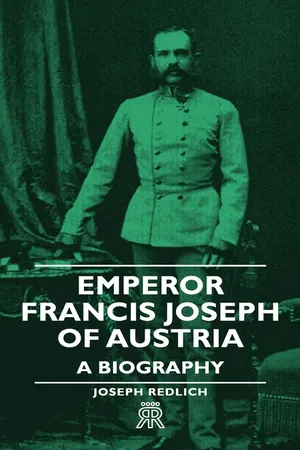
Emperor Francis Joseph of Austria - A Biography
About this book
The life of Emperor Francis Joseph can only be understood in close connection with the political transformation of Europe and the progressive shift in world power that went on during the century between the Congress of Vienna and the Treaty of Versailles. It is from that standpoint that it is here written. At the same time the specific content of this description is his human and political personality. On no other terms can any bounds be set or any form given to the vast mass of interconnected historical events covered by the period of Francis Joseph's life and reign.
Since, however, whether as man or ruler, he falls far short of being an embodiment of human greatness, it is in a somewhat limited sense only that he fills the conception of a historic personality. So comprehensive, on the other hand, is the range of countries and peoples over whom he reigned; so extensive is the period of his governance; so mighty and multifarious are the European issues influenced, and deeply influenced, by his action and his character, that, judged by the test of influence on great events, he must be said to have counted for more than any other European monarch of the nineteenth century. Compared with his, the singular and momentous career of Napoleon III is but an entr'acte in Europe. Guardian of an ancient line, inheritor and defender of rights that date far back into medieval times, natural foe of the modern struggle to transform Europe into a series of closed national states, Francis Joseph assumed and maintained for sixty years a position in the Europe that the war destroyed to which that of no other sovereign affords an analogue. What makes him all the more impressive is that there was in him, as in no other European monarch of the past century, a perfect correspondence between the man and his work.
To Francis Joseph and to the Empire that came to an end in 1918 the saying certainly applies which is the veritable title deed of biographical history—History is made by men. Even in a period preoccupied as is our own with research into the development and function of ideas and of institutions, economic, social and political, history cannot omit personality, since it is the instrument through which the will of a nation or a state has to be exercised. Least of all can this be done where, as with Francis Joseph, the idea of the ruler overpowers that of the man and makes his personal individuality its servant.
Trusted by 375,005 students
Access to over 1.5 million titles for a fair monthly price.
Study more efficiently using our study tools.
Information
Print ISBN
9781406701173
9781443720731
Table of contents
- Cover
- Title
- Dedication
- Introduction
- Contents
- Illustrations
- Half title
- Chapter I. Archduke Franzi
- Chapter II. The Young Emperor
- Chapter III. Dictating a Constitution: Absolutism Transitional and Permanent
- Chapter IV. Francis Joseph His Own Foreign Minister
- Chapter V. Austria and the Crimean War
- Chapter VI. Empress Elizabeth: Vienna in the Fifties
- Chapter VII. The Autocrat
- Chapter VIII. The War Against France and Piedmont-Sardinia: the Loss of Lombardt
- Chapter IX. The Era of Constitutional Experiments
- Chapter X. War With Prussia: The Dual Monarchy
- Chapter XI. King-Emperor: Dualism in Action
- Chapter XII. The Dual Alliance
- Chapter XIII. Emperor and Crown Prince
- Chapter XIV. The Writing on the Wall
- Chapter XV. Franz Joseph and Franz Ferdinand
- Chapter XVI. Serajevo
- Chapter XVII. The War and the Emperor’s Death
- Epilogue
- Index of Names