The M3 and M5 family of light tanks were the culmination of American tank development of the 1930s.
By the time of the outbreak of the World War II, they were approaching obsolescence, as tank forces in Europe were shifting from light to medium tanks as the main element of their armored forces. First entering combat in the autumn of 1941 in the Western Desert with the British Army, the Stuart quickly proved its inadequacies.
The M3 and M5 light tanks proved more suitable in the Pacific theater than in Europe, and fought successfully in many of the major battles including Guadalcanal, Tarawa and Peleliu. This title narrates this distinctive and unusual fighting vehicle's history.
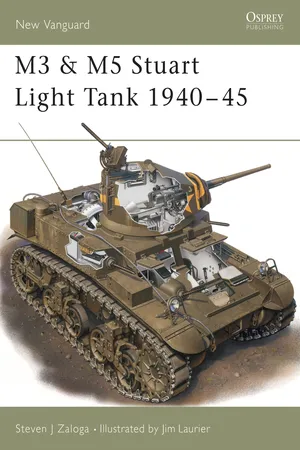
- 48 pages
- English
- ePUB (mobile friendly)
- Available on iOS & Android
eBook - ePub
M3 & M5 Stuart Light Tank 1940–45
About this book
Trusted by 375,005 students
Access to over 1.5 million titles for a fair monthly price.
Study more efficiently using our study tools.
Information
THE M3 AND M5 IN COMBAT
North Africa
While the M3 Stuart light tank was moved to a reconnaissance role in the British Army by the summer of 1942, it still remained a central element in the US Army’s armored divisions. Under the 1942 configuration, the two tank regiments in each division were each composed of two medium tank battalions and one light tank battalion. In addition, the army was still fielding separate GHQ tank battalions composed entirely of light tanks. The first extensive American use of the M3 light tank in combat since the Philippines came after Operation Torch in November 1942 when the US Army landed in North Africa. In small-scale fighting with the Vichy French in Morocco shortly after the landings, there was at least one encounter between the 13th Armored Regiment, 1st Armored Division with a French Renault R.35 light tank company near St. Lucien, but the French lost 14 tanks with only one M3 light tank damaged. On 9 November 1942 the 70th Tank Battalion (Light), one of the first units equipped with the new M5A1 light tanks, engaged in a short fire-fight with French forces near Rabat, knocking out several French Renaults, but also losing one tank to an anti-tank gun.

The second production version of the M3 light tank introduced the D38976 welded turret which was essentially similar to the earlier riveted type except for the construction technique. This tank of the 2nd Armored Division at Fort Benning, Georgia, on 18 December 1941 shows all the crew, ammunition, parts and supplies that were crammed into this small vehicle. Although not apparent from this angle, the M3 light tanks of the 2nd Armored Division were mainly the diesel engine version at this time, a type that was not popular because of the difficulty in getting the engine started, especially in cold weather. (US Army MHI)

The M5 light tank made its combat debut with the 70th Tank Battalion (Light) in North Africa in November 1942. They are seen here during a parade for President Roosevelt during his visit to Casablanca in January 1943 and still retain the prominent US flag insignia from the Operation Torch landings. (Svintage Archive / Alamy Stock Photo)
Far more intense combat awaited the 1st Armored Division in Tunisia. The 1st Battalion, 1st Armored Regiment was the right wing of ‘Blade Force’, assigned to create a ‘tank infested area’ on either side of the Chouigui pass connecting the Tine River valley and the Tunis plain. The encounter began on 25 November 1942 when the headquarters company knocked out a pair of Italian Semovente L40 da 47/32 tank destroyers. On 25 November the US tankers encountered the Afrikakorps for the first time, in a violent engagement with 13 tanks of Pz.Abt.190. Both A Company and B Company were deployed in camouflaged static positions on either side of the Chouigui–Mateur road. The German attack was first met by the battalion’s assault gun platoon, equipped with 75mm T30 howitzer motor carriages, an improvised vehicle consisting of an M3 half-track mounting a 75mm pack-howitzer. After several volleys, it became clear that the low-velocity howitzers were having no effect on the German tanks, and the platoon was ordered to withdraw under cover of smoke. The A Company commander, Major Singlin, ordered his company to attack the German column diagonally while B Company remained in position to provide fire support. The attack consisted of 12 M3 light tanks, led by Major Singlin in his command tank ‘Iron Horse’. The skirmish made the inadequacies of the M3 light tank painfully clear as this later account by one of the platoon commanders attests:
‘The 37mm gun of the little American M3 light tank popped and snapped like an angry cap pistol. From the partial defilade of their position on the right side of the attack, the American banged away at the German tank it had singled out as its very own in the column of Mark IV Specials. The Jerry seemed annoyed by these attentions. Questing about with his incredibly long, bell-snouted, ‘souped-up’75mm KwK 40 rifle, the German commander soon spotted his heckler. Deciding to do the sporting thing and lessen the extreme range, he leisurely commenced closing the 140 yard gap between himself and the light tank, keeping his thicker, sloping frontal plates turned squarely to the hail of 37mm fire. The crew of the M3 redoubled the servicing of their piece. The loader crammed the little projectiles into the breech and the commander (who was also the gunner) squirted them at the foe. Ben Turpin couldn’t miss at that range. Tracer-tailed armor piercing bolts streaked out of the American’s muzzle and bounced from the plates of the Mark IV. The German shed sparks like a power-driven grindstone. In a frenzy of desperation and fading faith in their highly touted weapon, the M3 crew pumped more than eighteen rounds at the Jerry tank while it came in. Through the scope sight, the tracer could be seen to hit, then glance straight up. Popcorn balls thrown by Little Bo Peep would have been just as effective. Fifty yards away, the Jerry paused and loosed a round which ricocheted from the wadi bank short of the American, showering sand into the open turret hatches and screaming away like an undernourished banshee. For a long moment, it looked as though he intended to use his gun tube to pry the American tank from its cozy terrain wrinkle. But a few yards further, he pulled right and mounted a small hummock, completely destroying the slight defilade advantage of the American tank now some thirty yards away.

The development of an enlarged turret with a rear radio bustle for the M3A3 light tank led to the decision to use the same turret on the improved M5A1 light tank. This is a standard production example, with the simple M20 elevator bracket mount for the turret machine-gun. (US Army MHI)
‘The M3 commander decided that he was in a predicament known in the trade as “situation doubtful”. A rapid retrograde movement to an alternate firing position was in order. The driver, half buried in the 37mm brass, was unable to receive the commander’s foot and toe signals. So the commander crouched behind him and ordered him to back out at all possible speed, but to keep faced to the Jerry. The feeling as the M3 lurched backward up the wadi bank was one of relief – no one enjoys playing “clay pigeon M3”. Death, unexpectedly deferred these many seconds, struck as the light tank bounced out of the wadi. The slug that was no doubt aimed at the turret, struck the vertical surface of the heavy armored driver’s door and literally caved in the front of the M3. With its driver instantly dead, the bow gunner blind, stunned and bleeding, the loader cut down by machine gun fire as he sought cover, and its commander lying wounded on the ground, the little tank, though sheathed in flame, backed on through the battle until stopped by friendly hands.’*
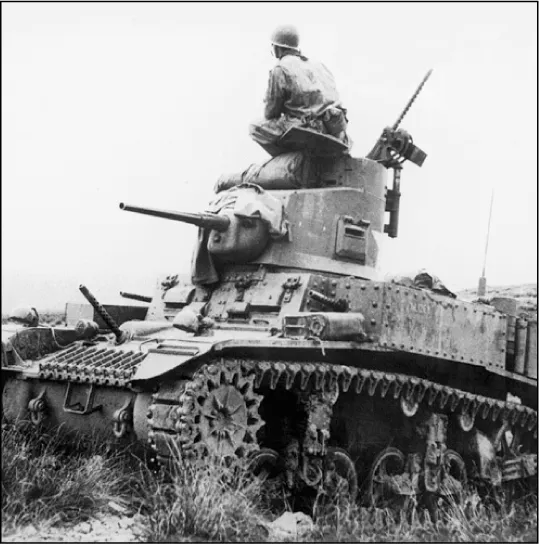
When first committed to combat in North Africa in November 1942, most US Army light tank battalions were equipped with a mixture of M3 and M3A1 light tanks. This is an M3 light tank of the 1st Armored Division with the third, round turret type, during operations near Maknassy, Tunisia, in 1943. Unlike the British, the US Army retained the sponson machine-guns at this stage of the war. (US Army MHI)
In the tank duel in ‘Happy Valley’, A Company was decimated. But while the German tank column was distracted by A Company’s attack, they exposed their thinner rear armor to B Company, and nine of the 13 German tanks were knocked out. A captured German tanker later mocked his captors saying that the ‘Americans would lose the war because they built such poor tanks’.
Considering that this skirmish had come over a year after Operation Crusader, it should have come as no surprise that th...
Table of contents
- Cover
- Title Page
- Contents
- M3 & M5 STUART LIGHT TANK 1940 – 45
- THE M3 LIGHT TANK
- M3 DEVELOPMENT CONTINUED
- SPECIALIZED STUART VARIANTS
- THE M3 AND M5 IN COMBAT
- THE PLATES
- eCopyright
Frequently asked questions
Yes, you can cancel anytime from the Subscription tab in your account settings on the Perlego website. Your subscription will stay active until the end of your current billing period. Learn how to cancel your subscription
No, books cannot be downloaded as external files, such as PDFs, for use outside of Perlego. However, you can download books within the Perlego app for offline reading on mobile or tablet. Learn how to download books offline
Perlego offers two plans: Essential and Complete
- Essential is ideal for learners and professionals who enjoy exploring a wide range of subjects. Access the Essential Library with 800,000+ trusted titles and best-sellers across business, personal growth, and the humanities. Includes unlimited reading time and Standard Read Aloud voice.
- Complete: Perfect for advanced learners and researchers needing full, unrestricted access. Unlock 1.5M+ books across hundreds of subjects, including academic and specialized titles. The Complete Plan also includes advanced features like Premium Read Aloud and Research Assistant.
We are an online textbook subscription service, where you can get access to an entire online library for less than the price of a single book per month. With over 1.5 million books across 990+ topics, we’ve got you covered! Learn about our mission
Look out for the read-aloud symbol on your next book to see if you can listen to it. The read-aloud tool reads text aloud for you, highlighting the text as it is being read. You can pause it, speed it up and slow it down. Learn more about Read Aloud
Yes! You can use the Perlego app on both iOS and Android devices to read anytime, anywhere — even offline. Perfect for commutes or when you’re on the go.
Please note we cannot support devices running on iOS 13 and Android 7 or earlier. Learn more about using the app
Please note we cannot support devices running on iOS 13 and Android 7 or earlier. Learn more about using the app
Yes, you can access M3 & M5 Stuart Light Tank 1940–45 by Steven J. Zaloga,Jim Laurier in PDF and/or ePUB format, as well as other popular books in History & Military & Maritime History. We have over 1.5 million books available in our catalogue for you to explore.