eBook - ePub
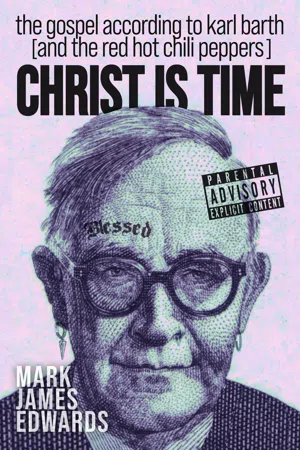
Christ Is Time
The Gospel according to Karl Barth (and the Red Hot Chili Peppers)
- 212 pages
- English
- ePUB (mobile friendly)
- Available on iOS & Android
eBook - ePub
About this book
Christ Is Time: The Gospel according to Karl Barth (and the Red Hot Chili Peppers) welcomes you to the jungle of Barth's head-banging opus, the Church Dogmatics, with the beats, rhythms, and lyrics of Smashing Pumpkins, Pearl Jam, Metallica, and more. Based on lectures at Princeton Seminary, Edwards distills Barth's treatment of key questions in philosophical and systematic theology, offering a playlist of greatest hits on trinity, Christology, prayer, and others. With the care of a scholar and the energy of a stack of Peaveys, Christ Is Time testifies that the eternal God "gives it away" as time through Jesus Christ. Let's face it: Karl's style is a bit Beastie. And since Depeche Mode can say it best, this just might be a match made in Nirvana. Go gaga.
Trusted by 375,005 students
Access to over 1 million titles for a fair monthly price.
Study more efficiently using our study tools.
Information
1
Trinity: Give It Away
When I was young and immature, I listened to the psychedelic funk-punk band Red Hot Chili Peppers. At the time, the Chili Peppers were just breaking out of their original underground LA fan base and, largely through the help of MTV, were being broadcast to the far reaches of the universe. This is how I, growing up in the great plains of North Dakota and desperate for something more than country music or the skinny pop of Mariah Carey, came to think of myself as a pure die-hard Pepper head. I had never been to a punk show, and to this day still have not seen the Chili Peppers in concert. Still, at the time, no one’s heart beat faster when the Chili Peppers played, and I repeatedly used them to amp me up for cross-country races. The possible exception was my mom. One day while cleaning up, she came across the album, read some of their many graphic and offensive lyrics, and furiously snapped my Blood Sugar Sex Magik compact disc in two. That disc was promptly replaced by a gift from a soon-to-be girlfriend, who not only gave me a copy of her album but also a hand-embroidered pillow case that matched the rose and tattoo tongues of the album’s cover art. In a statement of adolescent defiance, I put the pillow center on my bed and hung the broken compact disc from my ceiling light as a shrine to the oppression the grunge generation must endure.
The hit song that kicked all this saga off was the rowdy, aggressive, and fairly absurd Give it Away:

Thankfully I am no longer young, immature, and consumed by those self-proclaimed “Funky Monks.” I went to college, read Augustine, Aquinas, and Nietzsche, fell in love with philosophy of religion, became a Christian, continued through seminary, got hooked on Barth in doctoral work and now am seeking higher ground.

Even though they no longer dominate my identity and it is my preference to think to the rhythms of a critically realistic dialectical theology, it will be my thesis that Anthony Kiedis, Michael “Flea” Balzary, Chad Smith, and John Frusciante correctly identified, even if accidentally and a bit crudely, the key attribute of the being of God. The thesis driving this chapter, and indeed this very book, is that the God who is, is the God who “gives it away.”1

I. The God Who Gives It Away. Eternally.
Karl Barth (1886–1968) has often been described as a “christocentric” theologian, and indeed he is, especially in his epistemology. Yet, his future legacy may well focus more on his work as a “trinitarian” theologian. For the theology of Barth’s Church Dogmatics is, at least in my eyes and those of some of my colleagues, the most lengthy, systematic, and coherent treatment of the triune God the Christian church has ever seen. You should read it. Perhaps these reflections will inspire you to do so. Yes, it is Himalayan in size. But discipleship is a long journey and long-haul times require long-haul texts.
Barth’s diverse and extended discussions of the Trinity can be distilled by looking at what might be called the “Triune Moment.” Think of the Triune Moment as one slice or snapshot of God’s eternal life.2 In this chapter, we will look at two ways in which Barth describes this so-called Triune Moment and in the next we will look at a third way. In each of the three ways, Barth seeks to describe God’s “triunity” using a fresh vocabulary that aligns with what he says elsewhere. What he offers are essentially three complementary descriptions of the nature and character of the triune God, and though he was not exactly listening to the Chili Peppers while writing the Church Dogmatics (he dosed daily on Mozart), in all three Barth portrays a God who gives it away. Eternally.
The Triune Moment: The First Way
In an exposition in the first volume of Church Dogmatics on the Nicene Creed’s clause that the Holy Spirit proceeds from the Father and the Son, Barth describes what I am calling the Triune Moment in a traditional creedal way:
As God is in Himself Father from all eternity, He begets Himself as the Son from all eternity. As He is the Son from all eternity, He is begotten of Himself as the Father from all eternity. In this eternal begetting of Himself and being begotten of Himself, He posits Himself a third time as the Holy Spirit, i.e., as the love which unites Him in Himself.3
In this description, Barth articulates God’s triunity using the traditional creedal language of “begetting” and “being begotten.” For Barth, as indeed for all thinkers who have wanted to steer clear of Arianism, God is and always has been, in and as this eternal begetting of the Father, the being begotten of the Son, and t...
Table of contents
- Title Page
- Playlist
- Acknowledgments
- Abbreviations
- Introduction
- Chapter 1: Trinity: Give It Away
- Chapter 2: Eternity: Stairway to Heaven
- Chapter 3: Revelation: So What’cha Want?
- Chapter 4: Creation: Alive
- Chapter 5: Sin: To Live Is to Die
- Chapter 6: Christology + Humanity: Patience
- Chapter 7: Justification: Testify
- Chapter 8: Church: Come as You Are
- Chapter 9: The Lord’s Supper: Hunger Strike
- Chapter 10: Ethics + Prayer: Personal Jesus
- Chapter 11: Time: Today
- Chapter 12: Conclusion: Christ in Pop Culture the World
- Appendix: The Trinity and Election Debate: An Analytic Proposal
- Bibliography
Frequently asked questions
Yes, you can cancel anytime from the Subscription tab in your account settings on the Perlego website. Your subscription will stay active until the end of your current billing period. Learn how to cancel your subscription
No, books cannot be downloaded as external files, such as PDFs, for use outside of Perlego. However, you can download books within the Perlego app for offline reading on mobile or tablet. Learn how to download books offline
Perlego offers two plans: Essential and Complete
- Essential is ideal for learners and professionals who enjoy exploring a wide range of subjects. Access the Essential Library with 800,000+ trusted titles and best-sellers across business, personal growth, and the humanities. Includes unlimited reading time and Standard Read Aloud voice.
- Complete: Perfect for advanced learners and researchers needing full, unrestricted access. Unlock 1.4M+ books across hundreds of subjects, including academic and specialized titles. The Complete Plan also includes advanced features like Premium Read Aloud and Research Assistant.
We are an online textbook subscription service, where you can get access to an entire online library for less than the price of a single book per month. With over 1 million books across 990+ topics, we’ve got you covered! Learn about our mission
Look out for the read-aloud symbol on your next book to see if you can listen to it. The read-aloud tool reads text aloud for you, highlighting the text as it is being read. You can pause it, speed it up and slow it down. Learn more about Read Aloud
Yes! You can use the Perlego app on both iOS and Android devices to read anytime, anywhere — even offline. Perfect for commutes or when you’re on the go.
Please note we cannot support devices running on iOS 13 and Android 7 or earlier. Learn more about using the app
Please note we cannot support devices running on iOS 13 and Android 7 or earlier. Learn more about using the app
Yes, you can access Christ Is Time by Mark James Edwards in PDF and/or ePUB format, as well as other popular books in Theology & Religion & Christian Theology. We have over one million books available in our catalogue for you to explore.