From Abundance to Scarcity
eBook - ePub

From Abundance to Scarcity

A History Of U.S. Marine Fisheries Policy

  1. English
  2. ePUB (mobile friendly)
  3. Available on iOS & Android
eBook - ePub

From Abundance to Scarcity

A History Of U.S. Marine Fisheries Policy

About this book

The management of coastal and ocean fisheries is highly contentious. Industry interests focus on maximizing catches while conservationists and marine scientists have become increasingly concerned about dramatic declines in fish stocks and the health of ecosystems. Besides attempting to mediate among these interests, government agencies have pursued their own agendas, which have often lagged behind shifts in scientific understanding and public attitudes about the productivity of the oceans and uses of marine wildlife.

From Abundance to Scarcity examines the historical evolution of U.S. fisheries policy and institutions from the late 19th century to the present day, with an emphasis on changes since World War II. Based on archival research and interviews with dozens of key players in marine policymaking, it traces the thinking, legislation, mandates, and people that have shaped the various agencies governing fisheries in the United States. The book:

  • discusses the development of federal programs in marine biological sciences and the evolution of scientific understanding about marine wildlife populations
  • describes the work of federal fisheries programs in promoting the interests of the fishing industry
  • considers the response of agencies to factors such as dam-building and coastal development that have led to increased pollution and habitat loss
  • examines the shifts in understanding and values that underlie major legislation including the Marine Mammal Protection Act, the Endangered Species Act, the Magnuson-Stevens Act, and the Sustainable Fisheries Act
  • examines the evolving relationship between federal agencies, the fishing industry, communities, and nongovernmental conservation organizations, with an eye toward future management practice
From Abundance to Scarcity sheds light on the sets of interests that have shaped U.S. fisheries policy, lending historical depth to current debates and providing a fuller understanding of current laws and regulations, and administrative structures and mechanisms. It offers an insightful overview for professionals involved with fisheries management or the fishing industry, conservationists working on marine issues, and students and scholars of marine policy and affairs, environmental policy and law, or public policy and administration.

Information

Publisher
Island Press
Year
2013
Print ISBN
9781559637060
9781559637053
eBook ISBN
9781610912709

Part I

Abundance

e9781610912709_i0004.webp
1870—1940 In 1882, the U.S. Commission of Fish and Fisheries established its first permanent research station at Woods Hole, Massachusetts. In 1902, a second station was established at Beaufort, North Carolina, at a federal cost of less than $13,000. By 1941, the federal government had constructed 110 fish hatcheries around the country, at an average cost of $513,000, adjusted for inflation.
During its first decade, the commission had to rely upon vessels loaned or transferred from other agencies. In 1882, however, the commission completed the construction of two research vessels: the 200-foot Albatross and the 146-foot Fish Hawk. Between 1870 and 1940, artificial propagation of fish and shellfish dominated federal funding for fisheries, accounting for 65% of the total. Federal funding for biological research averaged 8% of the entire budget for fisheries activities. Funding for industry services averaged 3% of the total.
In 1940, Presidential Reorganization Plan III merged the Interior Department’s Bureau of Fisheries with the Agriculture Department’s Biological Survey to form the Fish and Wildlife Service in the Department of the Interior with four divisions: fishery biology, fish culture, fishery industries, and Alaska fisheries.

Chapter 1

The Sciences

Traditional groundfish fishermen who worked the nearshore waters of Massachusetts and Rhode Island with handheld longlines had endured enough. Newfangled fish traps seemed to be robbing them of their catch and threatening their future. But the fishermen who tended the traps charged the longliners with interfering in their livelihood. In the winter of 1869—1870, the controversy spilled into the state legislatures of Rhode Island and Massachusetts. The Massachusetts legislature refused to intervene in the controversy, while the Rhode Island legislature considered complete and immediate removal of the traps. The lack of knowledge about fish off New England fueled the controversy.
Combining his stature as a scientist with uncanny political instincts, an ambitious young naturalist at the Smithsonian Institution in Washington, D.C., by the name of Spencer Fullerton Baird transformed the controversy into a platform for committing the federal government to investigating marine life off New England. Baird, who was born in Reading, Pennsylvania, in 1823, had joined the staff of the Smithsonian Institution in 1850, after a brief career as a professor of natural history at Dickinson College.
During summer collecting expeditions in New England, Baird had gained firsthand experience with fishermen’s complaints about declining fish populations. Baird believed that resolving the controversy depended upon greater understanding of the fishes themselves. With $100 from the Smithsonian and a 30-foot Treasury Department sloop, Baird continued his own investigations in 1870. By the end of the year, he had prepared a proposal for an expanded inquiry that would require a larger budget and its own institution.
On January 23, 1871, Congressman Henry Dawes of Massachusetts introduced Baird’s proposal as a joint resolution of Congress. In urging support for the proposal, Congressman Dawes quoted a supporting letter from Baird: “Before intelligent legislation can be initiated, however, and measures taken that will not unduly oppress or interfere with interests already established, it is necessary that a careful, scientific research be entered upon, for the purpose of determining what really should be done; since any action presupposes a knowledge of the history and habits of the fish of our coast, that, I am sorry to say, we do not at present possess.”1
Less than three weeks later, President Ulysses S. Grant signed a joint congressional resolution requiring the appointment of a Commissioner of Fish and Fisheries. The unsalaried fisheries commissioner was to undertake an inquiry aimed at “ascertaining whether any . . . diminution in the number of the food-fishes [sic] of the coast and the lakes of the United States has taken place; and, if so, to what causes the same is due; and also whether any and what protective, prohibitory, or precautionary measures should be adopted.”2
The U.S. Fish and Fisheries Commission was a commission of one, and Baird the first fisheries commissioner. Baird successfully argued for insulating the office from political interference by making the position unsalaried and by insisting on scientific training. Because the work of the commission was expected to take just a few years, Congress provided no office space. Instead, Baird operated the commission out of his home.
Baird never resolved the controversy that gave rise to the commission. Like the many later controversies that engulfed the New England groundfish fishery, and many other fisheries, the conflict between fishermen using different gears had more to do with the fishermen than with the fish. It was unlikely that groundfish populations were in any danger of overfishing, given the rudimentary techniques that fishermen used, but the competition between fishermen was quite real. No fisherman owned the fish until he caught it. Once several fishermen began targeting the same fish populations or fish in the same area, each fisherman felt compelled to race to catch fish before a competitor could. This “race for the fish” generally produced conflicts between fishermen but did little damage to fish populations. The race did, however, have the unexpected consequence of putting science at the center of controversy surrounding marine fisheries, a place it would never relinquish.
The U.S. Fish and Fisheries Commission and its successors in the Departments of Interior and of Commerce were not charged specifically with resolving controversy, but with conducting and sponsoring research to increase knowledge generally, to assist the fishing industry, and to promote scientific management of fisheries. Especially after World War II, the federal government expanded its role in locating new fisheries off the United States and abroad as a means of increasing the economic viability of the fishing industry and to maintain U.S. leadership in the world. At the same time, the demand for data on fish populations and on fishing grew as governments at all levels attempted to manage conflicts among fishing fleets and extract maximum yield from fisheries. Through the 1950s and 1960s, confidence grew in the ability of scientists to manage fisheries for maximum sustainable yield. Together with estimates of potential catches that proved wildly generous, this confidence in scientific management encouraged a drive to increase catches that continued for the next 25 years.

Exploration

The birth of the U.S. Fish and Fisheries Commission is one of several emblematic events in the rise of marine biology in the 1860s and 1870s. Naturalists and oceanographers expanded their explorations of the oceans’ depths, once thought to be entirely lifeless. Until 1860, scientists believed that the oceans’ deepest waters never moved and, as a result, never received life-giving nutrients. The recovery of a cable encrusted with sea life from waters off Sardinia in the Mediterranean Sea brought an end to the theory and a beginning to one of the richest periods of ocean exploration in history. In December 1872, the HMS Challenger began its four-year, 69,000-mile voyage of exploration that collected 13,000 specimens of plants and animals from the oceans.
Although the immediate pretext for research by the fish commission was to investigate the causes for an alleged decline in New England food fishes, the institutional stature of the commission allowed Spencer Fullerton Baird to pursue his principal interest as a biologist: to assemble a portrait of marine wildlife in New England waters. Baird faced the daunting task of funding his research in the face of congressional skepticism about the practical benefits of field research. Instead of seeking direct funding from Congress for the commission’s work, Baird used the status of the fish commission as a government agency to secure support from other government agencies. In the first summer of research under the auspices of the commission, Baird set up his research headquarters in a building at Woods Hole, Massachusetts, owned by the Light House Board. In 1873, Baird talked the Navy into lending the fish commission an 80-ton steamer to explore the waters off Maine.
Baird had no staff, but with offers of collecting gear, small boats, and lab tables, he was able to recruit other biologists. While their tools were rudimentary, these biologists enjoyed the enormous advantage of waters within shouting distance of shore that had never been explored. In the first summer of research, 106 different species of finfish were collected, and Baird began preparing life histories for scup (Stenotomus chrysops) and bluefish (Pomatomus saltatrix). By the end of the commission’s first decade, researchers had identified 1,000 new species in New England waters.
Baird desperately wanted the fish commission to establish a permanent research station. Rather than looking first to Congress, Baird sought out and obtained private funding. Between private support and later, congressional appropriations, the fish commission was able to open its first permanent facility at Woods Hole in 1885. Baird also secured funding for the USS Albatross, the country’s first research vessel dedicated to oceanographic and fisheries research. Launched in 1882, the Albatross later sailed to the Pacific, where it explored the waters off the Pacific coast, Alaska, and as far west as the Philippines and Formosa (Taiwan).
Although Baird had greater interest in a general understanding of the fish off American shores, he and the fish commission did carry out research into fisheries problems. In 1871, for example, Baird conducted public hearings at ports in southern New England regarding the controversial decline of food fishes that had been a primary reason to create the fish commission. Baird used testimony from these hearings and results of his expeditions to prepare the commission’s first report, which was issued in 1873.
Baird also set a precedent for linking research to benefit scientific understanding with research to benefit fishermen. In instructing the captain of the Albatross before an expedition in New England waters in 1883, Baird directed that the distribution of fish should be noted. Baird then suggested the following: “Should you deem it expedient you will cruise off the coast a sufficient distance to determine the outward line of motion of the fish, and you will communicate to such fishing vessels as you may meet any information that may enable them the more successfully to prosecute their labors.”
Baird may simply have been showing his characteristic good political sense in seeking to benefit commercial fishermen while fulfilling his own desire for knowledge about the distribution of fishes off southern New England. Decades later, however, the link between science and commerce was made explicit when Congress began to direct the Bureau of Fisheries to seek out new species for commercial fishermen. In 1940, for instance, Congress appropriated $100,000 for a survey of king crabs in waters off Alaska, which led to a booming fishery by the end of the decade.
As in Baird’s day, the task of locating new fish populations after World War II was left to the government. The fishing industry itself invested very little in exploring new fishing grounds. For federal fisheries biologists, this was just as well. Research cruises aimed at locating commercially valuable fish populations enabled them to continue their basic biological work.
During the late 1950s and early 1960s, the Bureau of Commercial Fisheries enlarged its fleet of research vessels. With these vessels and chartered commercial fishing vessels, the bureau expanded its exploratory cruises into deeper water and to waters off other countries. In New England, the R/V Delaware discovered new fishing grounds for ocean perch (Sebastes marinus) in 1956. The R/V Oregon located concentrations of deepwater red shrimp (Hymenopenaeus robustus) and yellowfin tuna (Thunnus albacares) in the Gulf of Mexico. The Oregon later located large concentrations of pink shrimp (Penaeus duorarum) and brown shrimp (Penaeus aztecus) off French Guiana. Off Washington, the R/V John N. Cobb used an echo sounder to locate areas suitable for trawling for Petrale sole (Eopsetta jordani, Dover sole (Microstomus pacificus), and Pacific ocean perch (Sebastodes alutus). Other vessels explored the western Pacific for tuna and the waters off West Africa.
“It was the neatest job a young graduate student could have,” says Richard Roe about exploratory cruises in the Gulf of Mexico conducted by the Bureau of Commercial Fisheries during the 1960s. Roe later served in several senior positions at the NMFS, including regional director in New England.
“Surprisingly, there was very little known about the biota of the Gulf of Mexico and the Caribbean,” Roe says. “We did things that today you wouldn’t be able to do. We dragged all the way out to 2,000 fathoms, collecting and studying deepwater animals. We shipped stuff off wholesale to the Smithsonian, all of which was new, lots of new species and genera.”
“In the 1960s, we started doing some longline research in the Gulf and Caribbean because the Japanese were operating down there with longlines fishing for yellowfin tuna,” says Roe. “We would get access to their published reports, and noticed there were some billfish being taken, particularly swordfish. So we started doing our own exploratory long-lining, and we found swordfish.”
The Bureau of Commercial Fisheries made a point of quickly disseminating the results of such cruises to the commercial fishing industry. In some cases, commercial fishing awaited further government research on fishing gear, processing equipment, or marketing. In the mid-1950s, for example, the Delaware tested the effectiveness of different types of fishing gear for exploiting newly discovered Atlantic bluefin tuna (Thunnus thynnus).
The federal government sometimes intervened even more strongly in the development of fisheries. A year after the R/V John N. Cobb first located large schools of Pacific hake (Merluccius productus) off the state of Washington in 1964, the federal government chartered the commercial fishing vessel St. Michael to continue this research. At the end of its charter, the St. Michael began fishing commercially for hake, becoming the first U.S. commercial vessel to do so. The federal government was so anxious to develop this fishery that it also provided trawls and depth finders to several other fishing vessels. With this assistance, fishing effort grew, as did landings. In 1966, the small fleet landed 1,800 metric tons of hake, which was processed into fish meal and cat food. Offshore, an even larger fleet of factory trawlers from the Soviet Union began fishing for hake as well, landing 100,000 metric tons.
The expansion of the Gulf of Mexico longline fishery for swordfish (Xiphias gladius) followed a similar pattern of government research cruises and encouragement fostering increased exploitation by U.S. fishing fleets.
“We convinced a couple of long-liners to come down from Maine, about 1965 or 1966, and they came down and made absolutely bonanza trips, because the fishery was unexploited,” says Roe. “They were large fish. Once that fishery began to open up and people started making bucks, down came the longliners. And of course, in those days, there were no regulations. They started pounding on that resource, as well as marlin and sharks and a lot of the other species you catch on longlines.”
In the absence of effective controls, landings of swordfish from the Gulf of Mexico grew to 1...
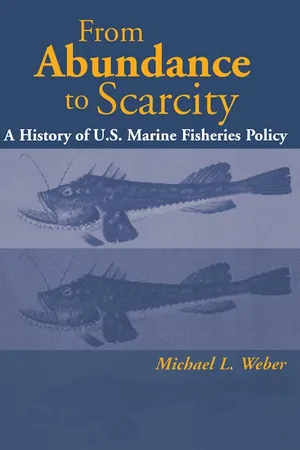
Table of contents

  1. ABOUT ISLAND PRESS
  2. Title Page
  3. Copyright Page
  4. Dedication
  5. Table of Contents
  6. Preface
  7. Introduction
  8. Part I - Abundance
  9. Part II - Scarcity
  10. Conclusion
  11. Sources
  12. Index
  13. Island Press Board of Directors

Trusted by 375,005 students

Access to over 1.5 million titles for a fair monthly price.

Study more efficiently using our study tools.

Frequently asked questions

Yes, you can cancel anytime from the Subscription tab in your account settings on the Perlego website. Your subscription will stay active until the end of your current billing period. Learn how to cancel your subscription
No, books cannot be downloaded as external files, such as PDFs, for use outside of Perlego. However, you can download books within the Perlego app for offline reading on mobile or tablet. Learn how to download books offline
Perlego offers two plans: Essential and Complete
  • Essential is ideal for learners and professionals who enjoy exploring a wide range of subjects. Access the Essential Library with 800,000+ trusted titles and best-sellers across business, personal growth, and the humanities. Includes unlimited reading time and Standard Read Aloud voice.
  • Complete: Perfect for advanced learners and researchers needing full, unrestricted access. Unlock 1.5M+ books across hundreds of subjects, including academic and specialized titles. The Complete Plan also includes advanced features like Premium Read Aloud and Research Assistant.
Both plans are available with monthly, semester, or annual billing cycles.
We are an online textbook subscription service, where you can get access to an entire online library for less than the price of a single book per month. With over 1.5 million books across 990+ topics, we’ve got you covered! Learn about our mission
Look out for the read-aloud symbol on your next book to see if you can listen to it. The read-aloud tool reads text aloud for you, highlighting the text as it is being read. You can pause it, speed it up and slow it down. Learn more about Read Aloud
Yes! You can use the Perlego app on both iOS and Android devices to read anytime, anywhere — even offline. Perfect for commutes or when you’re on the go.
Please note we cannot support devices running on iOS 13 and Android 7 or earlier. Learn more about using the app
Yes, you can access From Abundance to Scarcity by Michael L. Weber in PDF and/or ePUB format, as well as other popular books in Biological Sciences & Ecology. We have over 1.5 million books available in our catalogue for you to explore.