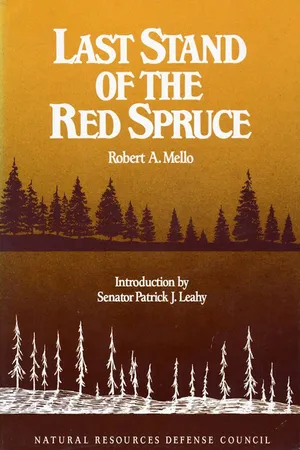
Here is a vitally important book for anyone who is concerned with acid rain and the fate of our forests. In his fascinating investigation into the decline of the red spruce on Camel Hump in Vermont, Robert A. Mello explores an ecological mystery. He presents, in clear, concise, non-technical language, both sides of an issue which has split the scientific community.Last Stand of the Red Spruce tells us the the time is long past-due to take action on acid rain. Mello urges pressure for legislation to preserve our health and warns us that we can no longer be complacent.
- English
- ePUB (mobile friendly)
- Available on iOS & Android
eBook - ePub
Last Stand of the Red Spruce
About this book
Information

1
Death in the Boreal Zone
The red spruce (Picea rubens Sarg.) brings beauty and grace to the most inhospitable climatic zone our eastern mountains have to offer, the montane boreal zone. In northern New England and New York this subarctic band extends from approximately 3,000 feet above sea level to the tree line; in the southern Appalachians it begins at about 5,000 feet and encompasses all the highest peaks. In this zone of fierce winds and severe cold, the growing season is short, and the soils are thin, rocky, and infertile. Yet the red spruce survives, often growing in pure stands and can live to be nearly 400 years old. Few other trees survive in the boreal zone. In the northern Appalachians only red spruce, balsam fir, and white birch can cope with such climatic conditions. Without these species, the upper third of the mountains would be mostly bare, eroded rock. These were the trees Thoreau saw jutting through the clouds over Vermont.
In the autumn of 1982, Dr. Hubert W. Vogelmann, Chairman of the Department of Botany at the University of Vermont, reported that the red spruces were dying in the virgin forests on the slopes of Camels Hump, a high peak of the northern Green Mountains of Vermont. Since 1965, when the forests there were inventoried, nearly half of the red spruces had died, some of which had been seedlings when Samuel de Champlain discovered Vermont in 1609. These young red spruces and their towering companions had dominated the vast expanses of high elevation and later had inspired the early settlers to give Vermont and her Green Mountains their names. Vogelmann described what he saw in an article entitled “Catastrophe on Camels Hump” published by Natural History in November 1982:1
Gray skeletons of trees, their branches devoid of needles, are everywhere in the forest. Trees young and old are dead, and most of those still alive bear brown needles and have unhealthy looking crowns.... As more and more trees die and are blown down, the survivors have less protection from the wind, and even they are toppled over. The forest looks as if it has been struck by a hurricane.2
Ordinarily, red spruces reseed quickly and heavily. As the great evergreens died and opened the canopy of the treetops, the bare forest floors became bathed in life-giving sunshine. Although an explosion of shrubs and other new vegetation followed, Vogelmann reported that there are no young spruces to be seen.3
Vogelmann, a field botanist and ecologist for twenty years, has always preferred field work to library or laboratory study. His extensive investigations have earned him national recognition and awards from The Nature Conservancy, Syracuse University, the U.S. Environment Protection Agency, and others. Since earning his doctorate from the University of Michigan in 1955, Vogelmann has conducted several field studies in marshes, swamps, and high elevation cloud forests from Canada to South America. His first ecological investigations focused on the arctic and subarctic vegetation of the Knob Lake region of Quebec, Canada. In 1964, Vogelmann began a series of botanical explorations in the Andes Mountains, the Putumayo, and the upper Amazon basin of Colombia, South America. The following year the Botanical Museum of Harvard University sent him back to Colombia to collect specimens of medicinal plants. From 1966 to 1970, Vogelmann conducted another series of studies as a National Science Foundation Teaching Fellow in the tropical cloud forests on the Sierra Madre Oriental Mountains of eastern Mexico. The majority of Vogelmann’s field work, however, has been in the high-elevation arctic and subarctic zones of the northern Appalachian Mountains; consequently, by 1979 he was very familiar with the red spruce.
The red spruce, one of North America’s most beautiful, hardy and valuable trees, is a luxuriant evergreen with a thick, shiny coat of dark green needles. A dramatic conifer, it grows to be one hundred feet tall and stands in an open field like a pyramid, with regular whorls of branches rising along its straight mastlike trunk. The red spruce was named because of the cylindrical reddish-brown cones that hang from its branches.
The habitat of the red spruce is relatively small and in the U.S. is closely associated with the Appalachian Mountains, which offer the wet and cool climate that spruce trees like best. Its natural range extends from Nova Scotia and New Brunswick southwestward to North Carolina and Tennessee. The further south one goes to find red spruce, the higher up the mountains one must climb. In the northern extreme of its range, red spruce grow from near sea level up to an elevation of about 4,500 feet; in the Great Smoky Mountains at the southern end of its range, red spruces grow from elevations of about 4,500 to 6,500 feet. Of the eight spruce species that live in North America, only three (red spruce, white spruce, and black spruce) live in the East and, of these, the red spruce alone grows south of upper West Virginia.
Commercially, the red spruce was once one of the most valuable softwoods in America; today, it is still the most important of the spruces. Since red spruce at one time made up approximately 80 percent of the eastern spruce volume, the paper and construction industries have traditionally relied on it heavily for pulpwood and timber. The red spruce’s long, straight trunk attains a diameter of three or four feet, making its logs a lumberman’s prize. By the late 1930s, red spruces in both the northern and southern Appalachians had been so heavily and repeatedly logged that the tree had nearly disappeared from more than a million acres of forest land. Its exploitation prompted some ecologists even then to express concern about the tree’s ability to recover its lost territory; forty years later, ecologists discovered a much more serious cause for concern.
In 1979, Vogelmann and his colleagues discovered that red spruces were dying inexplicably and prematurely. This evidence indicated that the decline of the trees was not only continuing, but accelerating. Three years later, when Vogelmann published his article in Natural History, the decline was still accelerating, and was not confined to Camels Hump. These trees were dying on the Appalachian Mountains from West Virginia to New England, on the Adirondack Mountains of New York, in the White Mountains of New Hampshire, in the Laurentian Mountains of Quebec, and throughout the Green Mountains of northern Vermont. Red spruces of various ages covering an enormous geographical area were dying simultaneously of unknown causes. Vogelmann observed that the greatest damage was occurring in the evergreen forests located at high elevations and on the slopes facing windward: “It is a disaster that, in a few short years, has dramatically changed the appearance of high mountains.”4
As a result of this sudden decline of the red spruce, scientists in the Northeast began trying to discover as quickly as possible the identity of the destructive forces at work. Forest environments are complex and require time to understand, but time was not on their side. Some prominent scientists viewed the dead evergreens as the omen of an impending environmental disaster, one that could eliminate the red spruce and possibly spread to other forest species. Yet, without a sound diagnosis, no reliable treatment could be offered to the remaining, embattled spruces.

Tree bark affected by fungus.

Forester points out galleries in a spruce bark infested by the eastern spruce bark beetle. Source: USDA Forest Service.

2
Three Great Natural Enemies
The forest has three great natural enemies—fire, insects, and fungi. In North America, more mature timber has been destroyed by this formidable triumvirate than has been harvested by man. Since no fires of any known consequence had occurred on Camels Hump since 1965, the first of the three could be ruled out. This still left a variety of diseases and pests as potential villains. If a recognized insect or fungus could be found attacking the dead and dying red spruce trees, then the cause of the decline would be known quickly and with certainty. Therefore, Vogelmann and the others began their investigations here.
Although many insects are known to attack red spruce, only three are voracious enough to kill the trees in large numbers. The spruce budworm, considered one of the most dangerous of all the forest insects, has devastated more spruces and balsams in the Northeast than any other. Several serious outbreaks of budworm in Canada and New England killed a considerable part of the affected forests. The most catastrophic outbreak on record began in northern Quebec about 1909 and spread southward into New England. By the time the epidemic was over in 1923, more than 200,000,000 cords of balsam fir and many millions of cords of spruce timber had been destroyed. The budworm, a defoliator, eats the buds and new needles of the red spruces in the spring, causing the trees to weaken and often to die. Trees, weakened by the loss of foliage, then become targets of another enemy—the eastern spruce bark beetle—which burrows under the bark of the tree. The tree promptly dies from the attack of the beetles and by the penetration of lethal fungi through the openings made by insects.
The European spruce sawfly is another defoliator; it eats the old needles of the red spruce until the current year’s new needles mature; then it eats them too. The sawfly has also caused an enormous loss of mature red spruce timber in the northeastern United States. The last outbreak of spruce sawfly in Vermont occurred in the late 1930s, leaving several thousands of acres of spruce forests in central and southern Vermont severely infested. Defoliated spruces were also found on Mt. Ellen, Mt. Abraham, and Mt. Battell near Lincoln, and on Green Peak in Dorset, Vermont.
Modern silvicultural management techniques combined with chemical spraying have helped control insect populations in recent years. The war against the spruce budworm and other enemies of the red spruce, however, was not yet won. In 1982 spruce-fir forests in Canada and Maine were blighted by another devastating epidemic of spruce budworm. More than 5 million acres of evergreen forests were infested in Maine, the nation’s leading producer of paper products. Therefore, when Vogelmann searched Camels Hump for prime suspects to blame for the dying red spruces, he naturally put insects high on the list. This suspect had to be taken off the list, however, when the scientist reported that “we have not f...
Table of contents
- About Island Press
- About the Natural Resources Defense Council
- Title Page
- Copyright Page
- Dedication
- Table of Contents
- Table of Figures
- Introduction
- Foreword
- Acknowledgments
- Atop Mt. Greylock, 1844
- Introduction
- 1 - Death in the Boreal Zone
- 2 - Three Great Natural Enemies
- 3 - A Close Correlation
- 4 - Discovering Inuisible Pathways
- 5 - The Search for Natural Causes
- 6 - Treatment Withheld
- 7 - Twilight
- Appendix 1 - Historical Progress Toward Understanding Acid Precipitation
- Appendix 2 - More Recent Developments on Acid Rain Recognized by National and International Agencies
- Endnotes
- Selected Bibliography
- Index
- ALSO AVAILABLE FROM ISLAND PRESS
Trusted by 375,005 students
Access to over 1.5 million titles for a fair monthly price.
Study more efficiently using our study tools.
Frequently asked questions
Yes, you can cancel anytime from the Subscription tab in your account settings on the Perlego website. Your subscription will stay active until the end of your current billing period. Learn how to cancel your subscription
No, books cannot be downloaded as external files, such as PDFs, for use outside of Perlego. However, you can download books within the Perlego app for offline reading on mobile or tablet. Learn how to download books offline
Perlego offers two plans: Essential and Complete
- Essential is ideal for learners and professionals who enjoy exploring a wide range of subjects. Access the Essential Library with 800,000+ trusted titles and best-sellers across business, personal growth, and the humanities. Includes unlimited reading time and Standard Read Aloud voice.
- Complete: Perfect for advanced learners and researchers needing full, unrestricted access. Unlock 1.5M+ books across hundreds of subjects, including academic and specialized titles. The Complete Plan also includes advanced features like Premium Read Aloud and Research Assistant.
We are an online textbook subscription service, where you can get access to an entire online library for less than the price of a single book per month. With over 1.5 million books across 990+ topics, we’ve got you covered! Learn about our mission
Look out for the read-aloud symbol on your next book to see if you can listen to it. The read-aloud tool reads text aloud for you, highlighting the text as it is being read. You can pause it, speed it up and slow it down. Learn more about Read Aloud
Yes! You can use the Perlego app on both iOS and Android devices to read anytime, anywhere — even offline. Perfect for commutes or when you’re on the go.
Please note we cannot support devices running on iOS 13 and Android 7 or earlier. Learn more about using the app
Please note we cannot support devices running on iOS 13 and Android 7 or earlier. Learn more about using the app
Yes, you can access Last Stand of the Red Spruce by Robert A. Mello in PDF and/or ePUB format, as well as other popular books in Biological Sciences & Botany. We have over 1.5 million books available in our catalogue for you to explore.