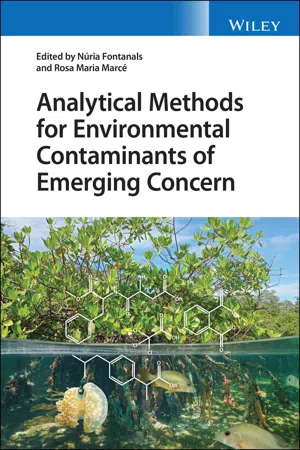
Analytical Methods for Environmental Contaminants of Emerging Concern
eBook - ePub

Analytical Methods for Environmental Contaminants of Emerging Concern

  1. English
  2. ePUB (mobile friendly)
  3. Available on iOS & Android
eBook - ePub

Analytical Methods for Environmental Contaminants of Emerging Concern

About this book

Analytical Methods for Environmental Contaminants of Emerging Concern

Provides the analytical methodology required to detect different families of organic compounds of emerging concern (CECs) from environmental samples

Most contaminants of emerging concern (CECs) —such as pharmaceuticals, personal care products, pesticides, sunscreens, perfluorinated compounds, and microplastics—have been present in the environment for years, yet some have only recently been identified, and many of these organic compounds remain unregulated. Analytical methods have been developed to determine the toxicity and risk of different families of CECs.

Analytical Methods for Environmental Contaminants of Emerging Concern presents the methods currently available to determine families of organic CECs in environmental samples. Each section of the book is devoted to a particular family of CECs, covering different analytical methods supported by examples of both cutting-edge research and commonly used methods. An international panel of experts describes every step of the analytical procedures, including sample preparation, chromatographic separation coupled to mass spectrometry or other instrumental techniques. Specific requirements are linked to the properties of the contaminants and the sample matrix for each procedure presented. Throughout the book, in-depth case studies of analytical procedures for CEC extraction, separation, and determination are presented to help readers transfer the analytical methods to their laboratories.

  • Provides detailed descriptions of various approaches for determining each group of CECs in environmental samples
  • Covers different types of aqueous, solid, and atmospheric samples
  • Includes up-to-date information on CEC properties, relevant legislation, reported or potential metabolites/transformation products, and environmental occurrence
  • Addresses CECs such as novel psychoactive substances, artificial sweeteners, musk fragrances, disinfection byproducts, and microplastics
  • Offers practical tips and advice on special care procedures to assist readers in CEC determination

Analytical Methods for Environmental Contaminants of Emerging Concern is an essential reference and guide for advanced students and researchers in analytical chemistry and science, environmental science, forensic science, and specialized subjects related to analytical chemistry.

Trusted byĀ 375,005 students

Access to over 1.5 million titles for a fair monthly price.

Study more efficiently using our study tools.

Information

Publisher
Wiley
Year
2022
Print ISBN
9781119763864
eBook ISBN
9781119763888

1
Pesticides

Irene Domínguez, Rosalía López Ruiz, Antonia Garrido Frenich, and Roberto Romero GonzÔlez
Department of Chemistry and Physics, Andalusian Center for the Assessment and Monitoring of Global
Change (CAESCG), University of Almeria, Agrifood Campus of International Excellence, Almeria, Spain

1.1 Overview of Pesticides

There are thousands of chemicals that can enter the environment and pesticides are among the most significant. They have been used in the last decades in several areas, but agricultural activity is the main source of the impact of pesticides in the environment and therefore they can be present in soil, water, crops as well as in the atmosphere [1].

1.1.1 Properties

Pesticides are a class of chemicals used to limit, inhibit or prevent the growth of harmful animals, insects, weeds or fungi [2]. They can be classified according to different criteria, such as target organism, origin or chemical structure, but the most common is considering the target organism, being herbicides, fungicides, insecticides, etc., among others [3]. There are more than 800 active components and they are available in different accessible products [4]. Despite the benefits of the use of these compounds, they can be toxic to humans and many of them have been classified as endocrine disruptors, and carcinogenic effects have also been reported [5].
The widespread use of pesticides in combination with their physico-chemical properties, such as water solubility, octanol/water partition coefficient, volatility and stability against degradation by abiotic and biotic factors, are the reasons for their distribution and occurrence in different environmental matrices such as water, soil, air and biota [6] by physical processes as sedimentation leaching, sorption and volatilization.
Once pesticides are in the environment, they can be transformed by biotic or abiotic process [7], increasing the number of potential transformation products (TPs) that can be detected, and most of them are still unknown [8]. In this sense, TPs could also have environmental concern and so in addition to the parent compounds they should also be monitored in order to get a comprehensive overview of the environmental fate of pesticides.

1.1.2 Legislation

The presence of these pollutants poses a potential risk for the environment and human health and, therefore, international organizations have set legal limits regarding the presence of pesticides in water and other environmental matrices, for controlling and preventing contamination of environmental ecosystems.
For instance, in Europe, the Water Framework Directive (WFD) is intended to protect transitional waters, inland surface waters, coastal waters and groundwater. Strategies against the chemical pollution of surface waters led to the Directive 2008/105/EC [9], establishing concentration limits of 33 priority substances and 8 other pollutants, including some pesticides such as simazine and trifluralin. Priority substances are considered to pose a significant risk to or via the aquatic environment, so environmental quality standards (EQSs) were set for each of them. Then, amending Directive 2013/39/EU [10] introduced 12 new compounds to the list and the need to establish an additional list of potential water pollutants (Watch List) that should be carefully monitored to support future reviews of the priority substances list. Currently, among the priority substances are 24 pesticides with Annual Average EQS (AA-EQS) values ranging from 1 Ɨ 10āˆ’8 µg lāˆ’1 for heptachlor and heptachlor epoxide to 1 µg lāˆ’1 for simazine. In 2020, the European Union (EU) established a new Watch List of substances, including azole compounds and providing maximum acceptable method detection limits for them from 29 to 199 ng lāˆ’1 [11]. Additionally, the Drinking Water Directive 98/83/EC, amended by EU 2015/1787 [12], set special quality requirements for water for human consumption. It set concentration limits for a range of hazardous substances, including pesticides, establishing a general maximum individual concentration of 0.1 µg lāˆ’1 for individual pesticides (0.030 µg lāˆ’1 in the case of aldrin, dieldrin, heptachlor and heptachlor epoxide) and 0.5 µg lāˆ’1 for the sum of all individual pesticides and relevant metabolites/TPs detected. The same values, 0.1 and 0.5 µg lāˆ’1, for individual and to...

Table of contents

  1. Cover
  2. Title page
  3. Copyright
  4. Table of Contents
  5. Contributors
  6. Preface
  7. 1 Pesticides
  8. 2 Pharmaceuticals
  9. 3 Personal Care Products
  10. 4 New Psychoactive Substances
  11. 5 Artificial Sweeteners
  12. 6 Perfluorinated Substances
  13. 7 High Production Volume Chemicals
  14. 8 Musk Fragrances
  15. 9 Disinfection Byproducts in Water
  16. 10 Microplastics
  17. Index
  18. End User License Agreement

Frequently asked questions

Yes, you can cancel anytime from the Subscription tab in your account settings on the Perlego website. Your subscription will stay active until the end of your current billing period. Learn how to cancel your subscription
No, books cannot be downloaded as external files, such as PDFs, for use outside of Perlego. However, you can download books within the Perlego app for offline reading on mobile or tablet. Learn how to download books offline
Perlego offers two plans: Essential and Complete
  • Essential is ideal for learners and professionals who enjoy exploring a wide range of subjects. Access the Essential Library with 800,000+ trusted titles and best-sellers across business, personal growth, and the humanities. Includes unlimited reading time and Standard Read Aloud voice.
  • Complete: Perfect for advanced learners and researchers needing full, unrestricted access. Unlock 1.5M+ books across hundreds of subjects, including academic and specialized titles. The Complete Plan also includes advanced features like Premium Read Aloud and Research Assistant.
Both plans are available with monthly, semester, or annual billing cycles.
We are an online textbook subscription service, where you can get access to an entire online library for less than the price of a single book per month. With over 1.5 million books across 990+ topics, we’ve got you covered! Learn about our mission
Look out for the read-aloud symbol on your next book to see if you can listen to it. The read-aloud tool reads text aloud for you, highlighting the text as it is being read. You can pause it, speed it up and slow it down. Learn more about Read Aloud
Yes! You can use the Perlego app on both iOS and Android devices to read anytime, anywhere — even offline. Perfect for commutes or when you’re on the go.
Please note we cannot support devices running on iOS 13 and Android 7 or earlier. Learn more about using the app
Yes, you can access Analytical Methods for Environmental Contaminants of Emerging Concern by Nuria Fontanals, Rosa Maria Marce, Nuria Fontanals,Rosa Maria Marce in PDF and/or ePUB format, as well as other popular books in Physical Sciences & Analytic Chemistry. We have over 1.5 million books available in our catalogue for you to explore.