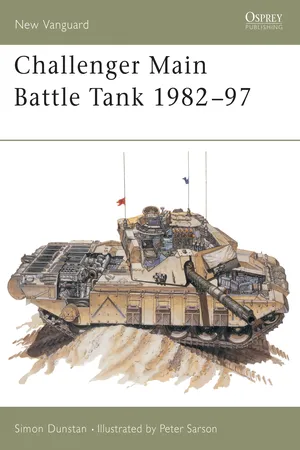
The successor to the Chieftain from the 1960's, work began in 1976 on development of a new MBT specifically for the Iranian army, who needed a more capable tank than the Chieftain to suit their climatic and geographical conditions.
However, once the revolution occurred in 1979 the British army was reluctantly forced to accept this new design themselves. Once in service there were technical problems resulting in various modifications. However, the Challenger would go on to great success in the Gulf War, playing crucial roles in both Desert Storm and Desert Sabre operations.
In this book, Simon Dunstan examines this tank in detail, evaluating its performance both on the test range and in the field of battle.
- 48 pages
- English
- ePUB (mobile friendly)
- Available on iOS & Android
eBook - ePub
Challenger Main Battle Tank 1982–97
About this book
Trusted by 375,005 students
Access to over 1 million titles for a fair monthly price.
Study more efficiently using our study tools.
Information
THE PLATES

A1: CHALLENGER I MK. 2, C Squadron, The Royal Hussars, Fallingbostel, BAOR, West Germany, 17 September 1986 (Sgt. ‘Pink’ Penkethman)
The Royal Hussars were the first armoured regiment to be equipped with Challenger and this one is finished in the standard British Army camouflage scheme of matt black irregular stripes over the green base colour. It also features low visibility callsigns; in this case 21 within a circle denoting the Troop Sergeant of 2 Troop, C Squadron. The callsign is painted on each turret side and on a plate attached to the turret basket facing to the rear. 1a The regimental crest of The Royal Hussars adorns the door front of the TOGS barbette. 1b On the lower hull front is the bridging classification sign of a small black 60 within a solid grey circle, indicating the vehicle’s weight in metric tonnes. Above it is the vehicle registration number 35KA68 inscribed in white on a black rectangle. This is repeated on the rear hull plate beside the right hand light cluster, as viewed, with the letter and number groups arranged vertically. Below the towing bar is a white square with the tank callsign and squadron marking superimposed in black, which can be illuminated at night for vehicle identification by personnel on the ground; for instance during night replenishment. This is common to all Challengers and applies to all the colour plates in this book. It also acts as a convoy distance marker at night. On the left rear hull plate above a jerry can is a first aid box indicated by a red cross on a white solid circle. This Challenger is depicted on Battle Run 9 at the Hohne Ranges near Fallingbostel with Prime Minister Margaret Thatcher in the turret and a Union Flag flying from the radio antenna. During a visit with Chancellor Helmut Kohl, she witnessed a firepower demonstration by a squadron of Challengers and a company of Leopard 2s. The two leaders then each climbed aboard one of their nation’s respective MBTs and fired one round each at a target down range: both being successful much to the organisers’ relief. Following her visit, the PM maintained a keen and inquiring interest in all matters relating to Challenger and the development of its successor.
A2: CHALLENGER I MK. 3, D Squadron, The Royal Scots Dragoon Guards (Carabiniers and Greys), 7th Armoured Brigade Group, Saudi Arabia, 14 November 1990 (Lt. Angus Fraser)
Following several weeks of troop, squadron and regimental training, 7th Armoured Brigade Group was declared operational on 16 November 1990 after a major exercise in the area of Jebel Nufayl. Participating in the FTX, this Challenger 1 Mark 3 belongs to the Troop Leader of 3 Troop, D Squadron, SCOTS DG indicated by the white stencilled callsign on the forward bazooka plate on each side of the tank. The callsign Three Zero is repeated on a metal plate attached to the rear of the turret with the figures and stencilled rectangle painted in yellow on a black background. On the radio antenna is a piece of tape; one of several early measures to identify a troop leader. 2a Behind the commander’s cupola is a TOGS indicator – this one is circular when viewed from any direction. In SCOTS DG, it indicates 3 Troop and is intended to be visible at night through TOGS to aid identification of the various sub-units. Particular to D Squadron is the painting of a white stripe down the middle of the driver’s hatch as a reference for the centre line of the vehicle when closed down. Like several young subalterns in the cavalry regiments deployed on Operation Granby, this troop leader was determined to acquire an Arab polo pony and brought his polo sticks just in case, one of which is stowed in the turret basket. In a similar vein the tank, whose registration number is 79KF22, is named DIOMEDES painted in black on the hull sides beside the driver (2b) – Diomedes who, in Greek legend, was a hero of the siege of Troy second only to Achilles in bravery or, in the Twelve Labours of Hercules, Diomedes was the king of the Bistones who owned horses which were fed on human flesh. Once vanquished by Hercules, Diomedes was given to his own mares to be eaten which, in the context of the Gulf War, is possibly more appropriate. However, the squadron leader, Major ‘Jacko’ Page, on attachment from The Parachute Regiment, did not approve of such embellishments and the name did not last beyond the week. Similarly the polo sticks did not survive beyond Concentration Area Keyes.

Although impressive rates of availability were achieved during the Gulf campaign, this has not necessarily been the case in BAOR where the dearth of spare parts and lack of track mileage for MBTs has on occasions reduced the availability of Challenger to less than 20 per cent. This has been exacerbated by the reduction in the number of training areas in Germany which means that many MBTs are confined to their hangars or tank parks. (Author’s collection)

‘Absolute’, a CRARRV of A Squadron, King’s Royal Hussars, turns off the ‘Panzerstrasse’ to be replenished with fuel during an exercise on the Hohne/Bergen ranges in June 1995; lashed to its hull roof is a burnt-out auxiliary engine which it has just removed from a Challenger MBT. The CRARRV is highly regarded by REME personnel who have christened the vehicle ‘Rhino’ which has been adopted as its official name. (Author’s collection)

B: CHALLENGER I MK. 2 Command Tank, Regimental Headquarters, 14th/20th King’s Hussars, 4th Armoured Brigade, 1st (UK) Armoured Division, Kuwait, 28 February 1991 (Lt.Col. Mike Vickery)
‘EMPEROR’ is the traditional name given to the commanding officer’s tank of the 14th/20th King’s Hussars. It derives from the Battle of Vittoria in 1813 during the Peninsular War when the 14th Regiment of (Light) Dragoons captured the coach of King Joseph Buonaparte as he fled the battlefield. Among the spoils was an item described as ‘a silver utensil’ which was in fact His Majesty’s solid silver chamberpot. This gave rise to the regiment’s nickname thereafter of ‘The Emperor’s Chambermaids’, although the contemporary sobriquet is ‘The Hawks’. The chamberpot has been preserved ever since in the Officers’ Mess and does duty on special occasions as a ‘loving cup’ with the consumption of copious quantities of champagne. Bearing the registration number 36KA34, EMPEROR was one of only a few Mark 2 Challengers in the Gulf theatre that were not fitted with Armoured Charge Bins before the war began. As the armoured regiment within 4th Armoured Brigade it carries the black jerboa brigade insignia on the TOGS barbette. On all quarters it displays the inverted black V mutual recognition device of the coalition forces and, on the sides and turret rear, the callsign One One Bravo, denoting the commanding officer. Accordingly, the EMPEROR is a command tank with a three-radio fit, including BID for secure clear speech communications with higher headquarters which proved to be of a significant factor in the successful conduct of the fast-moving land offensive. Draped over the top of the turret rear is a fluorescent orange air recognition panel and forward of that is the transponder stalk of the Trimble GPS navigation aid which was such a vital asset in the featureless desert; note the top of the device is painted white. On each forward Chobham armour side panel is the unit code 1/1/HQ - the first figure denotes 4th Armoured Brigade; the second the 14th/20th King’s Hussars as the senior regiment within the brigade and finally the sub-unit within that regiment. A Painted in red on the fume extractor of the main armament are silhouettes of the enemy vehicles destroyed by the EMPEROR during the 100-Hours War; EMPEROR’s contribution to the regimental ‘gamebook’ being five T-55s and eight other vehicles including a BRDM-2 which was about to engage the Hawks with Sagger missiles before it was destroyed by One One Bravo.

In January 1996, two armoured squadrons and a headquarters squadron of The Queen’s Royal Hussars deployed to Bosnia as part of the British contingent to the NATO Implementation Force or IFOR. DROITWICH, the tank illustrated in Plate G1, heads a column of AFVS through an area of devastation at Mrkonjic Grad in the first patrol conducted by the Challengers of The Queen’s Royal Hussars. (Author’s collection)

C: CHALLENGER I MK. 3, C Squadron, Queen’s Royal Irish Hussars, 1 Staffords Battle Group, 7th Armoured Brigade, 1st (UK) Armoured Division, Kuwait, 28 February 1991 (Sgt. Tony Stirling)
When the Gulf crisis erupted on 2 August 1990, the QRIH had only recently joined 7th Armoured Brigade in Germany, having been stationed at Tidworth in UK equipped with Chieftain MBT. Accordingly they were new to Challenger and were not scheduled to be fully operational until April 1991. Thus when 7th Armoured Brigade was deployed to the Gulf, the regiment was augmented by a complete squadron of 17th/21st Lancers who had served on Challenger for several years. To benefit from this experience, a formed troop of 17th/21st Lancers was attached to each squadron of the QRIH as their fourth troop. Four One within a circle denotes the Troop Sergeant’s tank of 4 Troop, C Squadron. The latter, together with B Squadron, SCOTS DG, were detached from their parent regiments to form the tank element of 1 Staffords Battle Group. Originally named CRAIGAVON on the hull sides beside the driver’s position, the name was not reapplied on the Cho...
Table of contents
- Cover
- Title Page
- CONTENTS
- CHALLENGER MAIN BATTLE TANK 1982–97
- CHALLENGER TECHNICAL DESCRIPTION
- CANADIAN ARMY TROPHY
- CHALLENGER TO CHALLENGER 2
- THE GULF WAR – OPERATION DESERT SABRE
- PLATES COMMENTARY
- ABOUT THE AUTHOR
- ABOUT THE ILLUSTRATOR
- eCopyright
Frequently asked questions
Yes, you can cancel anytime from the Subscription tab in your account settings on the Perlego website. Your subscription will stay active until the end of your current billing period. Learn how to cancel your subscription
No, books cannot be downloaded as external files, such as PDFs, for use outside of Perlego. However, you can download books within the Perlego app for offline reading on mobile or tablet. Learn how to download books offline
Perlego offers two plans: Essential and Complete
- Essential is ideal for learners and professionals who enjoy exploring a wide range of subjects. Access the Essential Library with 800,000+ trusted titles and best-sellers across business, personal growth, and the humanities. Includes unlimited reading time and Standard Read Aloud voice.
- Complete: Perfect for advanced learners and researchers needing full, unrestricted access. Unlock 1.4M+ books across hundreds of subjects, including academic and specialized titles. The Complete Plan also includes advanced features like Premium Read Aloud and Research Assistant.
We are an online textbook subscription service, where you can get access to an entire online library for less than the price of a single book per month. With over 1 million books across 990+ topics, we’ve got you covered! Learn about our mission
Look out for the read-aloud symbol on your next book to see if you can listen to it. The read-aloud tool reads text aloud for you, highlighting the text as it is being read. You can pause it, speed it up and slow it down. Learn more about Read Aloud
Yes! You can use the Perlego app on both iOS and Android devices to read anytime, anywhere — even offline. Perfect for commutes or when you’re on the go.
Please note we cannot support devices running on iOS 13 and Android 7 or earlier. Learn more about using the app
Please note we cannot support devices running on iOS 13 and Android 7 or earlier. Learn more about using the app
Yes, you can access Challenger Main Battle Tank 1982–97 by Simon Dunstan,Peter Sarson in PDF and/or ePUB format, as well as other popular books in Technology & Engineering & Military & Maritime History. We have over one million books available in our catalogue for you to explore.