The TOGAF® Standard, 10th Edition - A Pocket Guide
eBook - ePub

The TOGAF® Standard, 10th Edition - A Pocket Guide

  1. English
  2. ePUB (mobile friendly)
  3. Available on iOS & Android
eBook - ePub

The TOGAF® Standard, 10th Edition - A Pocket Guide

About this book

This is the official Pocket Guide for the TOGAF® Standard, 10 th Edition from The Open Group. Building on over 25 years of development and constant input from The Open Group Architecture Forum's global community of Enterprise Architecture thought leaders, the TOGAF Standard, 10 th Edition expands the material available to architecture practitioners to make adoption of best practices easier. With greatly expanded guidance and "how-to" material, it enables organizations to operate in an efficient and effective way across a broad range of use-cases, including Agile enterprises and Digital Transformation.The TOGAF Standard is the most prominent and reliable Enterprise Architecture standard, ensuring consistent standards, methods, and communication among Enterprise Architecture professionals. Those professionals who are fluent in the TOGAF approach enjoy greater industry credibility, job effectiveness, and career opportunities. The TOGAF approach helps practitioners avoid being locked into proprietary methods, utilize resources more efficiently and effectively, and realize a greater return on investment.This official Pocket Guide provides an overview of the contents and purpose of the TOGAF Standard in a condensed form. As such it does not cover every aspect of the standard in detail, but provides highlights and key reference information.Topics covered include:

  • A high-level introduction to the TOGAF Standard, introducing the modular TOGAF documentation set, the TOGAF Library, and the TOGAF framework
  • Guidance on how to read the standard
  • An introduction to the general how-to information provided in the TOGAF Standard, including guidance for practitioners, and how to use the standard in the Digital Enterprise
  • An overview of guidance to support the establishment of an Enterprise Architecture team
  • An overview of the guidance provided in the TOGAF Standard for specific topic domains, including Security Architecture, Business Architecture, Data/Information Architecture, Agile Methods, and Reference Models and Methods
  • An introduction to the TOGAF Fundamental Content documents provided in the TOGAF Standard, which describe the concepts considered to be universally applicable to the TOGAF framework, including:
    • Key techniques of the ADM cycle
    • Guidelines for adapting the TOGAF ADM for different usage scenarios
    • The Architecture Content Framework
    • Enterprise Architecture Capability and Guidance
  • The TOGAF Architecture Development Method (ADM), including summary phases for each of the ADM phases
  • An overview of ADM deliverables

Frequently asked questions

Yes, you can cancel anytime from the Subscription tab in your account settings on the Perlego website. Your subscription will stay active until the end of your current billing period. Learn how to cancel your subscription.
At the moment all of our mobile-responsive ePub books are available to download via the app. Most of our PDFs are also available to download and we're working on making the final remaining ones downloadable now. Learn more here.
Perlego offers two plans: Essential and Complete
  • Essential is ideal for learners and professionals who enjoy exploring a wide range of subjects. Access the Essential Library with 800,000+ trusted titles and best-sellers across business, personal growth, and the humanities. Includes unlimited reading time and Standard Read Aloud voice.
  • Complete: Perfect for advanced learners and researchers needing full, unrestricted access. Unlock 1.4M+ books across hundreds of subjects, including academic and specialized titles. The Complete Plan also includes advanced features like Premium Read Aloud and Research Assistant.
Both plans are available with monthly, semester, or annual billing cycles.
We are an online textbook subscription service, where you can get access to an entire online library for less than the price of a single book per month. With over 1 million books across 1000+ topics, we’ve got you covered! Learn more here.
Look out for the read-aloud symbol on your next book to see if you can listen to it. The read-aloud tool reads text aloud for you, highlighting the text as it is being read. You can pause it, speed it up and slow it down. Learn more here.
Yes! You can use the Perlego app on both iOS or Android devices to read anytime, anywhere — even offline. Perfect for commutes or when you’re on the go.
Please note we cannot support devices running on iOS 13 and Android 7 or earlier. Learn more about using the app.
Yes, you can access The TOGAF® Standard, 10th Edition - A Pocket Guide by Andrew Josey,Dave Hornford in PDF and/or ePUB format, as well as other popular books in Education & Architecture General. We have over one million books available in our catalogue for you to explore.

Information

1. Introduction

This chapter provides an introduction to the TOGAF® Standard, an open, industry consensus framework for Enterprise Architecture.
Topics addressed in this chapter include:
An introduction to the TOGAF Standard
The structure and content of the TOGAF documentation
An overview of the TOGAF Standard
The TOGAF Library
An overview of the TOGAF framework
How to read the standard

1.1. Introduction to the TOGAF Standard

The TOGAF Standard is a framework for Enterprise Architecture. Put simply, it is a standard approach for developing, approving, using, and maintaining Enterprise Architectures. It applies to all Enterprise Architecture practices. It is based on an iterative process model supported by best practices and a re-usable set of existing architectural assets.
The TOGAF Standard is developed and maintained by members of The Open Group, working within the Architecture Forum. The original development of the TOGAF Standard, Version 1 in 1995 was based on the US Department of Defense Technical Architecture Framework for Information Management (TAFIM). Starting from this sound foundation, The Open Group Architecture Forum has developed successive versions of the TOGAF Standard at regular intervals and published each one on The Open Group public website. Successive versions have represented the current state of stable, scalable, best practice.
This version builds on previous versions of the TOGAF Standard, expanding and updating the material available to architecture practitioners to assist them in building a sustainable Enterprise Architecture.

1.2. Structure of the TOGAF Documentation

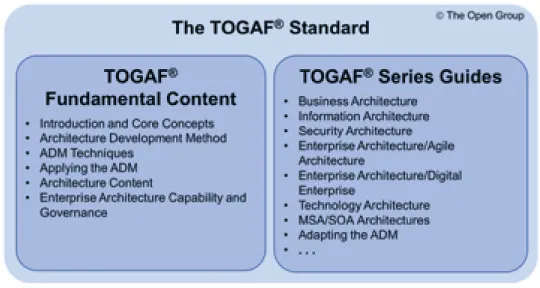
The TOGAF documentation set is structured to address the transition from common universal concepts to the unique configuration within an organization. It includes the formal TOGAF Standard and a broader body of knowledge in the TOGAF Library, as shown in Figure 1.
The TOGAF Standard represents today’s stable, scalable, best practices, with concepts and guidance that apply across industries, scale, and pace of change. This is expected from a standard – proven practices, stable concepts, and being actionable. The TOGAF Standard provides a body of proven practices addressing its broad uses. The TOGAF Fundamental Content includes the universal concepts of Enterprise Architecture. The TOGAF Series Guides take these concepts and make them actionable. Together, the TOGAF Fundamental Content and the TOGAF Series Guides are the TOGAF Standard.
Illustration
Figure 1. The TOGAF Documentation Set
The intent of dividing the TOGAF Standard into these separate documents is to allow for different areas of specialization to be considered in detail and potentially addressed in isolation. Although all the constituent documents work together as a whole, it is also feasible to select particular documents for adoption while excluding others.
The TOGAF documentation set structure is modular. There is a clear hierarchy from the universal concepts in the TOGAF Fundamental Content, to the stable best practices in the TOGAF Series Guides, to emerging ideas in the TOGAF Library. The structure of the TOGAF documentation set makes the adoption of your optimal method easier.

1.3. An Overview of the TOGAF Standard

Illustration
Figure 2. The TOGAF Standard
The TOGAF Standard applies to all Enterprise Architecture practices. It does not matter whether your architecture will support strategy, portfolio, project, or solution delivery, or whether it is about embarking on a Digital Transformation or legacy simplification. The TOGAF Fundamental Content and TOGAF Series Guides provide enduring, stable, universal concepts, and proven best practices.

1.3.1. The TOGAF Fundamental Content

The TOGAF Fundamental Content consists of six documents as shown in Table 1. Central to the TOGAF Fundamental Content is the TOGAF Architecture Development Method (ADM), which provides a tested and repeatable process for developing architectures.
Table 1. TOGAF Fundamental Content Documents
Document
Summary
The TOGAF Standard: Introduction and Core Concepts (see Section 5.1)
This document introduces the TOGAF Standard. It provides an executive overview of Enterprise Architecture and the TOGAF Standard; it describes the structure of the TOGAF documentation set, the core concepts of the framework, together with terminology and definitions that apply to the Fundamental Content.
The TOGAF Standard: Architecture Development Method (see Chapter 6)
This document describes the TOGAF ADM, which is an iterative approach to developing an Enterprise Architecture.
The TOGAF Standard: ADM Techniques (see Section 5.3)
This document contains a collection of techniques available for applying the TOGAF approach and the TOGAF ADM.
The TOGAF Standard: Applying the ADM (see Section 5.4)
This document contains guidelines for adapting the TOGAF ADM to address the specific style of architecture required in a practical context.
The TOGAF Standard: Architecture Content (see Section 5.5)
This document describes the TOGAF Content Framework, a structured metamodel for architectural artifacts, and an overview of typical architecture deliverables.
The TOGAF Standard: Enterprise Architecture Capability and Governance (see Section 5.6)
This document describes the organization, processes, skills, roles, and responsibilities required to establish and operate an architecture function within an enterprise and describes an Enterprise Architecture governance framework.
The role of the TOGAF ...

Table of contents

  1. Cover
  2. Title
  3. Colofon
  4. Table of Contents
  5. Preface
  6. About the Authors
  7. Trademarks
  8. Acknowledgements
  9. 1. Introduction
  10. 2. General How-To Information
  11. 3. Establishing an Enterprise Architecture Team
  12. 4. Domain-Specific Guidance
  13. 5. TOGAF Fundamental Content
  14. 6. The TOGAF Architecture Development Method
  15. 7. ADM Deliverables
  16. A: Glossary and Acronyms
  17. Index