This document is a compilation of two documents within the TOGAF® Standard. It has been developed and approved by The Open Group, and is part of the TOGAF Standard, 10th Edition.
The two documents in this set are:
1. TOGAF Standard — Architecture Content
This document describes the TOGAF Content Framework and a structured metamodel for architectural artifacts, the use of re-usable Architecture Building Blocks (ABBs), and an overview of typical architecture deliverables.
2. TOGAF Standard — Enterprise Architecture Capability and Governance
This document discusses the organization, processes, skills, roles, and responsibilities required to establish and operate an architecture function within an enterprise, and describes an Enterprise Architecture governance framework.
The TOGAF Standard is intended for Enterprise Architects, Business Architects, IT Architects, Data Architects, Systems Architects, Solution Architects, and anyone responsible for the architecture function within an organization.
- English
- ePUB (mobile friendly)
- Available on iOS & Android
eBook - ePub
The TOGAF® Standard, 10th Edition Content, Capability, and Governance
About this book
Information
Topic
EducationSubtopic
Architecture GeneralThe TOGAF Standard
The TOGAF® Standard, 10th Edition — Architecture Content
The Open Group
Chapter 1: Introduction
This chapter provides an introduction to the guidance provided in the TOGAF Standard — Architecture Content (this document).
1.1 Overview
Architects executing the Architecture Development Method (ADM) will produce a number of outputs as a result of their efforts, such as process flows, architectural requirements, project plans, or project compliance assessments. The Content Framework provides a structural model for architectural content that allows the major work products that an architect creates to be consistently defined, structured, and presented.
The Content Framework provided here is intended to allow the TOGAF framework to be used as a stand-alone framework for architecture within an enterprise. However, other Content Frameworks exist (such as the Zachman® Framework) and it is anticipated that some enterprises may opt to use an external framework in conjunction with the TOGAF framework. In these cases, the TOGAF Content Framework provides a useful reference and starting point for TOGAF content to be mapped to other Content Frameworks.
The Architecture Content Framework uses the following three categories to describe the type of architectural work product within the context of use:
■ A deliverable is a work product that is contractually specified and in turn formally reviewed, approved, and signed off by the stakeholders
Deliverables represent the output of projects and those deliverables that are in documentation form will typically be archived at completion of a project, or transitioned into an Architecture Repository as a reference model, standard, or snapshot of the Architecture Landscape at a point in time.
■ An artifact is an architectural work product that describes an aspect of the architecture
Artifacts are generally classified as catalogs (lists of things), matrices (showing relationships between things), and diagrams (pictures of things). Examples include a requirements catalog, application interaction matrix, and a value chain diagram. An architectural deliverable may contain many artifacts and artifacts will form the content of the Architecture Repository.
■ A building block represents a potentially re-usable component of enterprise capability that can be combined with other building blocks to deliver architectures and solutions
Building blocks can be defined at various levels of detail, depending on what stage of architecture development has been reached. For instance, at an early stage, a building block can simply consist of a name or an outline description. Later on, a building block may be decomposed into multiple supporting building blocks and may be accompanied by a full specification. Building blocks can relate to "architectures" or "solutions".
— Architecture Building Blocks (ABBs) typically describe what is required of SBBs at a more logical or supplier-independent level; those requirements may include services to be performed, data resources, and capabilities needed. ABBs include logical business, application, and technology components
— Solution Building Blocks (SBBs) represent physical or supplier-specific components that have the capability to realize part or all of a more logical ABB. There are business, application, and technology SBBs.
The relationships between deliverables, artifacts, and building blocks are shown in Figure 1-1.
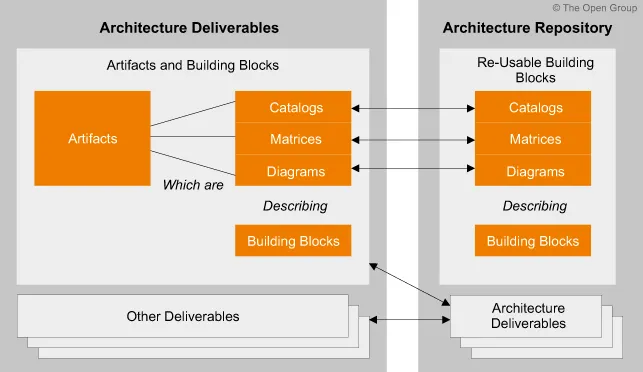
Figure 1-1 Relationships between Deliverables, Artifacts, and Building Blocks
For example, an Architecture Definition Document is a deliverable that documents an Architecture Description. This document will contain a number of complemen...
Table of contents
- Cover
- Title
- Colofon
- Contents
- List of Figures
- Preface
- Trademarks
- Referenced Documents
- Volume Architecture Content
- Volume Enterprise Architecture Capability and Governance
- Index
Trusted by 375,005 students
Access to over 1.5 million titles for a fair monthly price.
Study more efficiently using our study tools.
Frequently asked questions
Yes, you can cancel anytime from the Subscription tab in your account settings on the Perlego website. Your subscription will stay active until the end of your current billing period. Learn how to cancel your subscription
No, books cannot be downloaded as external files, such as PDFs, for use outside of Perlego. However, you can download books within the Perlego app for offline reading on mobile or tablet. Learn how to download books offline
Perlego offers two plans: Essential and Complete
- Essential is ideal for learners and professionals who enjoy exploring a wide range of subjects. Access the Essential Library with 800,000+ trusted titles and best-sellers across business, personal growth, and the humanities. Includes unlimited reading time and Standard Read Aloud voice.
- Complete: Perfect for advanced learners and researchers needing full, unrestricted access. Unlock 1.5M+ books across hundreds of subjects, including academic and specialized titles. The Complete Plan also includes advanced features like Premium Read Aloud and Research Assistant.
We are an online textbook subscription service, where you can get access to an entire online library for less than the price of a single book per month. With over 1.5 million books across 990+ topics, we’ve got you covered! Learn about our mission
Look out for the read-aloud symbol on your next book to see if you can listen to it. The read-aloud tool reads text aloud for you, highlighting the text as it is being read. You can pause it, speed it up and slow it down. Learn more about Read Aloud
Yes! You can use the Perlego app on both iOS and Android devices to read anytime, anywhere — even offline. Perfect for commutes or when you’re on the go.
Please note we cannot support devices running on iOS 13 and Android 7 or earlier. Learn more about using the app
Please note we cannot support devices running on iOS 13 and Android 7 or earlier. Learn more about using the app
Yes, you can access The TOGAF® Standard, 10th Edition Content, Capability, and Governance by The Open Group in PDF and/or ePUB format, as well as other popular books in Education & Architecture General. We have over 1.5 million books available in our catalogue for you to explore.