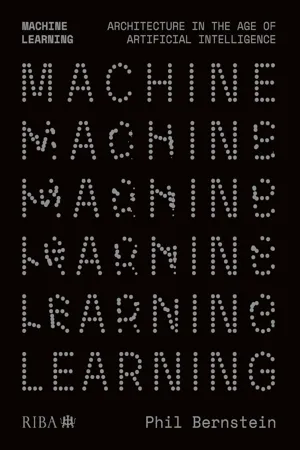
Machine Learning
eBook - ePub

Machine Learning

Architecture in the age of Artificial Intelligence

  1. 200 pages
  2. English
  3. ePUB (mobile friendly)
  4. Available on iOS & Android
eBook - ePub

Machine Learning

Architecture in the age of Artificial Intelligence

About this book

'The advent of machine learning-based AI systems demands that our industry does not just share toys, but builds a new sandbox in which to play with them.' - Phil Bernstein

The profession is changing. A new era is rapidly approaching when computers will not merely be instruments for data creation, manipulation and management, but, empowered by artificial intelligence, they will become agents of design themselves. Architects need a strategy for facing the opportunities and threats of these emergent capabilities or risk being left behind. Architecture's best-known technologist, Phil Bernstein, provides that strategy. Divided into three key sections – Process, Relationships and Results – Machine Learning lays out an approach for anticipating, understanding and managing a world in which computers often augment, but may well also supplant, knowledge workers like architects. Armed with this insight, practices can take full advantage of the new technologies to future-proof their business. Features chapters on:

  • Professionalism
  • Tools and technologies
  • Laws, policy and risk
  • Delivery, means and methods
  • Creating, consuming and curating data
  • Value propositions and business models.

Frequently asked questions

Yes, you can cancel anytime from the Subscription tab in your account settings on the Perlego website. Your subscription will stay active until the end of your current billing period. Learn how to cancel your subscription.
No, books cannot be downloaded as external files, such as PDFs, for use outside of Perlego. However, you can download books within the Perlego app for offline reading on mobile or tablet. Learn more here.
Perlego offers two plans: Essential and Complete
  • Essential is ideal for learners and professionals who enjoy exploring a wide range of subjects. Access the Essential Library with 800,000+ trusted titles and best-sellers across business, personal growth, and the humanities. Includes unlimited reading time and Standard Read Aloud voice.
  • Complete: Perfect for advanced learners and researchers needing full, unrestricted access. Unlock 1.4M+ books across hundreds of subjects, including academic and specialized titles. The Complete Plan also includes advanced features like Premium Read Aloud and Research Assistant.
Both plans are available with monthly, semester, or annual billing cycles.
We are an online textbook subscription service, where you can get access to an entire online library for less than the price of a single book per month. With over 1 million books across 1000+ topics, we’ve got you covered! Learn more here.
Look out for the read-aloud symbol on your next book to see if you can listen to it. The read-aloud tool reads text aloud for you, highlighting the text as it is being read. You can pause it, speed it up and slow it down. Learn more here.
Yes! You can use the Perlego app on both iOS or Android devices to read anytime, anywhere — even offline. Perfect for commutes or when you’re on the go.
Please note we cannot support devices running on iOS 13 and Android 7 or earlier. Learn more about using the app.
Yes, you can access Machine Learning by Phil Bernstein in PDF and/or ePUB format, as well as other popular books in Architecture & Artificial Intelligence (AI) & Semantics. We have over one million books available in our catalogue for you to explore.

BIBLIOGRAPHY

  • Agrawal, A. Gans, J. and Goldfarb, A. Prediction Machines: The Simple Economics of Artificial Intelligence, Harvard Business Review Press, Boston, MA, 2018.
  • Alberti, L.B. On the Art of Building in Ten Books, MIT Press, Cambridge, MA, 1988. American Institute of Architects. 'AIA Document B101-2017: Standard Form of Agreement Between Owner and Architect, 2017, American Institute of Architects, Washington, DC: AIA, 2017.
  • The Architect's Handbook of Professional Practice: 15th Edition. Wiley, Hoboken, NJ, 2014.
  • The Business of Architecture 2020. American Institute of Architects. Washington, DC, 2020.
  • Anderson, S. 'Problem-Solving and Problem-Worrying', Lectures given at Architectural Association, London, March 1966 and ASCA Cranbrook, 5 June 1966.
  • Architects Council of Europe with Nacey Research. The Architectural Profession in Europe 2020, 2021.
  • Architects Registration Board. ARB Criteria at Part 3 Prescription of Qualifications. Architects Registration Board, 2012.
  • The Architects Code: Standards of Professional Conduct and Practice, 2017.
  • Asadi, E. Li, B. and Chen, I. 'Pictobot: A Cooperative Painting Robot for Interior Finishing of Industrial Developments', IEEE Robotics & Automation Magazine, Vol. 25, issue June 2018, 2018, p 13.
  • Association of General Contractors of America. Construction Inflation Report Q1 2021, AGC America, Washington, DC, 2021.
  • Autor, D. 'Why are there Still So Many Jobs? The History and Future of Workplace Automation', Journal of Economics Perspectives, Vol. 29, issue 3, 2015, pp 3-30.
  • Baker, K. 'How Many Architects Does Our Economy Need?', ARCHITECT, 5 January 2018.
  • Baker, K. et. al. Compensation Report 2019, American Institute of Architects, Washington, DC, 2019.
  • Bernstein, H.M. Managing Uncertainty and Expectations in Building Design and Construction, McGraw Hill Construction Analytics, New York, 2014.
  • Bernstein, P. Architecture, Design, Data: Practice Competency in the Era of Computation, Birkhauser, Basel, 2018.
  • – 'Canonical Models of Architecture', LOG: Model Behavior, Vol. 50, issue 2021, pp 239-48.
  • Bernstein, P. and Deamer, Peggy. BIM In Education, Yale University School of Architecture, NH, 2011.
  • Bernstein, P. 'Intention to Artifact' in Digital Workflows in Architecture: Design–Assembly–Industry, ed. Scott Marble, Birkhäuser, Basel, 2012.
  • – 'The Distractions of Disruptions: Technical Supply in an Era of Social Demand', Architectural Design (AD), Vol. 90, issue 2, 2020, pp 11.
  • – 'Innovative Tools in the Movement Toward Slave-Free Building', in Sharon Price, Harriet Harriss, Phillip Bernstein, Susan Jones, Christ Sharples and Michael Green (eds), Grace Farms/Pratt Institute Seminar Series, 2020.
  • BIM Industry Working Group. BIM Management for Value, Cost & Carbon Improvement: A Report for The Government Construction Client Group, UK Government Department of Business, Innovation and Skills.London, https://www.hse.gov.uk/construction/areyou/principal-designer.htm, 2021 (accessed 6 June 2021).
  • Brockman, J. Possible Minds: Twenty-five Ways of Looking at Al, Penguin Press, New York, 2019.
  • Brynjolfsson, E. and McAfee, A. The Second Machine Age: Work, Progress, and Prosperity in a Time of Brilliant Technologies, W.W. Norton & Company, New York, 2014.
  • Brynjolfsson, E. and T. Mitchell. 'What Can Machine Learning Do? Workforce Implications', Science, Vol. 358w, https://doi.org/10.1126/science.aap8062, 2017 (accessed 27 December 2020).
  • Brynjolfsson, E. and A. McAfee. 'Will Humans Go the Way of Horses? Labor in the Second Machine Age', Foreign Affairs, Vol. 94, issue 4, 2015, pp 8-14.
  • Carpo, M. The Alphabet and the Algorithm, MIT Press, Cambridge, MA, 2011.
  • The Digital Turn in Architecture 1992-2012, Wiley, Chichester, 2013.
  • The Second Digital Turn: Design beyond Intelligence, MIT Press, Cambridge, MA, 2017.
  • Carr, N.G, 'IT Doesn't Matter', Harvard Business Review, https://hbr.org/2003/05/it-doesnt-matter,...

Table of contents

  1. Cover
  2. Title
  3. Copyright
  4. FRONT MATERIALS
  5. Contents
  6. PROCESS
  7. RELATIONSHIPS
  8. RESULTS
  9. CONCLUSION
  10. END MATERIALS