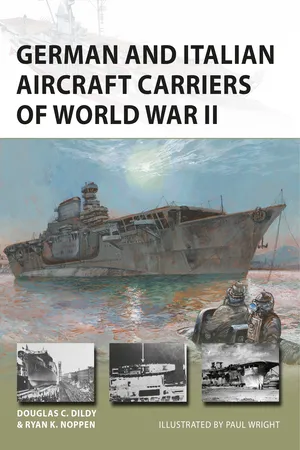
This fully illustrated study details Germany and Italy's failed development of World War II aircraft carriers, and the naval aviation ships that the two Axis powers sent into action in their place.
The quest for a modern aircraft carrier was the ultimate symbol of the Axis powers' challenge to Allied naval might, but fully-fledged carriers proved either too difficult, expensive or politically unpopular for either to make operational. After the Anglo-German Naval Agreement of 1935, Hitler publicly stated his intention to build an aircraft carrier, the Graf Zeppelin, which was launched in 1938. A year later, the ambitious fleet-expansion Z-Plan, was unveiled with two additional aircraft carriers earmarked for production . However, by the beginning of World War II, Graf Zeppelin was not yet completed and work was halted. Further aircraft carrier designs and conversion projects such as the ocean liner Europa and heavy cruiser Seydlitz were considered but, in January 1943, all construction work on surface vessels ceased and naval resources were diverted to the U-boat Campaign.
This book explains not only the history of Germany's famous Graf Zeppelin fleet carrier and German carrier conversion projects but also Italy's belated attempt to convert two of her ocean liners into carriers. It considers the role of naval aviation in the two countries' rearmament programmes and describes how ultimately it was only Italian seaplane carriers and German ocean-going, catapult-equipped flying boat carriers that both Axis powers did eventually send into combat.
eBook - ePub
German and Italian Aircraft Carriers of World War II
- 48 pages
- English
- ePUB (mobile friendly)
- Available on iOS & Android
eBook - ePub
German and Italian Aircraft Carriers of World War II
About this book
Trusted by 375,005 students
Access to over 1.5 million titles for a fair monthly price.
Study more efficiently using our study tools.
Information
GERMAN AND ITALIAN AIRCRAFT CARRIERS OF WORLD WAR II
GERMANY
Introduction
Although the field of aviation was still in its infancy, by the beginning of World War I the leadership of the German Kaiserliche Marine (Imperial Navy) possessed a forward-thinking vision of the strategic use of naval aviation. Long-range reconnaissance and naval mine detection, coupled with the new technology of radio communication, were two strategic tasks which German naval planners quickly realized could be accomplished from the air, giving the Kaiserliche Marine an unprecedented over-the-horizon capability. The primary technological medium initially selected for these tasks was the rigid airship, or dirigible, and the Kaiserliche Marine invested significantly in its development; more than 80 dirigibles were constructed by the Luftschiffbau Zeppelin and Luftschiffbau Schütte-Lanz companies for the Kaiserliche Marine from 1912 to 1918. The preference for the dirigible over heavier-than-air aircraft throughout the first half of the war was technologically myopic in hindsight, but the long-range and combat capabilities of naval aircraft were minimal at best for much of the war. The short range of early float and sea planes, their limited armament and payload, and their inability to operate in inclement weather were some of the reasons the Kaiserliche Marine did not heavily invest in seaplane carriers and tenders. Another reason was that its handful of seaplane tenders, as well as those of the British Royal Navy and the French Marine Nationale, were converted from merchant vessels which did not possess the speeds sufficient to operate with battle fleets. Lastly, the Marinenachrichtendienst (Naval Intelligence Service) followed the troubled development and operations of HMS Campania, the Royal Navy’s first ship with a practical flight deck; its relatively unsuccessful service from 1915 to 1917 convinced German admirals that such projects did not warrant further research and development.
German seaplane carriers, 1914–18
Entering World War I, Großadmiral (Grand Admiral) Alfred von Tirpitz, head of the Reichsmarineamt (Imperial Naval Office), and the “big gun” battleship admirals of the Kaiserliche Marine’s Hochseeflotte (High Seas Fleet) were counting on Ferdinand Graf (Count) von Zeppelin’s dirigible airships for long-range maritime surveillance, fleet reconnaissance, and bombing operations. While potentially effective in these roles, the huge slow airships were unable to provide timely tactical reconnaissance for smaller forces operating primarily in the Baltic Sea.

The Kaiserliche Marine seaplane carrier SMS Santa Elena, assigned to Germany’s Baltic Fleet and capable of operating four float biplanes (two from each side), seen here with the starboard hangars open and six Friedrichshafen FF.33 two-seat reconnaissance floatplanes visible. (Ryan Noppen Collection)
Consequently, towards the end of 1914, the Kaiserliche Marine authorized the modification of the captured British merchantman Glyndwr to embark and employ up to four floatplanes (two carried aft on the aft well deck, with two more stored in the holds) by lowering them into the water for take-off. The modifications were completed, and the 6,000-ton ship was commissioned into the Kaiser’s navy as an “auxiliary seaplane carrier” in December 1914. However, it was severely damaged by mines six months later while returning from a seaplane raid on a Russian factory on the coast of the Gulf of Riga and was never fully repaired or returned to service as an active seaplane carrier.
Nevertheless, the Glyndwr’s operations were encouraging enough for three more merchantmen to be made into auxiliary seaplane carriers. The first two were the 13,900-ton Answald and the 13,200-ton Santa Elena, both commissioned in July 1915, after conversion by Danzig Kaiserliche Werft. Modifications included being fitted with hangars and hoisting booms fore and aft of the central superstructure with two 3.4cm/45cal antiaircraft (AA) guns mounted on the fo’c’sle and stern. Each ship operated four reconnaissance floatplanes – looking for Russian naval vessels – for the Baltic Fleet.
These operations were successful enough to warrant augmenting the pair with a third seaplane carrier, and the interned Br...
Table of contents
- Cover
- Title Page
- Table of Contents
- Germany
- Italy
- Conclusion
- Select Bibliography
- eCopyright
Frequently asked questions
Yes, you can cancel anytime from the Subscription tab in your account settings on the Perlego website. Your subscription will stay active until the end of your current billing period. Learn how to cancel your subscription
No, books cannot be downloaded as external files, such as PDFs, for use outside of Perlego. However, you can download books within the Perlego app for offline reading on mobile or tablet. Learn how to download books offline
Perlego offers two plans: Essential and Complete
- Essential is ideal for learners and professionals who enjoy exploring a wide range of subjects. Access the Essential Library with 800,000+ trusted titles and best-sellers across business, personal growth, and the humanities. Includes unlimited reading time and Standard Read Aloud voice.
- Complete: Perfect for advanced learners and researchers needing full, unrestricted access. Unlock 1.5M+ books across hundreds of subjects, including academic and specialized titles. The Complete Plan also includes advanced features like Premium Read Aloud and Research Assistant.
We are an online textbook subscription service, where you can get access to an entire online library for less than the price of a single book per month. With over 1.5 million books across 990+ topics, we’ve got you covered! Learn about our mission
Look out for the read-aloud symbol on your next book to see if you can listen to it. The read-aloud tool reads text aloud for you, highlighting the text as it is being read. You can pause it, speed it up and slow it down. Learn more about Read Aloud
Yes! You can use the Perlego app on both iOS and Android devices to read anytime, anywhere — even offline. Perfect for commutes or when you’re on the go.
Please note we cannot support devices running on iOS 13 and Android 7 or earlier. Learn more about using the app
Please note we cannot support devices running on iOS 13 and Android 7 or earlier. Learn more about using the app
Yes, you can access German and Italian Aircraft Carriers of World War II by Ryan K. Noppen,Douglas C. Dildy,Paul Wright in PDF and/or ePUB format, as well as other popular books in History & German History. We have over 1.5 million books available in our catalogue for you to explore.