During the 19th century, US forces confronted the Seminole people in a series of bitter wars over the fate of Florida.
After the refusal of the Seminoles to move west to the Creek Reservation in Mississippi, the US government sent troops to bring Florida under federal control, marking the beginning of the Second Seminole War. On December 28, 1835, troops led by Major Francis Langhorne Dade were ambushed and massacred en route to Fort King.
Two years of guerrilla warfare ensued, as the Seminoles evaded the US forces sent to defeat them. Ordered to hunt down the Seminoles, a US force led by Colonel Zachary Taylor incurred heavy losses at the battle of Lake Okeechobee (December 25, 1837), but the Seminoles were forced to withdraw. At the battle of the Loxahatchee River (January 24, 1838), forces led by Major General Thomas S. Jesup encountered a large group of Seminoles and met them with overwhelming numbers and greater firepower.
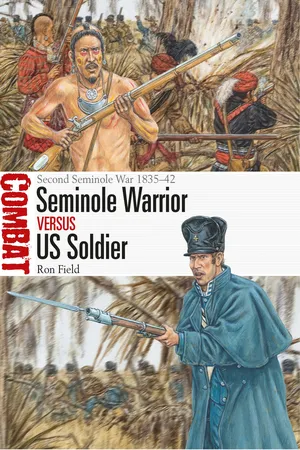
Despite their stubborn efforts to resist the US military, the Seminoles were defeated and Florida became a state of the Union in 1845. This fully illustrated study assesses the forces fighting on both sides, casting light on the tactics, weaponry, and combat record of the Seminole warriors and their US opponents during the Second Seminole War.
- 80 pages
- English
- ePUB (mobile friendly)
- Available on iOS & Android
eBook - ePub
About this book
Information
The Opposing Sides
ORIGINS AND ORGANIZATION
Seminole
According to Richard K. Call, the third Governor of the Territory of Florida, the Seminoles and their allies could field between 1,200 and 2,000 warriors of either Indian or African-American origin at the beginning of the Second Seminole War. These were supplemented by an unknown number of Creeks (American State Papers “Military Affairs,” Vol. 7: 218). The numbers dwindled considerably during the course of the war as chiefs, subtribes, and clans surrendered or reluctantly turned themselves in for migration west.

Originally published in Vues et Souvenirs de l’Amérique du Nord by Francis Comte de Castelnau (1802–80) in 1842, this lithograph depicts a Lower Creek village on the Apalachicola River c.1838. (Florida Photographic Collection RC12212)

A nephew of Seminole Chief Micanopy, Coacoochee was captured with Osceola on October 21, 1837, under a white flag of truce and imprisoned in Fort Marion, St. Augustine, but escaped on the night of November 29/30 and fought at Lake Okeechobee on December 25. He was eventually captured on June 4, 1841 and on October 11 that year was sent to the Indian reservation in Arkansas Territory. This illustration was published in 1848 in John T. Sprague’s The Origin, Progress, and Conclusion of the Florida War. (Internet Archive)
Much of the organization, training, and customs of the Seminoles were based on Creek culture, social order, and warfare. They formed themselves into clans, which tended to live in their own talwas or towns. At the top of the social hierarchy, the town elders were responsible for electing the talwa leader known as the Mico, the chief of the clan (Covington 1993: 6). The Seminoles generally adhered to the Creek traditions of warfare and placed their warriors into four classes, which were selected by the clan elders. The tustunugee was regarded as a war leader, the imala lakalgi and the labotskalgi were of secondary and tertiary importance, and the Imala was the lowest class of warrior.

Seminole warrior
Dade’s Massacre, December 28, 1835

This plate depicts a Seminole warrior about to fire on the column led by Brevet Major Francis L. Dade following the first signal shot fired by Chief Micanopy. Approximately half the column of US troops fell dead or wounded as a result of this first volley.

Weapons, dress and equipment
His main weapon is a “Wickham Type” Indian Trade Rifle (1), which was a smoothbore version of the Model 1814 Common Rifle. This weapon has been altered from flintlock to percussion and fires a .54-caliber ball; it has iron mounts and an oval patch box in the butt. Its maximum range was about 300yd with an effective range of only about 50yd or less. Attached to the warrior’s waist belt is a spear-pointed knife (2) in a leather sheaf decorated with painted and dyed porcupine quills. The knife handle is incised with an irregular pattern. His cartridges and caps are carried in a leather pouch (3) worn over his left shoulder with the pouch on the right hip.
His hair (4) is cut close to the head, except for a strip about 1in wide running over the front of the scalp from temple to temple, and another strip, of about the same width, perpendicular to the former, crossing the crown of the head to the nape of the neck. At each temple a heavy tuft of hair (5) is allowed to hang to the bottom of the lobe of the ear. The long hair of the strip crossing to the neck is gathered and braided into two ornamental queues. He has two wild turkey feathers tied into his hair (6), and his face is painted with half-circles beneath his eyes, and large circles on each cheek (7), the colors representing war and death respectively. He also wears a moustache and imperial or goatee beard on his face. His chest and arms are also streaked with paint (8).
Clothing includes a cotton breech cloth (9) with appliquéd edging, and tassels. Fastened around his waist with tassels is a narrow leather belt (10) with a wool cloth panel inset with glass beadwork. A gorget (11) of plain hammered silver and a star-pattern medallion (12) are hung around his neck. Supported by leather thongs tied around his waist belt, his buckskin leggings (13) are made of deerskin. Leg garters (14) made of finger-woven wool yarn, with miniature glass beads, are tied just below his knees. His plain moccasins (15) are each made from one piece of buckskin gathered together and stitched in a pucker on top of the foot and behind the heel.

Seminole Chief Ee-mat-lá, or King Phillip, was painted by George Catlin while imprisoned at Fort Moultrie, near Charleston, South Carolina, in January 1838. Catlin described him as a “very aged chief, who has been a man of great notoriety and distinction in his time” (Catlin 1845: 220). Ee-mat-lá died on October 8, 1839, while being transported west (Catlin, Letters and Notes, vol. 2, no. 57, 1841; reprint 1973). (Smithsonian American Art Museum, Gift of Mrs. Joseph Harrison, Jr., 1985.66.302)
Having earned his position based upon his prowess in combat, the tustunugee was charged with mustering the warriors and leading them during raids. In the event of war, he gathered the warriors by placing a red club in the town square. He also placed a number of red sticks, to signify the number of days before the warriors must gather, in the hands of war leaders from neighboring bands and directed them to muster their warriors. Once gathered, the warriors sat in the council lodge to listen to the war plans of the tustunugee and make final preparations for the impending action (Covington 1993: 7).
Once a tustunugee had secured followers for his war party, tradition required that the party perform certain rituals. Every warrior set out to purify himself in order to suppress the wants of the flesh by taking part with others in the ceremony of the black drink, which was a strong emetic that thoroughly cleansed the digestive tract. Seated in a circle, the warriors received the potion from a medicine man and swallowed it in heavy drafts, following which each warrior would experience stomach pains and projectile vomit for some time until his system was empty. Following this, the warriors fasted and refrained from cohabiting with their women. Thus, purity and abstention would lead them to victory. Even on the expedition which followed, however, the warriors ate little and took little rest. Vestiges of these ancient practices still existed in 1836; but the nature of the Second Seminole War, which involved guerrilla tactics involving smaller numbers rather than larger war parties going into battle, meant these practices and rituals faded out and warriors ate and drank whenever they could. Some imbibed alcohol when it could be procured (Mahon 2017: 14).
US Army
On the eve of the Second Seminole War, the aggregate strength of the US Army was 7,151 officers and men composed of the 1st through 7th Infantry, 1st through 4th Artillery, and the Regiment of Dragoons (American State Papers “Military Affairs,” Vol. 5: 634). The regiments were scattered throughout the United States for the defense of the inland and maritime frontiers, with only nine companies of artillery and two companies of infantry – altogether only 26 officers and 510 men – posted in Florida (Risch 1989: 220).
As a result of the demand for a greater force of the regular army to overcome the Seminoles, elements of the 2d, 3d, and 4th Artillery, and 2d Dragoons, plus a battalion of US Marines, were also required to serve as infantry in the swamplands of Florida. By November 30, 1836, a total of 76 officers and 1,681 men of all branches of service were posted in the territory. By November 30, 1837, the regular force had increased to 230 officers and 4,322 men and, although numbers were reduced as the Seminoles were subjugated during the next three years, there were still 186 officers and 3,615 men on duty in Florida in 1841. This regular force was supplemented throughout most of the war by Floridian mounted volunteers, plus those from states such as Tennessee, Alabama, and Louisiana. Enlisted for terms of three, six, or 12 months, all these volunteers were also often required to fight on foot (Sprague 1848: 103–06).
From 1821 through 1836, the company was at its smallest size in the US Army. The infantry company had a maximum authorized strength of three officers consisting of one captain, one first lieutenant, and one second lieutenant, and 51 en...
Table of contents
- Cover
- Title Page
- Table of Contents
- Introduction
- The Opposing Sides
- Dade’s Massacre
- Lake Okeechobee, or Big Water
- The Loxahatchee River, or Turtle River
- Analysis
- Aftermath
- Orders of Battle
- Bibliography
- eCopyright
Trusted by 375,005 students
Access to over 1.5 million titles for a fair monthly price.
Study more efficiently using our study tools.
Frequently asked questions
Yes, you can cancel anytime from the Subscription tab in your account settings on the Perlego website. Your subscription will stay active until the end of your current billing period. Learn how to cancel your subscription
No, books cannot be downloaded as external files, such as PDFs, for use outside of Perlego. However, you can download books within the Perlego app for offline reading on mobile or tablet. Learn how to download books offline
Perlego offers two plans: Essential and Complete
- Essential is ideal for learners and professionals who enjoy exploring a wide range of subjects. Access the Essential Library with 800,000+ trusted titles and best-sellers across business, personal growth, and the humanities. Includes unlimited reading time and Standard Read Aloud voice.
- Complete: Perfect for advanced learners and researchers needing full, unrestricted access. Unlock 1.5M+ books across hundreds of subjects, including academic and specialized titles. The Complete Plan also includes advanced features like Premium Read Aloud and Research Assistant.
We are an online textbook subscription service, where you can get access to an entire online library for less than the price of a single book per month. With over 1.5 million books across 990+ topics, we’ve got you covered! Learn about our mission
Look out for the read-aloud symbol on your next book to see if you can listen to it. The read-aloud tool reads text aloud for you, highlighting the text as it is being read. You can pause it, speed it up and slow it down. Learn more about Read Aloud
Yes! You can use the Perlego app on both iOS and Android devices to read anytime, anywhere — even offline. Perfect for commutes or when you’re on the go.
Please note we cannot support devices running on iOS 13 and Android 7 or earlier. Learn more about using the app
Please note we cannot support devices running on iOS 13 and Android 7 or earlier. Learn more about using the app
Yes, you can access Seminole Warrior vs US Soldier by Ron Field,Adam Hook in PDF and/or ePUB format, as well as other popular books in History & Military & Maritime History. We have over 1.5 million books available in our catalogue for you to explore.