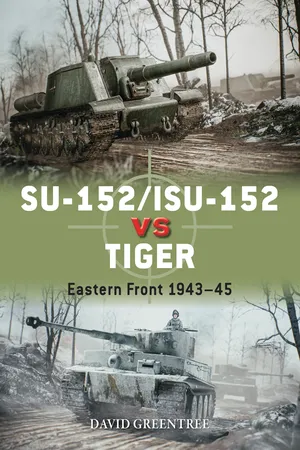
This fully illustrated volume compares two of the most iconic AFV's: the SU-152/ISU-152 and the Tiger, used on the Eastern Front during World War II.
On the Eastern Front in 1943, the Tiger-equipped heavy Panzer battalions gave German armoured divisions an unmatched capability that cost the Red Army dearly. The Tiger's 88mm gun had the potential to carve through Soviet defences in the attack and cause havoc amongst advancing Soviet armoured formations when used in defence. Neither of the Red Army's heavy tanks (the KV-1 and KV-2) could match the Tiger's gun, and, more importantly, penetrate its armour at anything approaching standard combat range.
The Soviet response was a stopgap Tiger-killing vehicle that mounted a 152mm artillery piece onto the KV tank's chassis: the SU-152. The latter would evolve into the ISU-152 in late 1943 (mounting the same powerful gun on an IS chassis). This fascinating book describes the mighty duels fought between these opposing AFVs.
The colour illustrations explore key details of both the SU-152/ISU-152 and Eastern Front Tigers, including armament, ammunition and crew positions, and the period photographs show rarely seen views of these iconic AFVs in action. How each attempted to best the other using its strengths and advantages is documented across a wide range of dramatic Eastern Front armoured battles.
- 80 pages
- English
- ePUB (mobile friendly)
- Available on iOS & Android
eBook - ePub
About this book
Trusted by 375,005 students
Access to over 1.5 million titles for a fair monthly price.
Study more efficiently using our study tools.
Information
COMBAT
BELGOROD–KHARKOV OFFENSIVE, AUGUST 1943
On 3 August 1943, following Germany’s failed attempt to break the Soviet line at Kursk, the Soviet Steppe and Voronezh fronts launched an offensive to encircle Kharkov from the north and west with M. Katukov’s 1st TA and P. Rotmistrov’s 5th GTA, plus two additional MCs. Four tank corps would make supporting attacks. The line between Army Detachment Kempf and Fourth Panzer Army was soon broken when Belgorod was captured. Kharkov was bypassed to the north and the Soviets swung south-west heading toward the Dnepr. On 12 August, 2nd SS Panzer Division Das Reich and 3rd SS Panzer Division Totenkopf arrived from a deployment further south to near Bogodukhov, 30km north-west of Kharkov, to stop the Soviets from surrounding Kempf in Kharkov. By occupying ambush positions, 3rd and 4th batteries of 1549th SAP destroyed seven German tanks, including three Tigers. German aircraft were called in and one SU-152 was destroyed. By the next day, three SU-152s had been lost because of engine trouble and seven others needed major repair. When the last two suffered engine problems on 15 August, the unit was out of action completely; however, by 22 August, nine were brought back to operational capability in time for the next attack on Das Reich. Both 5th SS Panzer Division Wiking and 3rd SS Panzer Division Totenkopf had stood on the defence east of Bogodukhov, supported by Das Reich, while Totenkopf and PGD GD moved on 27th Army, supported by 6th Guards Army near Krasnokutsk, cutting them off and forcing them to withdraw temporarily. However, 5th GTA could not be stopped from moving on Korotich to cut the Poltava–Kharkov rail line, which was defended by Das Reich and Wiking.

1529th SAP arrived with 7th Guards Army on 30 May 1943 with 270 personnel, including 67 officers, 74 NCOs and 129 privates. On 8 July, in the Kursk offensive, the army commander, Lieutenant General Shumilov, visited the unit and expressed gratitude at the way enemy armour was targeted. No. 3 Battery had set two on fire and hit another two, including a Tiger, from a company attached to 7th Panzer Division. The commander, Major Dormakov, had been a forward observer for howitzers belonging to an infantry division earlier in the war. He was decorated for destroying eight Tigers in August near Korotich. (From the fonds of the RGAKFD in Krasnogorsk via Stavka)
On 21–22 August, 18th Tank Corps from 5th GTA engaged Das Reich in a successful attack on Hill 123.1, on their way to Korotich. By the evening they were on the outskirts with 5th GMC. The Germans needed to leave Kharkov and launched a successful counter-attack on Korotich on 23 August. On the same day, 1549th SAP was ordered to Korotich, making a 72km night march. Wiking elements had occupied Korotich, especially the Poltava–Kharkov rail embankment. The next day, 5th GTA lost 39 tanks storming the embankment. On 25 August, 1549th SAP reported Lieutenant Bogatyrev (3rd Battery Commander) destroying a Tiger, two SU-152s of 5th Battery destroying two Tigers, and 4th Battery destroying another Tiger, whilst supporting 32nd TB at Korotich. The regiment lost three SU-152s evacuated from the battlefield. Three men were killed and seven wounded. On a rainy 26 August, a German counter-attack with four Tigers, supported by Panzergrenadiers, was defeated by 1549th SAP and elements of 25th Tank Brigade with the loss of three tanks. The cost was 42 T-34s destroyed. By 28 August, Das Reich had only six Tigers and 24 Panthers in working order. Still, they counter-attacked in the morning in poor visibility, according to 1549th SAP, with the loss of three Tigers and two damaged. By the end of the day, 5th GTA had 50 operational tanks. In the evening of the following day, the Germans pulled back to a new position.

5th GTA lost 450 tanks and SP guns in August. The Tigers had survived Kursk and were able to provide a solid defence following the battle. Here, a Tiger is seen ready to engage Soviet armour somewhere in southern Russia following the battle of Kursk. (Keystone-France/Gamma-Keystone via Getty Images)
On 26 August, ten SU-152s of 1529th SAP, together with the T-34s of 5th GMC, prepared to attack Kommunar state farm. A German company with two Tigers, probably from Das Reich, was detected prior to the attack. At 0730hrs, two groups of five SU-152s advanced in the fog. At ranges of between 200 and 300m, the 152mm guns swept away buildings and soon one of the Tigers was burning. The farm was occupied, however, without infantry support, and by the evening the unit had to withdraw to its former positions. The next day, at 1430hrs, the SU-152s again occupied the farm, destroying two Pz IVs. Although Soviet infantry arrived in the evening, they quickly moved further forward, leaving the SP guns once again on their own. A German counter-attack at dusk with infantry and Tigers was effective. The infantry highlighted the SU-152s with tracer bullets for the Tigers. The Germans destroyed four SU-152s. In total, 1529th SAP lost eight SU-152s in two days, seven burnt and one sent for factory repair. The last four SU-152s, along with their crews, would be given to 1548th SAP on 9 September.
German aircraft would prioritize the identification and destruction of SU-152s. As part of 3rd GMC of Voronezh Front, 1831st TSAP went into the Belgorod battle in August 1943, supporting 8th GMB. The attempt to advance on Chupakhovka initially failed because of intense German artillery barrages; 1831st TSAP then occupied a defensive line near Pyatkin from 22 to 25 August. German planes targeted the SU-152s; only when the Germans moved back from their positions did 3rd GMC launch a pursuit. On 26 August, a strong German armoured force struck 7th GMB in the flank at Levchenka and it had to withdraw; 1831st TSAP was used to support 30th Rifle Division, while 23rd Rifle Corps was being attacked by German armour. Enemy planes targeted the SU-152s, setting two ablaze, though in both instances the fires were extinguished.

In late July 1943, 1538th TSAP had seven SU-152s and one KV-1S, and was attached to 82nd Tank Regiment during Operation Kutuzov to seize Orel. On 24 July, the regiment was operationally subordinated to 283rd Rifle Division of Bryansk Front with six operational SU-152s and four being repaired. On 30 July, supporting the division in fighting for the fortified village of Shumovo, the SP guns suppressed the fire of three Pz IVs and two Tigers with no loss. On 1 August, equipment was received from the reorganization of 1452nd SAP and ten SU-122s were assigned to the regiment; in the next week or so, maintenance issues kept the operational strength low and no combat was experienced until mid-September. 1538th SAP, renamed 374th TSAP, was equipped with ISU-152s in February 1944 and would fight with 4th Tank Army. (Nik Cornish at www.Stavka.org.uk)
While advancing on the Poltava–Kharkov rail line, 1549th SAP continued to experience heavy losses. On 1 September, a battalion of 25th Tank Brigade, with three SU-152s, commanded by Lieutenant Bulavitsy, was ambushed while advancing on Ogultsy. Once clear of the embankment, the T-34s were soon knocked out along with a company of infantry accompanying them. Bulavitsy was killed when he went on a foot reconnaissance to see what had happened to the T-34s. Two Panzer IVs and seven Tigers with infantry support then moved on the SU-152s. Lieutenant Kobozev, the senior surviving officer, with no orders to retreat and out of ammunition, decided to stay. All three SU-152s were soon burning wrecks. Kobozev’s crew escaped on foot. He attempted to recover his SPGs at night; however, the Germans destroyed them completely. The attack had cost the Germans as well, with three Tigers and two Pz IVs also burning. In addition, seven SU-152s needed major repair; five of them needed new engines. The unit claimed ten Pz IVs and 15 Tigers destroyed in a month of continuous fighting. The claims of Tigers destroyed are probably inaccurate, with SU-152 crews reporting Pz IVs with schuerzen as Tigers. German sources do report three Tigers lost due to enemy fire by Das Reich, though do not specify the cause.

On 1 September 1943, 1831st SAP was brought to help 3rd GMC. The SU-152s supported 35th GTB and three Tigers were destroyed for the loss of one SU-152 near Kholodny. The enemy was located in defensive positions in Yanovshchina (Gogolevo). The unit commander, Lieutenant Colonel Kulikov, was wounded in fierce fighting from 2–5 September. Owing to equipment issues, especially those associated with the filters, 1831st TSAP needed a breather. On 28 February 1944, 343rd TSAP was formed from 1831st SAP with ISU-152s joining 5th Army of 3rd Belorussian Front for Operation Bagration in June 1944. (Courtesy of the Central Museum of the Armed Forces, Moscow via Stavka)
KRIVOI ROG, OCTOBER 1943
The Soviets pushed over the Dnieper River at Kremenchug and Zaporozhye in the first week of October. On the 15th, six armies pushed out of Kremenchug and punched a hole between Wohler’s Eighth Army and General Hans-Valentin Hube’s First Panzer Army. From 5 September to 14 October, 1549th SAP was refitting...
Table of contents
- Cover
- Title Page
- Table of Contents
- Introduction
- Chronology
- Design and Development
- Technical Specifications
- The Combatants
- Combat
- Analysis
- Bibliography
- Acronyms
- eCopyright
Frequently asked questions
Yes, you can cancel anytime from the Subscription tab in your account settings on the Perlego website. Your subscription will stay active until the end of your current billing period. Learn how to cancel your subscription
No, books cannot be downloaded as external files, such as PDFs, for use outside of Perlego. However, you can download books within the Perlego app for offline reading on mobile or tablet. Learn how to download books offline
Perlego offers two plans: Essential and Complete
- Essential is ideal for learners and professionals who enjoy exploring a wide range of subjects. Access the Essential Library with 800,000+ trusted titles and best-sellers across business, personal growth, and the humanities. Includes unlimited reading time and Standard Read Aloud voice.
- Complete: Perfect for advanced learners and researchers needing full, unrestricted access. Unlock 1.5M+ books across hundreds of subjects, including academic and specialized titles. The Complete Plan also includes advanced features like Premium Read Aloud and Research Assistant.
We are an online textbook subscription service, where you can get access to an entire online library for less than the price of a single book per month. With over 1.5 million books across 990+ topics, we’ve got you covered! Learn about our mission
Look out for the read-aloud symbol on your next book to see if you can listen to it. The read-aloud tool reads text aloud for you, highlighting the text as it is being read. You can pause it, speed it up and slow it down. Learn more about Read Aloud
Yes! You can use the Perlego app on both iOS and Android devices to read anytime, anywhere — even offline. Perfect for commutes or when you’re on the go.
Please note we cannot support devices running on iOS 13 and Android 7 or earlier. Learn more about using the app
Please note we cannot support devices running on iOS 13 and Android 7 or earlier. Learn more about using the app
Yes, you can access SU-152/ISU-152 vs Tiger by David Greentree in PDF and/or ePUB format, as well as other popular books in History & German History. We have over 1.5 million books available in our catalogue for you to explore.