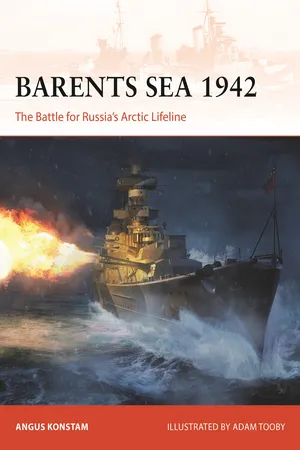
A gripping examination of the Battle of the Barents Sea, fought in the near darkness and icy cold of the northern winter, in which the Kriegsmarine sought to sever the crucial Allied Arctic Convoy route once and for all.
The Arctic convoys that passed through the cold, dangerous waters of the Barents Sea formed a vital lifeline – a strategic link in tanks, supplies and above all goodwill between the Western Allies and the Soviet Union. In December 1942, under Operation Regenbogen (Rainbow), the German Kriegsmarine sought to strike a crippling blow on the Arctic convoys and finally sever this all-important sea route.
In this fascinating work, renowned naval expert Angus Konstam documents the fate of the Allied Convoy JW 51B as it came under attack from some of the Kriegsmarine's most powerful surface warships – a pocket battleship, a heavy cruiser and six destroyers. Illustrated with stunning battlescene artworks, maps, 3D diagrams and photographs, it explores the David and Goliath struggle between the Allied ships defending the convoy and the powerful German force, until the arrival of the two British cruisers tipped the balance of power.
The Battle of the Barents Sea, fought amid snowstorms and the darkness of the Arctic night, would prove to be a turning point in the hard-fought war in northern waters, and would test Hitler's patience with his surface fleet to the limit.
- 96 pages
- English
- ePUB (mobile friendly)
- Available on iOS & Android
eBook - ePub
About this book
Trusted by 375,005 students
Access to over 1.5 million titles for a fair monthly price.
Study more efficiently using our study tools.
Information
THE BATTLE OF THE BARENTS SEA
The 16 merchant ships that made up Convoy JW-51A slipped out of the protected anchorage of Loch Ewe on 15 December, then headed north towards Cape Wrath. With them were the three escort destroyers that would accompany them as far as Iceland, as well as the corvettes, trawlers and minesweeper which would go all the way to Murmansk. Three days later, as the convoy was almost within sight of the south-east corner of Iceland, the escort destroyers parted company, and the fighting escort of six destroyers appeared. The following day, 19 December, Force R joined them, consisting of the light cruisers Sheffield and Jamaica, and the destroyers Beagle, Matchless and Opportune. The same day, Admiral Tovey left Scapa Flow in King George V, accompanied by the cruiser Berwick and three destroyers. They would form the convoy’s distant cover force.
The weather was remarkably clement for that time of year, which increased the chances of detection by German aircraft or U-boats. However, the near-constant darkness of the Arctic in mid-December cloaked the convoy from prying eyes, and it passed Bear Island without incident. On Christmas Day the convoy entered the Kola Inlet. It seems that this time at least, the Germans had been caught napping. The two cruisers of Force R had arrived in the Kola Inlet the day before, and having refuelled, they were preparing to go to sea again, to cover Convoy JW-51B’s passage through the Barents Sea. Meanwhile, on 25 December Tovey’s distant covering force arrived back in Scapa Flow. It would sit the next convoy out, but six days later it would return to sea, to screen the transit of the returning convoy RA-51.

In the Arctic during winter, accurate navigation was vital to the success of operations, but it was extremely difficult to achieve. The lack of daylight and clear skies, or even a visible horizon, often made position-taking impossible. So, navigators had to use ‘dead reckoning’, an estimated position based on course, speed and known weather conditions.
JW-51A HEADS NORTH
On the evening of Monday 21 December, as Convoy JW-51A was passing to the west of Jan Mayen Island, 800 miles to the south, the next convoy was setting out from Loch Ewe. Over the previous week Captain Radcliffe RNR had done wonders, preparing his civilian charges for sea. There were 15 merchant ships in the convoy – eight American, three British, and two which were American owned but registered in Panama. There were also two British-registered tankers. For this convoy, its commodore, Captain Melhuish of the Royal Indian Navy (RIN), flew his flag in the British-flagged freighter Empire Archer. Together they carried over 2,000 vehicles (mainly American trucks), 202 tanks, 87 fighters and 33 bombers, all in crates, plus just over 24,000 tons of fuel, of which half was for the aircraft. They were also laden with over 54,000 tons of general cargo, mainly foodstuffs.

Bulldog was the only B-class destroyer converted into a specialist anti-submarine vessel, and she would have been a useful addition to Captain Sherbrooke’s fighting escort. She missed the battle though, as storm damage suffered off Iceland meant she had to return home for repairs.
Once safely out into The Minch, the convoy formed up into four columns, spaced 1,000yds apart, with 1,000yds between each ship within the column. The local escort of three Hunt-class escort destroyers had just returned from escorting the previous convoy as far as Iceland, but now they were making the voyage again, formed up ahead and on the flanks of the merchantmen. Then the convoy set off northwards, making a steady 8 knots. The escort would be relieved when it passed the south-east corner of Iceland. By the following afternoon, it was well to the west of Orkney, and steaming through increasingly rough seas. The destroyer Onslow, flagship of the 17th Destroyer Flotilla, had been in Loch Ewe for the pre-sailing briefing, and had then sped off ahead of the convoy to join her flotilla in the Seidisfjordur, the navy’s forward base on the east coast of Iceland.
Also heading north were two reinforcements for Captain Sherbrooke, the destroyers Achates and Bulldog, which had just been detached from the Clyde Special Escort. By now though, the rough seas had built up into a violent storm, with howling winds in excess of 60 knots. Both destroyers tried to ride out the tempest, but during a lull on Wednesday 23 December Bulldog resumed her voyage prematurely, and paid the price. The storm picked up again, and the 50ft waves ripped open the destroyer’s forecastle like a sardine can. She limped back to Greenock for repairs, leaving Achates to continue on alone. She finally reached the sheltered Seidisfjordur at 11.30 the following day – just in time to repair the damage the gale had wreaked on her topmast before putting to sea again as part of her new flotilla.
By then Convoy JW-51B was about 150 miles to the south-east of Iceland, and heading north. She too had suffered during the storm. The British freighter Dover Hill had shipped water into her machinery spaces and her boilers were damaged. She was forced to turn for home. The rest steamed on, and by noon on Christmas Eve, as Achates was dropping anchor off Seidisfjordur, JW-51B was to the west of the Faroes. That day, Captain Sherbrooke held a planning meeting on board Onslow, and laid out his aggressive plans in the event the convoy was attacked. The older destroyers Achates and Bulldog – now reduced to just Achates – would stick with the convoy, which would have increased its speed to 10 knots and altered course directly away from the German threat.
The Achates would lay smoke to cover its withdrawal, while the smaller warships of the close escort would do what they could to shield the merchantmen. That left Onslow and her four sister ships. They were well used to working together, and so they would harry the attacker as a team, to buy time for the convoy to make its escape. Sherbrooke knew that his torpedoes were one-shot weapons. Once they’d been launched, the threat they posed would have gone. So, he planne...
Table of contents
- Cover
- Title Page
- Table of Contents
- Introduction
- Chronology
- Opposing Commanders
- Opposing Forces
- Opposing Plans
- The Battle of the Barents Sea
- Aftermath
- Remembering the Battle
- Further Reading
- eCopyright
Frequently asked questions
Yes, you can cancel anytime from the Subscription tab in your account settings on the Perlego website. Your subscription will stay active until the end of your current billing period. Learn how to cancel your subscription
No, books cannot be downloaded as external files, such as PDFs, for use outside of Perlego. However, you can download books within the Perlego app for offline reading on mobile or tablet. Learn how to download books offline
Perlego offers two plans: Essential and Complete
- Essential is ideal for learners and professionals who enjoy exploring a wide range of subjects. Access the Essential Library with 800,000+ trusted titles and best-sellers across business, personal growth, and the humanities. Includes unlimited reading time and Standard Read Aloud voice.
- Complete: Perfect for advanced learners and researchers needing full, unrestricted access. Unlock 1.5M+ books across hundreds of subjects, including academic and specialized titles. The Complete Plan also includes advanced features like Premium Read Aloud and Research Assistant.
We are an online textbook subscription service, where you can get access to an entire online library for less than the price of a single book per month. With over 1.5 million books across 990+ topics, we’ve got you covered! Learn about our mission
Look out for the read-aloud symbol on your next book to see if you can listen to it. The read-aloud tool reads text aloud for you, highlighting the text as it is being read. You can pause it, speed it up and slow it down. Learn more about Read Aloud
Yes! You can use the Perlego app on both iOS and Android devices to read anytime, anywhere — even offline. Perfect for commutes or when you’re on the go.
Please note we cannot support devices running on iOS 13 and Android 7 or earlier. Learn more about using the app
Please note we cannot support devices running on iOS 13 and Android 7 or earlier. Learn more about using the app
Yes, you can access Barents Sea 1942 by Angus Konstam,Adam Tooby in PDF and/or ePUB format, as well as other popular books in History & 20th Century History. We have over 1.5 million books available in our catalogue for you to explore.