- 80 pages
- English
- ePUB (mobile friendly)
- Available on iOS & Android
eBook - ePub
About this book
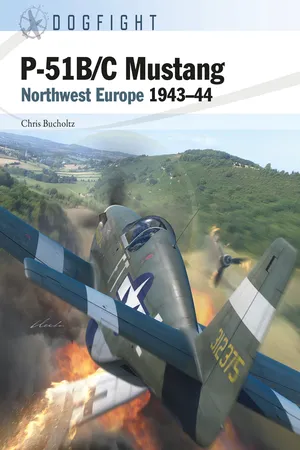
This up-to-date volume straps the reader into the cockpit of the P-51B/C as the Mustang-equipped fighter groups of the 'Mighty Eighth' Air Force attempt to defend massed heavy bomber formations from deadly Luftwaffe fighters charged with defending the Third Reich.
Luftwaffe Reichsmarschall Hermann Göring admitted that the appearance of long-range Mustangs over Berlin spelled the end of the Jagdwaffe's ability to defeat American daylight bombing. But the Mustang was far more than an escort – it was a deadly hunter that could out-perform nearly every German fighter when it was introduced into combat. Entering combat in Europe in December 1943, P-51Bs and P-51Cs had advantages over German Bf 109s and Fw 190s in respect to the altitude they could reach, their rate of climb and top speed. Initially tapped for close bomber escort, Mustangs were quickly turned loose to range ahead of the bomber stream in order to challenge German fighters before they could assemble to engage the bombers en masse. Thanks to the Mustang's superior performance, USAAF pilots effectively blunted the Luftwaffe's tried and tested tactic for destroying B-17s and B-24s. Boldness and aggression in aerial combat meant that P-51B/C pilots inflicted a rapidly mounting toll on their German counterparts in the West during the early months of 1944, contributing mightily to Allied air superiority over northern France on D-Day.
This volume, packed full of first-hand accounts, expertly recreates the combat conditions and flying realities for Mustang pilots (including headline aces such as Don Blakeslee and Don Gentile, as well as lesser known aviators). It is heavily illustrated with photographs, artwork and innovative and colourful 3D ribbon diagrams, which will provide a realistic overview of the most dynamic dogfights in aviation history.
Luftwaffe Reichsmarschall Hermann Göring admitted that the appearance of long-range Mustangs over Berlin spelled the end of the Jagdwaffe's ability to defeat American daylight bombing. But the Mustang was far more than an escort – it was a deadly hunter that could out-perform nearly every German fighter when it was introduced into combat. Entering combat in Europe in December 1943, P-51Bs and P-51Cs had advantages over German Bf 109s and Fw 190s in respect to the altitude they could reach, their rate of climb and top speed. Initially tapped for close bomber escort, Mustangs were quickly turned loose to range ahead of the bomber stream in order to challenge German fighters before they could assemble to engage the bombers en masse. Thanks to the Mustang's superior performance, USAAF pilots effectively blunted the Luftwaffe's tried and tested tactic for destroying B-17s and B-24s. Boldness and aggression in aerial combat meant that P-51B/C pilots inflicted a rapidly mounting toll on their German counterparts in the West during the early months of 1944, contributing mightily to Allied air superiority over northern France on D-Day.
This volume, packed full of first-hand accounts, expertly recreates the combat conditions and flying realities for Mustang pilots (including headline aces such as Don Blakeslee and Don Gentile, as well as lesser known aviators). It is heavily illustrated with photographs, artwork and innovative and colourful 3D ribbon diagrams, which will provide a realistic overview of the most dynamic dogfights in aviation history.
Tools to learn more effectively

Saving Books

Keyword Search

Annotating Text

Listen to it instead
Information

CHAPTER 1
IN BATTLE
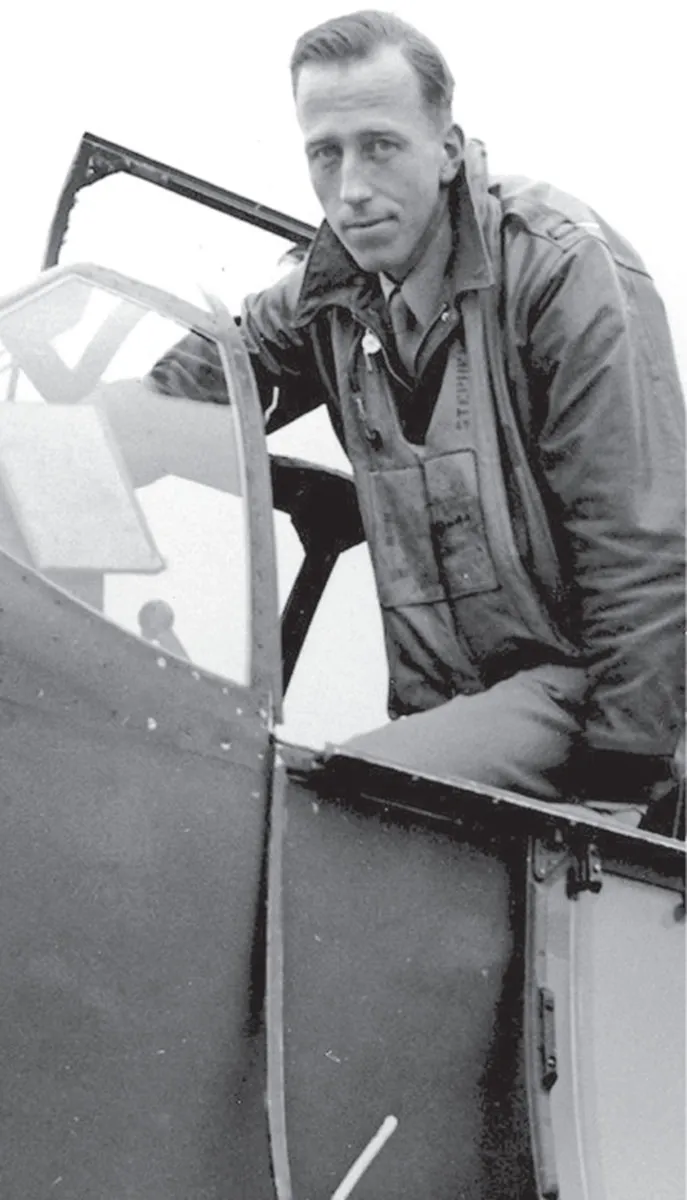
Maj Jim Howard climbs into the cockpit of one of the 354th FG’s first P-51B-1s, 43-12175 – this aircraft was subsequently lost on April 8, 1944 while escorting 664 bombers targeting Brunswick. Howard was used to bringing pilots up to speed on new aircraft, for prior to being assigned to command the 356th FS he had served with the 329th FG at Santa Ana, in California, where he familiarized newly winged aviators with the P-38 Lightning. (Author’s Collection)
Five miles above the earth, crisp contrails etched the steely blue sky high over Germany – a white arrow pointed directly at the aircraft factories at Oschersleben and Halberstadt. The B-17 Flying Fortresses of the 1st Bomb Division, in close formation, headed in a straight line toward their targets just 65 miles southwest of Berlin. The Eighth Air Force had only resumed penetrating this far into the Third Reich in late December 1943 after suffering disastrous losses during the second Schweinfurt raid on October 14 that same year.
But on this day – January 11, 1944 – the B-17s were not coming alone. Escorting them was a revolutionary fighter that would enable USAAF bombers to range across the entire Third Reich and, in the process, destroy the Luftwaffe’s day fighter force: the North American Aviation (NAA) P-51B Mustang.
In January 1944, just one group in the European Theater of Operations (ETO) was equipped with the P-51B – the 354th Fighter Group (FG). At the time, the Mustang had a 95-mile range advantage over the P-47 Thunderbolt and a 30-mile advantage over the P-38 Lightning, and so the 354th often found itself as the only escort for the bombers during the last few miles to the target – usually the most hotly contested part of the mission.
Leading the 354th FG on the 11th was Maj James Howard, who was an unusual fighter pilot for a number of reasons. Firstly, he was 6ft 2in. tall – three inches over the USAAF’s official maximum height for fighter pilots. Secondly, he was 30 years old, making him an “old man” in comparison with his subordinates. Thirdly, he had significant combat experience. Howard had earned his wings of gold with the US Navy in August 1939 and then resigned his commission in June 1941 to join the American Volunteer Group (AVG) in China, where he had been born to missionary parents. Having claimed 2.333 aerial victories in China, Howard entered the US Army Air Forces (USAAF) in early 1943 when the AVG was disbanded. Now the commanding officer (CO) of the 356th Fighter Squadron (FS), he had knocked down a Bf 109 on 20 December during one of the group’s early missions.

Maj Howard’s gun camera captures the demise of a Bf 110 on January 11, 1944, the Zerstörer still clearly carrying launchers for W.Gr. 21 “Dodel” air-to-air unguided rockets. The drag-inducing launchers could be jettisoned after the weapons were fired, but this fighter had been engaged northwest of Halberstadt before its pilot had expended his 21cm rockets during an attack on B-17s from the 401st BG. (Author’s Collection)
Returning to January 11, 1944, Howard sent one of the three squadrons to cover the front of the bomber stream while he remained with the other squadrons at the rear of the formation. The B-17s made their bomb runs and turned for home, and 20 minutes later the Luftwaffe struck. Waves of Bf 109s and twin-engined bomber-destroyers went after the lead formations of B-17s, and Howard led his squadron to their defense.
Spotting a Bf 110 below him at the same altitude as the bombers, he dropped his external tanks and dove, pulling up behind the enemy fighter. “I waited until his wingspan filled my gunsight and opened up with a four-second burst,” Howard subsequently reported. He sprayed the Bf 110 with 0.50-cal. rounds, scoring hits across the engines, fuselage and cockpit. The Bf 110 veered off course, went into a dive and broke up at 5,000ft.
Howard had lost the rest of his flight in his dive, and found himself alone above the bomber stream. A few minutes later, a Bf 109 flew toward him, and he raked it with machine gun fire, then he spotted an Fw 190 and closed in from astern, opening fire and seeing parts fly off the aeroplane. The pilot jettisoned the canopy and jumped, possibly “in anticipation of something worse,” Howard recalled. Noting that the rest of his flight had moved back in the bomber stream, he throttled back to stay with the lead element, noting it “seemed to have more than its share of enemy fighters.”
As Howard had fired on the Fw 190, two of his four guns had stopped – ammunition feed jams were a common early problem with the P-51B. Now restricted to only two machine guns, and still looking for Mustangs to join with, he spotted a Bf 109 just underneath and a few hundred yards ahead of him. Upon seeing the Mustang, the Bf 109 pilot chopped his throttle, trying to make Howard overshoot. “It’s an old trick,” Howard said. He and his nemesis then tried to “out-scissor” each other. “We went into a circle dogfight, and it was a matter of who could maneuver best and cut the shortest circle. I dumped 20 degrees of flap and began cutting inside him, so he quit and went into a dive, with me after him. I got on his tail and got in some long-distance squirts from 300 or 400 yards, but I didn’t see him hit the ground.”

Maj Jim Howard chats with his crew chief, SSgt M. P. Trice, on the wing root of P-51B-5 43-6315, which bears his full tally of claims following his mission on January 11, 1944 – seven (one flag is obscured to the right) Japanese aircraft with the AVG in 1942 and six German fighters with the 354th FG. Howard was not flying his assigned aircraft, nicknamed DING HAO! (Chinese for “Very Good!”), during his Medal of Honor mission. Instead, he was at the controls of 43-6441, coded AJ-X, which was assigned to 1Lt Bart Tenore. (Author’s Collection)
Finding himself “on the deck,” Howard pulled up and located a P-51B that was itself trying to join up, mistakenly, with a Bf 109. “The ’51 saw me coming in from behind and he peeled, off while the ME started a slow circle,” said Howard. “Things happen so fast it’s hard to remember them in sequence when you get back.”
Now down to one gun, Howard climbed back up to the bombers and soon recognized about 20 German fighters setting up an attack on two boxes of B-17s from the 401st Bomb Group (BG). Singling out a Bf 110 on the right side of the formation, Howard dove and fired, his one working gun producing strikes. “I could see gas and smoke coming out, [and] white and black smoke.” The Zerstörer (destroyer) flipped onto its back and fell into a vertical dive.
Soon, a Bf 109 came in on the bombers’ right side. Howard zoomed in close, and the German headed for the deck. Apparently unaware that Howard was following, the pilot’s dive was interrupted by 0.50-cal. rounds from the Mustang’s one operable gun. “I gave him a squirt and he headed straight down with black smoke pouring out,” Howard said. He then climbed again to defend the bombers, driving more fighters off with feints, bluffs and mock attacks, including one against a persistent Ju 88 that kept trying to climb to attack the bombers. After its third try, the aircraft eventually gave up its pursuit.
Howard then joined up with three stray Mustangs and returned safely to the 354th FG’s airfield at Boxted, in Essex, where he claimed two victories, two probables and one damaged. Confirmations from other members of the group changed one of the probables to a victory.
Meanwhile, the 401st BG at Deenethorpe, in Northamptonshire, also corroborated the story. No fewer than 16 debriefing documents described the jaw-dropping antics of the single Mustang that flew over, around and through the bomber formation in their defense. “For sheer determination and guts, it was the greatest exhibition I’d ever seen,” said Maj Allison Brooks, who was leading the 401st BG that day. “It was a case of one lone American against what seemed like the entire Luftwaffe. They can’t give that boy a big enough reward.”
Howard’s tally that day made him the 354th FG’s first ace, and his relentless defense of the 401st BG earned him the Medal of Honor – the only such decoration bestowed on an Eighth Air Force fighter pilot. When the press was turned loose on him on 13 January – the first time the USAAF admitted the Mustang was in action over Germany – one reporter asked Howard, “Why did you risk your neck doing what you did?” He replied, “I seen my duty and I done it!”
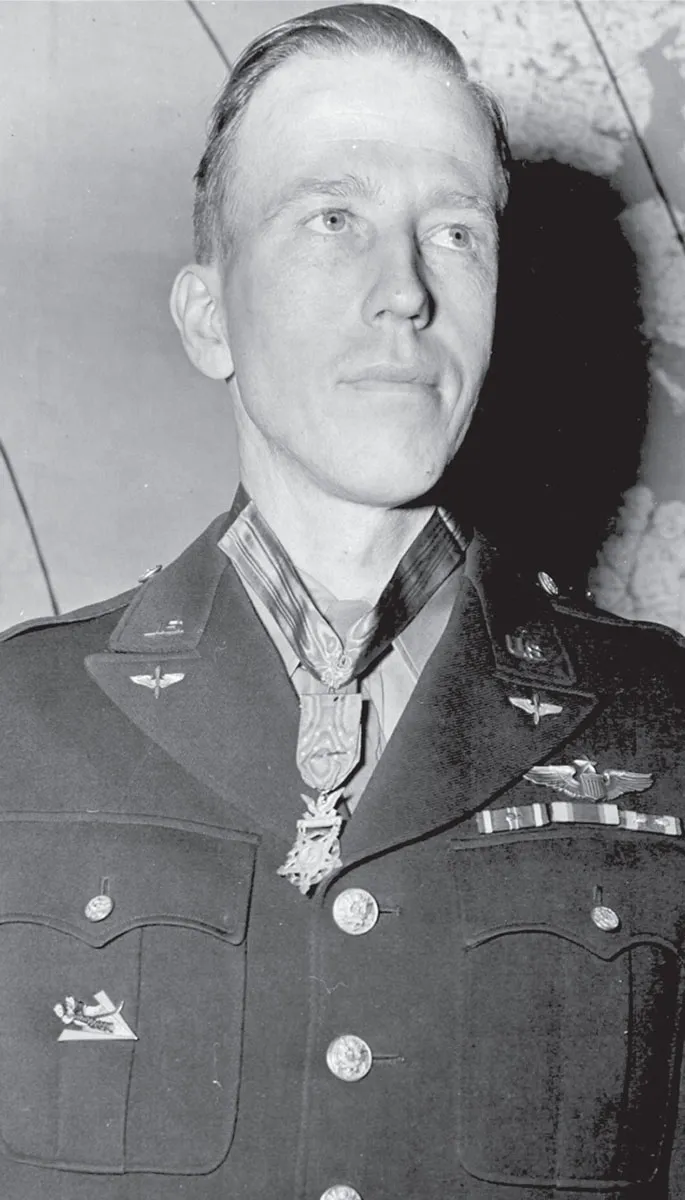
Col Howard wears the Medal of Honor around his neck following an award ceremony in June 1944. Note the AVG “Flying Tiger” emblem on his right pocket. The 6ft 2in. Howard was officially three inches too tall to fly fighters, but his experience as a Naval Aviator and victories with the AVG proved that his height had no bearing on his effectiveness as a pilot. (Author’s Collection)
CHAPTER 2
SETTING THE SCENE
By late 1943, the Eighth Air Force was facing an existential problem. The assumption that “the bomber will always get through,” as future Prime Minister Stanley Baldwin first asserted in the British Parliament in 1932, stemmed from earlier thinking from the likes of Italian General Giulio Douhet and Russian–American aviation pioneer Alexander Seversky. The US Army Air Corps (USAAC) built its strategy for war around this concept, but put a twist on it. Instead of the mass terror raids advocated by Douhet, it would strike specific military targets by daylight, using advanced bombsight technology and purpose-built heavy bombers with the range and payload to inflict heavy damage deep inside enemy territory.
World War II offered the USAAC (which became the USAAF in March 1942) a chance to prove its theories. In practice, the bombers did get through, but with grave casualties when they flew without fighter escort – something the Royal Air Force (RAF) had experienced earlier in the war. The P-47 Thunderbolt had a combat radius of 275 miles in September 1943. On deep penetration missions into Germany, Luftwaffe fighters would simply wait for the fighter escort to break away for home before pouncing on the bombers.
The Luftwaffe had developed a complex system of layered defense against American bombers, taking advantage of the P-47D’s limited endurance in order to commit its powerfully armed Zerstörer to combat out of the Thunderbolt’s range. The heavy weapons carried by the Zerstörer were capable of inflicting terrible losses.
Seeking a knockout blow before attrition rendered the Eighth Air Force unable to mount effective missions, the USAAF launched a two-prong raid on the German aircraft ...
Table of contents
- Cover
- Title page
- Contents
- CHAPTER 1: IN BATTLE
- CHAPTER 2: SETTING THE SCENE
- CHAPTER 3: PATH TO COMBAT
- CHAPTER 4: WEAPON OF WAR
- CHAPTER 5: ART OF WAR
- CHAPTER 6: COMBAT
- AFTERMATH
- APPENDICES
- ACKNOWLEDGMENTS
- SELECTED SOURCES
- ABOUT THE AUTHOR/ILLUSTRATORS
- eCopyright
Frequently asked questions
Yes, you can cancel anytime from the Subscription tab in your account settings on the Perlego website. Your subscription will stay active until the end of your current billing period. Learn how to cancel your subscription
No, books cannot be downloaded as external files, such as PDFs, for use outside of Perlego. However, you can download books within the Perlego app for offline reading on mobile or tablet. Learn how to download books offline
Perlego offers two plans: Essential and Complete
- Essential is ideal for learners and professionals who enjoy exploring a wide range of subjects. Access the Essential Library with 800,000+ trusted titles and best-sellers across business, personal growth, and the humanities. Includes unlimited reading time and Standard Read Aloud voice.
- Complete: Perfect for advanced learners and researchers needing full, unrestricted access. Unlock 1.4M+ books across hundreds of subjects, including academic and specialized titles. The Complete Plan also includes advanced features like Premium Read Aloud and Research Assistant.
We are an online textbook subscription service, where you can get access to an entire online library for less than the price of a single book per month. With over 1 million books across 990+ topics, we’ve got you covered! Learn about our mission
Look out for the read-aloud symbol on your next book to see if you can listen to it. The read-aloud tool reads text aloud for you, highlighting the text as it is being read. You can pause it, speed it up and slow it down. Learn more about Read Aloud
Yes! You can use the Perlego app on both iOS and Android devices to read anytime, anywhere — even offline. Perfect for commutes or when you’re on the go.
Please note we cannot support devices running on iOS 13 and Android 7 or earlier. Learn more about using the app
Please note we cannot support devices running on iOS 13 and Android 7 or earlier. Learn more about using the app
Yes, you can access P-51B/C Mustang by Chris Bucholtz,Gareth Hector,Jim Laurier in PDF and/or ePUB format, as well as other popular books in History & 20th Century History. We have over one million books available in our catalogue for you to explore.