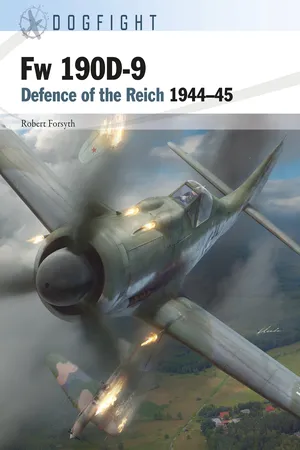
This up-to-date history by leading German aviation specialist Robert Forsyth reveals what it was like to pilot the 'long-nosed' Dora in combat as Germany desperately battled to remain in the war.
Arguably one of the finest piston-engined fighters ever built, the Focke-Wulf Fw 190D-9 raised the bar in terms of aircraft design and operational capability during World War II. Designed by Kurt Tank, the 'long-nosed' Fw 190D9 'Dora' bettered most of the fighters that the Allied and Soviet air forces could field when it first appeared in the skies over the Western and Eastern Fronts in 1944. Indeed, with experienced German pilots at the controls it proved to be an immediate match for even the later-mark Griffon Spitfire and the P-51D/K. Well-armed, with two 13mm machine guns and two 20mm cannon, the D-9 began to equip Luftwaffe units from August 1944. Later on in the war, one of the key missions of the D-9 was to provide top cover for Me 262 jet fighters when they were at their most vulnerable during take-off and landing.
Featuring first-hand accounts, photographs, artwork and innovative and colourful 3D ribbon diagrams, this fascinating volume portrays what it was like to fly the superlative Fw 190D-9 in combat, providing a realistic insight in to how German pilots used the superb Focke-Wulf aircraft in combat against American, British and Russian fighters in the Defence of the Reich in 1944–45.
- 80 pages
- English
- ePUB (mobile friendly)
- Available on iOS & Android
eBook - ePub
About this book
Trusted by 375,005 students
Access to over 1 million titles for a fair monthly price.
Study more efficiently using our study tools.
Information

CHAPTER 1
IN BATTLE
By 12 April 1945, as the shrinking Third Reich crumbled under the weight of Allied and Soviet armies advancing into it from the west and the east respectively, infantry and armoured units of Lt Gen Evelyn Barker’s VIII Corps – a part of the British Second Army – had crossed the Weser river and had pressed onwards across the fields and heaths of northern Germany. As they advanced, the 1. Fallschirm-Armee (Parachute Army) fell back, establishing bridgeheads over the Aller river. Here, Barker’s tanks, which had moved rapidly northeast to reach the town of Uelzen, were slowed. According to 21st Army Group commander, Field Marshal Bernard Montgomery, enemy resistance stiffened and there followed four days of ‘hard fighting’.
Coordinating Luftwaffe air support for the beleaguered German ground forces fighting in the Uelzen area was the Luftwaffe’s 14. Fliegerdivision, which had just taken over tactical control of Stab, I., II. and IV./JG 26. Since the autumn of 1944, these component Gruppen of the famous ‘Schlageter’ Geschwader had gradually replaced its Focke-Wulf Fw 190As with Fw 190D-9s, known colloquially as the ‘long-nosed Dora’ on account of its lengthened nose, which housed a 1,726hp Jumo 213A engine. There had been some degree of expectation for the long-awaited and much vaunted new fighter, and the limited numbers which had been delivered had proved generally satisfactory.
The aircraft was built as an aerial interceptor and air superiority fighter to deal with the twin threats of improved Allied fighter designs such as the British Tempest V and the American P-51B/D Mustang, as well as the prospective debut of the B-29 Superfortress bomber in the skies over Europe. Due to tactical exigencies, the D-9 had been deployed as a fighter, as an airfield protection aircraft and, increasingly, as a fighter-bomber.
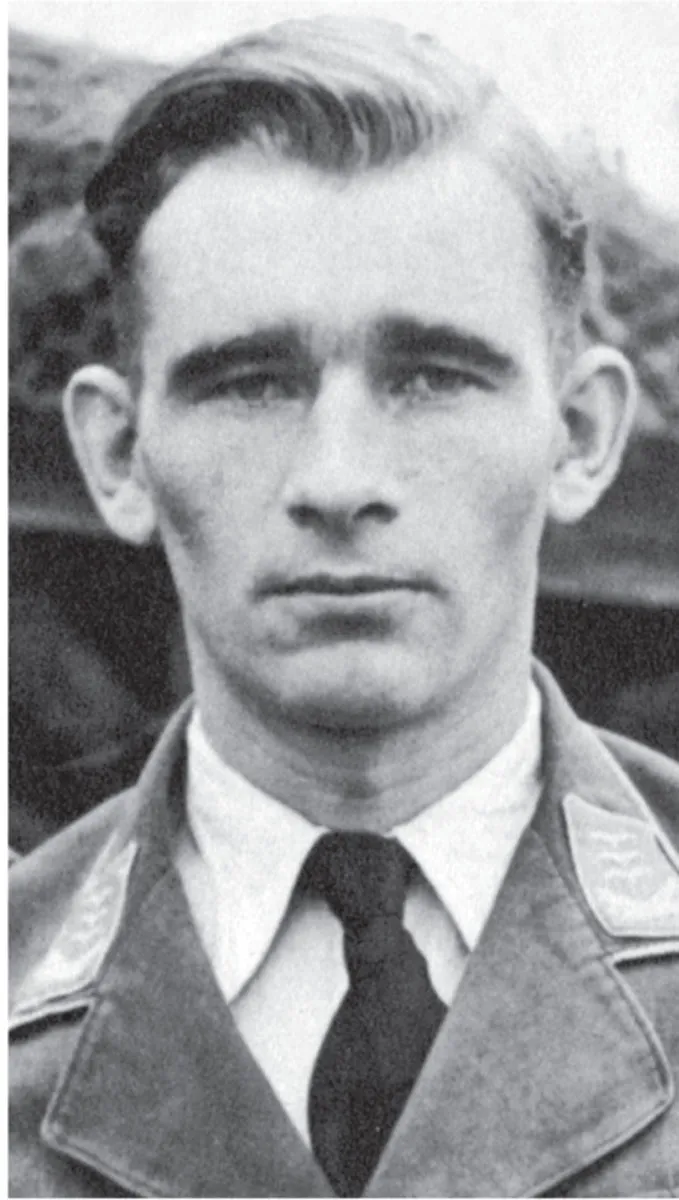
Karl Borris was the Gruppenkommandeur of I./JG 26 from 1 August 1944 through to war’s end, but he spent the entire war flying with the Geschwader. His Gruppe received its first Fw 190D-9s in mid-December 1944. Borris, seen here with the rank of Hauptmann, had a reputation as a steadfast pilot and unit commander. He claimed a Spitfire flying the Fw 190D-9 on 14 January 1945 for his final victory, raising his personal score to 43, of which no fewer than 28 are listed as Spitfires from June 1940. (EN Archive)
On 12 April, however, the 14. Fliegerdivision would deploy the Fw 190D-9s of I./JG 26, commanded by Major Karl Borris and based at Stade, west of Hamburg, in their primary intended role. Conditions were good, with any early morning cloud dissipating to leave clear skies. Furthermore, in an increasingly rare occurrence, a delivery of aviation fuel had reached the airfield in sufficient quantity to mount several sorties.
At 1230 hrs, Oberleutnant Hans Dortenmann, the Staffelkapitän of 3./JG 26, took off to lead 12 ‘Doras’ carrying drop tanks for maximum range, comprised of a Schwarm of four aircraft from each of the Gruppe’s three Staffeln, on what would be his second operation of the day. He had already flown an early morning mission to strafe ground targets in the vicinity of the Weser, and had observed a mass of enemy vehicles around Bremen before being forced to return to base due to enemy antiaircraft fire. This second mission was intended as an armed reconnaissance of the lower Elbe river.
Just over 470km away, 12 Tempest Vs of the 2nd Tactical Air Force’s No 33 Sqn took off from the Dutch airfield of Kluis on an offensive fighter sweep to the Uelzen area. The fighters were led aloft by the unit CO, Sqn Ldr A. W. Bower. No enemy aircraft were subsequently sighted once over Uelzen, so the RAF fighters split up into sections to attack ground targets on their way home. Leading Blue Section was South African Air Force pilot Capt E. D. Thompson, who continued to head eastward at 8,000ft with his Tempest Vs until around 19km northeast of Uelzen, when enemy motor transport was observed below through an increasingly hazy sky. The Tempest Vs descended and carried out three stafing runs, shooting up four vehicles and damaging a fifth. As Thompson pulled up from his third attack, he spotted what he thought were Bf 109s:
I did a 190° turn, and when at about 2,000ft I sighted 15+ Me 109s [sic] passing overhead at about 5,000ft, flying West to East. I reported that we were being bounced, and dropped tanks.
Indeed, at that very moment, Dortenmann’s formation spotted the Tempest Vs, and a wild, turning dogfight began north of Uelzen, with aircraft weaving from 800m down to ground level. Leutnant Karl-Heinz Ossenkop was flying an Fw 190D-9 in the 2. Staffel Schwarm led by Staffelkapitän Leutnant Waldemar Söffing. He recalled (Caldwell, JG 26 War Diary, pg 463):
Eight Tempests were crossing beneath us. We dropped our tanks and dived to the attack. They fired their rockets into the empty sky. A turning combat began. I reached firing position on my target; because of my superior height, I needed little lead. At 100–70m distance I gave him a short salvo. The Tempest burst into flames, and seconds later, crashed to the ground. The pilot had no chance to get out. I saw several parachutes and smoke plumes, and heard several victory cries over the radio.
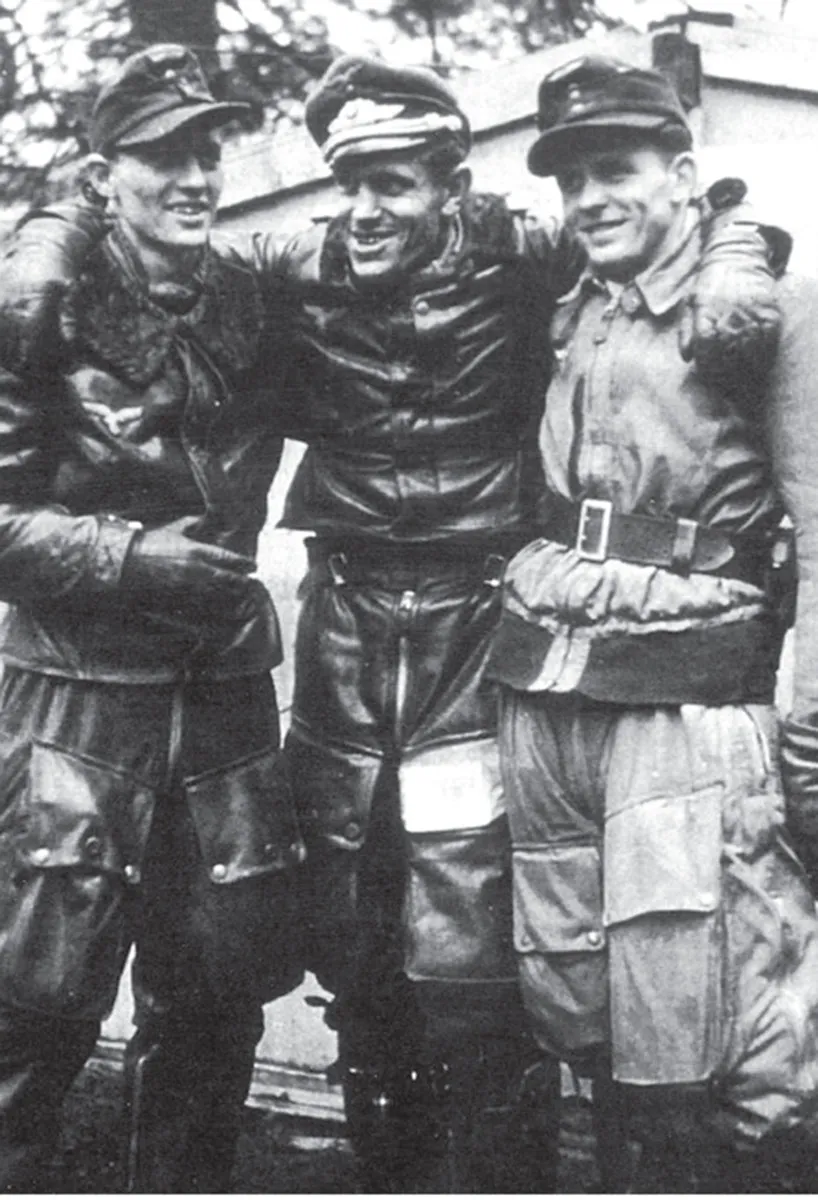
Clad in late-war leather flying gear, Leutnant Waldemar Söffing (centre), Staffelkapitän of 2./JG 26, is flanked by Leutnant Karl-Heinz Ossenkop (left) and Oberleutnant Georg Kittelmann (right) at Fürstenau in February 1945. Flying a D-9, Söffing would claim a Tempest V of No 33 Sqn shot down over Uelzen on 12 April for his 28th of an eventual 34 victories, while Ossenkop also claimed one of the RAF fighters that same day for his second victory. Kittelmann was shot down and killed near Troisdorf by a P-47 while flying a ‘Dora’ on 25 February 1945. (Dietmar Hermann Collection)
For the Tempest V pilots bounced by the Fw 190D-9s, it was a tough struggle to recover the ascendency in the engagement, as Thompson later reported (still mistaking the Focke-Wulfs for Messerschmitts):
I saw two Me 109s [sic] coming down on my No. 2, so I broke round hard to port, endeavouring to cover him, when I sighted 2 Me 109s coming down on my tail and was forced to break round hard to starboard. I saw Blue 3 coming up to cover Blue 2. At this moment I lost sight of Blue 2 while taking evasive action. By this time most of the Me 109s had joined in the fight, and it was almost impossible to keep track of the whole of my section. During this time, my height had varied from 0ft to 3,000ft. While at about 1,000ft, one Me 109 came down on my port side and pulled away from me, exposing himself to an easy attack. I opened fire from about 200 yards and saw him go diving straight into a wood and blow up in flames. Almost immediately I found myself being attacked from behind at very close range.
Thompson’s assailant was most probably Leutnant Söffing, who had latched onto his fighter and fired a burst at it. As the No 33 Sqn pilot described:
I received severe damage to my port aileron, so broke down hard to ground level, endeavouring to break off the engagement, but this Me 109 maintained his chase and I found I was only able to evade his fire by violent weaving as near to the ground as possible.
As Karl-Heinz Ossenkop recounted (Caldwell, JG 26 War Diary, pg 463):
I next saw Söffing chasing an escaping Tempest at ground level. ‘Come with me! We’ll catch him!’ he shouted. I flew left, Waldemar flew right, but the Tempest pulled away from us at tree-top height, despite our use of full throttle and MW 50 methanol injection.
At least one other No 33 Sqn pilot, South African Flg Off D. J. ter Beek, reported having to dive away to escape the scene, weaving, at ground level, under attack from several Fw 190D-9s. It was only when he reached the bombline that the Focke-Wulfs broke away.
The JG 26 pilots claimed five victories and one probable, for the loss of Leutnant Erich Asmus of the Gruppenstab who most likely fell to Thompson’s guns. No 33 Sqn had actually lost two aircraft and their pilots, with Flt Sgts P. W. C. Watton and J. Staines being posted as missing. The latter was on only his second operational flight, having joined the squadron just ten days earlier. It is likely that one of these pilots was Leutnant Ossenkop’s first claim.
Söffing’s attack on Thompson’s Tempest V had shot away the outboard half of its port aileron and left the main wing holed. The South African managed to fly his aircraft back to Kluis, where he made a flapless landing, touching down at about 130mph and narrowly avoiding nosing up into the sand at the end of the runway.

Erfurt-built Fw 190D-9 Wk-Nr. 500342 of II./JG 26 has its engine run up at Reinsehlen in December 1944. The Gruppe was undergoing conversion to the ‘Dora’ when this photograph was taken. The white ‘9’ on the rudder is not a tactical code, but rather a temporary number used for ferry or delivery flights. (EN Archive)
This brief but fierce engagement was one of several that took place over northern and central Germany during the last weeks of the war between what were two of the finest piston-engined fighters of the conflict. Despite being outnumbered and usually lacking the training of their Allied counterparts, it demonstrates how pilots flying the Fw 190D-9 could compete with, and defeat, one of the best Allied fighters in aerial combat.
That evening, it was the turn of the D-9s from II./JG 26 to conduct one of their now regular missions to strike at enemy artillery positions and supply dumps around Bremen using 250 or 500kg high-explosive bombs, or AB 250 or SC 250 containers loaded with 2kg SD-2 Splitterbombe (fragmentation) bomblets. The AB 250 was not a popular ordnance choice amongst ‘Dora’ pilots since the ability to jettison containers was not always reliable and the impact fuses of the bombs could not be disarmed after take-off.
For several days in April 1945, II./JG 26’s D-9s carried out such low-level fighter-bomber missions. Typical was the one flown on 17 April, when 14. Fliegerdivsion despatched no fewer than 47 Focke-Wulfs to attack enemy motor transport columns in the Soltau–Uelzen–Salzwedel area. Pilots claimed two Tempest Vs shot down and a third one probably destroyed during the mission (in fact just one Tempest V was lost), with three D-9s lost and a fourth damaged in return.
Despite their paucity in number, the ‘Doras’ of JG 26 remained a thorn in the side of Allied ground forces fighting in Lower Saxony through to VE Day, the appearance of the aircraft having raised the stakes for Allied fighter pilots operating in-theatre.

CHAPTER 2
SETTING THE SCENE
In September 1944, the Luftwaffe fighter arm was at a pivotal and indeed perilous point in its existence, under pressure from a growing list of priorities, but compromised by shortcomings which it could not control. The Allied landings in Normandy in June had forced the Oberkommando der Luftwaffe (OKL – Luftwaffe High Command) to move nearly 1,000 fighters into France drawn from six Geschwader. But operating conditions on the ‘Invasion Front’ proved testing in the extreme.
Nevertheless, the Jagdwaffe fought a determined yet ultimately futile battle there, often from the most rudimentary emergency airfields, against an enemy significantly more powerful than itself and able to draw upon reserves and resources which it could not match. Major Hans-E...
Table of contents
- Cover
- Title Page
- Contents
- CHAPTER 1: IN BATTLE
- CHAPTER 2: SETTING THE SCENE
- CHAPTER 3: PATH TO COMBAT
- CHAPTER 4: WEAPON OF WAR
- CHAPTER 5: ART OF WAR
- CHAPTER 6: COMBAT
- AFTERMATH
- SELECTED SOURCES
- ABOUT THE AUTHOR/ILLUSTRATORS
- eCopyright
Frequently asked questions
Yes, you can cancel anytime from the Subscription tab in your account settings on the Perlego website. Your subscription will stay active until the end of your current billing period. Learn how to cancel your subscription
No, books cannot be downloaded as external files, such as PDFs, for use outside of Perlego. However, you can download books within the Perlego app for offline reading on mobile or tablet. Learn how to download books offline
Perlego offers two plans: Essential and Complete
- Essential is ideal for learners and professionals who enjoy exploring a wide range of subjects. Access the Essential Library with 800,000+ trusted titles and best-sellers across business, personal growth, and the humanities. Includes unlimited reading time and Standard Read Aloud voice.
- Complete: Perfect for advanced learners and researchers needing full, unrestricted access. Unlock 1.4M+ books across hundreds of subjects, including academic and specialized titles. The Complete Plan also includes advanced features like Premium Read Aloud and Research Assistant.
We are an online textbook subscription service, where you can get access to an entire online library for less than the price of a single book per month. With over 1 million books across 990+ topics, we’ve got you covered! Learn about our mission
Look out for the read-aloud symbol on your next book to see if you can listen to it. The read-aloud tool reads text aloud for you, highlighting the text as it is being read. You can pause it, speed it up and slow it down. Learn more about Read Aloud
Yes! You can use the Perlego app on both iOS and Android devices to read anytime, anywhere — even offline. Perfect for commutes or when you’re on the go.
Please note we cannot support devices running on iOS 13 and Android 7 or earlier. Learn more about using the app
Please note we cannot support devices running on iOS 13 and Android 7 or earlier. Learn more about using the app
Yes, you can access Fw 190D-9 by Robert Forsyth,Gareth Hector,Jim Laurier in PDF and/or ePUB format, as well as other popular books in History & German History. We have over one million books available in our catalogue for you to explore.