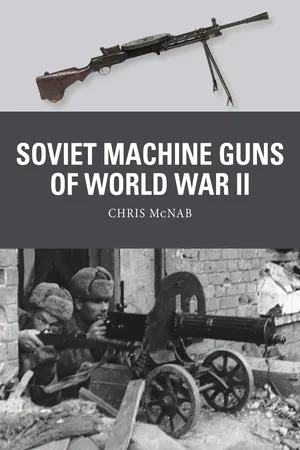
This study looks at how the Soviet armed forces developed and deployed a range of machine guns that fitted with their offensive and defensive infantry tactics across six years of total war.
In 1939, three machine guns dominated the Red Army's front-line infantry firepower – the DShK 1938 heavy machine gun, the PM M1910 medium/heavy machine gun and the Degtyaryov DP-27, a lighter, bipod-mounted support weapon. Confronted by cutting-edge German technology during the Great Patriotic War (1941–45), the Soviets responded with the development of new weaponry, including the RPD light machine gun, the 7.62×54mmR SG43 medium machine gun and the improved version of the DP-27, the DPM. Taken together, all these weapons gave the Red Army a more practical range of support weapons, better able to challenge the Germans for fire superiority on the battlefield.
Fully illustrated, this study explains the technology and the tactics of these machine guns. Noted authority Chris McNab sets out how these machine guns were distributed and tactically applied and provides numerous examples of the weapons in action, from assault teams on the streets of Stalingrad to tank crews struggling for survival at Kursk. The book also reflects upon the weapons' post-war service; many of the machine guns remain in front-line use today.
Illustrated with high-quality photographs and specially commissioned artwork, this is a deep analysis of these essential tools of warfare within the Soviet forces.
- 80 pages
- English
- ePUB (mobile friendly)
- Available on iOS & Android
eBook - ePub
Soviet Machine Guns of World War II
About this book
Trusted by 375,005 students
Access to over 1.5 million titles for a fair monthly price.
Study more efficiently using our study tools.
Information
USE
Tactical fire support in total war
Despite their considerable power to inflict death and material damage, machine guns are still fundamentally small-unit support weapons, as compared to the area destruction wrought by artillery and air power. In terms of localized manoeuvre warfare, however, the Red Army of World War II leant heavily on its machine guns at squad to company levels. Streams of automatic fire, dependably directed at enemy troops and positions, enabled tactical opportunities for both attack and defence through a combination of attrition, damage and suppression.

This photograph from June 1942 shows a Red Army cavalry machine-gun team moving at a fast pace. Their M1910/30 machine gun is ready-mounted on the four-wheel tachanka carriage, with ammunition boxes and accessories stored at the far rear. (Sovfoto/Universal Images Group via Getty Images)
As the ‘Impact’ chapter will show, the weight of automatic fire that could be generated would be crucial not only to the evolution of Red Army tactics, but also to how the Soviet armed forces composed and developed their units, often reducing manpower while increasing firepower. In this chapter, however, we will focus our attention on the Red Army infantry use of LMGs, MMGs and HMGs, drawing on original manuals to explore how machine-gun tactics worked at squad and section levels. The use of HMGs and tank machine guns is also considered. This context allows us to explore how the nature of the individual weapons, or the classification to which they belonged, influenced the tactical guidelines for infantry automatic fire. For ultimately, the machine guns were only as effective as the men who operated them and the officers and NCOs who provided the machine-gun teams with their direction and mission.
SOVIET LMGs IN INFANTRY SERVICE
In July 1944, Krasnoarmeyets Nikolai Mikhailovich Dyakonov, a DP machine-gunner with the 415th Rifle Regiment, 1st (Brestovsky) Rifle Division, was at the vanguard of the Soviet crossing of the Bug River, as the Red Army drove westwards towards Germany. The crossing was stiffly opposed, but Dyakonov, leading a small group of men, occupied a significant piece of high ground on the western riverbank. For two days, they clung on to this scrap of land, while the Germans threw superior volumes of manpower and firepower at them. Key to the Red Army’s grip on the position was Dyakonov’s DP, which ran through magazine after magazine, barrel after barrel, as Dyakonov brought fire down upon every German assault. By the time they were relieved, the small unit had killed more than 200 of the enemy, a large proportion falling to Dyakonov’s DP. Such was his, and the weapon’s, contribution that Dyakonov was made a Hero of the Soviet Union and his DP went on permanent display at the Central Museum of the Armed Forces in Moscow.

In Stalingrad in 1942, a DP machine-gunner uses a ruined stair-banister to give him a stable firing platform. The DP was a relatively accurate machine gun, its comparatively low rate of fire helping to control the dispersion of the shots, much like the British Bren gun. (Sovfoto/Universal Images Group via Getty Images)
Such a story shows how even an LMG, in the right hands, can tilt the outcome of a local battle. When referring to the LMG in Soviet use in World War II, however, we are of course really referring to the DP/DPM, the standard LMG at squad level. As we have seen, the Fedorov Avtomat was produced in such minor quantities in the 1920s that it had little combat impact in World War II, putting in an inconsequential appearance during the Winter War. It was the DP, therefore, that delivered the weight of fire from within the infantry squad, although in the following descriptions of its tactical use we should bear in mind that the rifle squad, and the platoon and company of which that squad was a part, would typically be operating under the support-fire umbrella of far heavier weapons, including variously the M1910/30, the DShK and the SG-43, the applications of which will be considered in due course.
The LMG in the rifle squad
The DP provided the core of automatic firepower in the Red Army rifle squad (also referred to in some sources as a section), which in June 1940 was composed of 12 men (weaponry in parentheses): squad leader (rifle); assistant squad leader (rifle); light machine-gunner (LMG); assistant machine-gunner (rifle); grenadier (grenade launcher); grenadier’s assistant (rifle); sniper (scoped rifle); and five riflemen (rifles). The composition of the rifle squad was intended to provide a useful spectrum of localized fire options, from the precision of the sniping rifle through to the area effects of the LMG. As the reality of combat soon proved, however, the rifle squad was an unwieldy unit for a single NCO (the squad leader) to control. The first change, in July 1941, was that the grenadier was dropped and the assistant grenadier became a standard rifleman in an 11-man rifle squad. On 10 December 1942, a more radical reorganization came with the Rifle Regiment Tables of Organization and Equipment (TO&E; Shtat) 04/551, with a reduction to nine men but in two different types of rifle squad. The Type A (Light) rifle squad was composed of the following: squad leader (rifle); assistant squad leader (rifle); light machine-gunner (LMG); assistant machine-gunner (rifle or carbine); and five riflemen (rifles). The Type B (Heavy) rifle squad was made up of the following: squad leader (rifle); assistant squad leader (rifle); two light machine-gunners (LMGs); two assistant machine-gunners (rifles or carbines); and three riflemen (rifles) (Sharp 1998: 117).
The reduction in manpower from 12 men in mid-June 1940 to nine men at the end of 1942 represented a shift in mindset in the Red Army, born of the hard realities of combat, reflecting the progressive realization that infantry battles were more often decided by who gained fire superiority than by volume of boots on the ground. One side of this shift was the mass-equipping of Soviet infantry units with PPSh-41 submachine guns, but the other was a proliferation of machine guns. Both the Type A and Type B nine-man rifle squads could be more easily coordinated around the DP fire by the squad leader and assistant squad leader (both NCOs). Type B rifle squads, furthermore, boosted the volume of automatic fire through a doubling of the LMG contribution to two DPs, with each machine-gunner supported by his own assistant gunner. This modification had an appreciable effect on the volumes of fire that the Type B rifle squad could generate. The DP had a practical rate of fire of about 80rd/min, so two DPs working together could generate 160rd/min (more in extremis), and with strong coordination from the squad leader and assistant squad leader one DP could be kept in action while the other was undergoing a magazine change or a barrel change.
In the Type B configuration, there was also a significant increase in the volumes of LMG ammunition that the rifle squad could transport into action. In action, the DP machine-gunner would only carry a single 47-round magazine, fitted to the DP (any more than that would be physically overtaxing); it was the assistant gunner who would do the heavy lifting when it came to ammunition, carrying three pre-loaded magazines in an ammunition can or bag, for a total of 141 rounds. So, while the Type A rifle squad transported 188 rounds of pre-loaded DP ammunition, the Type B rifle squad had 376 rounds, which with intelligent conservation of fire and, again, coordination between the machine-gunners, could make a significant difference to both the intensity and the duration of fire. In turn, it could also mean less-frequent trips back to the central company ammunition store, although as the DP fired the same cartridge as the regular infantry rifle, finding ammunition to reload the pan magazines might not have been problematic, depending on the wider ammunition-supply situation.

A DP gunner and assistant gunner take aim in an urban combat setting. The DP’s bipod was detachable (which meant it could also be lost) and was prone to buckling under hard use, a problem rectified in the later DPM. (From the fonds of the RGAKFD in Krasnogorsk via Stavka)
Further multiplications of firepower become evident when we broaden our focus to rifle platoon level. Each rifle platoon consisted, at least on paper, of two light and two heavy rifle squads. Theoretically at least, therefore, the rifle platoon of 1943–45 had six LMGs and a total of 1,128 rounds of in-magazine ammunition; we can triple these figures for a rifle company, which had three rifle platoons. As always, however, the reality of war can be a long way apart from the theory. In practice, the Red Army rifle platoon typically consisted of three rifle squads rather than four, or of four reduced-strength rifle squads of six men each; this latter option became more common in the final two years of the war, when combat losses were becoming truly problematic. Yet the concentration of the Red Army rifle squad around the DP was part of a general Soviet shift to automatic fire, which we will explore more deeply in the ‘Impact’ chapter. Further organizational adjustments increased the volumes of submachine guns (SMGs) that were issued within the rifle squad and within the company, and it became ever more common for assistant machine-gunners to be issued with an SMG rather than a rifle. This made sense because although the DP was not a heavy support weapon, like all machine guns it would still attract much of the enemy’s attention and fire once its position was identified. It was for this reason that a well-trained DP team would move to alternate cover after several bursts of fire, to prevent the enemy bringing their weapons to bear on a single position. For the assistant machine-gunner, the SMG was not only a more compact weapon to carry along with heavy and bulky ammunition boxes; its rapid rate of fire meant he was better equipped to defend the machine-gunner should the enemy approach to close quarters.
Operating the DP
To operate a DP, first the distinctive pan magazine had to be loaded. This activity required some manual dexterity, as it required dropping the cartridges into the magazine while rotating the two halves of the magazine housing in relation to one another, to apply tension to the internal magazine spring. To do this, with the magazine upside down the machine-gunner would hook his finger into the D-ring screwed to the upper surface of the pan and pull the upper housing towards himself and against the spring tension, so that the first cartridge guide pins in the lower housing were visible and aligned through the magazine feed port. When this was so, he would drop in a cartridge, which sat neatly in the cartridge guide pins with the rim against the outer edge of the magazine...
Table of contents
- Cover
- Title Page
- Table of Contents
- Introduction
- Development
- Use
- Impact
- Conclusion
- Bibliography
- eCopyright
Frequently asked questions
Yes, you can cancel anytime from the Subscription tab in your account settings on the Perlego website. Your subscription will stay active until the end of your current billing period. Learn how to cancel your subscription
No, books cannot be downloaded as external files, such as PDFs, for use outside of Perlego. However, you can download books within the Perlego app for offline reading on mobile or tablet. Learn how to download books offline
We are an online textbook subscription service, where you can get access to an entire online library for less than the price of a single book per month. With over 1.5 million books across 990+ topics, we’ve got you covered! Learn about our mission
Look out for the read-aloud symbol on your next book to see if you can listen to it. The read-aloud tool reads text aloud for you, highlighting the text as it is being read. You can pause it, speed it up and slow it down. Learn more about Read Aloud
Yes! You can use the Perlego app on both iOS and Android devices to read anytime, anywhere — even offline. Perfect for commutes or when you’re on the go.
Please note we cannot support devices running on iOS 13 and Android 7 or earlier. Learn more about using the app
Please note we cannot support devices running on iOS 13 and Android 7 or earlier. Learn more about using the app
Yes, you can access Soviet Machine Guns of World War II by Chris McNab,Alan Gilliland,Steve Noon in PDF and/or ePUB format, as well as other popular books in History & Military & Maritime History. We have over 1.5 million books available in our catalogue for you to explore.