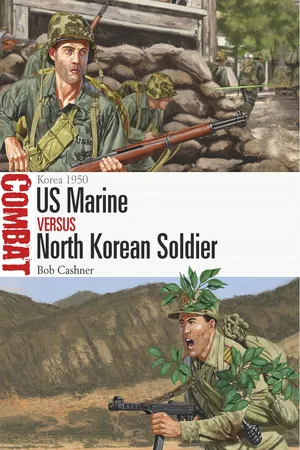
This absorbing study casts light on the tactics, weapons and combat effectiveness of the US Marines and North Korean soldiers who fought one another in August and September 1950.
Equipped with Soviet tanks and bolstered by a cadre of combat veterans returning from the Chinese Civil War, North Korea's army launched its surprise offensive against the Republic of Korea on 25 June 1950; within days Seoul had fallen and the majority of South Korea's divisions had been shattered. American ground troops rushed to Korea also seemed incapable of stopping the rapidly advancing North Koreans. By August, the remnants of the South Korean and US Army divisions had been pushed into a small corner around the port of Pusan, their backs to the sea. Time was also running out for the North Koreans; virtually all of their planning and preparations were based on a two-month campaign. Although the North Korean People's Army had enjoyed an impressive string of victories, its losses were no longer being replaced in the needed quantity or quality. It was truly a do-or-die moment for both sides.
Despite its heavily slashed budget and manpower, the Marine Corps responded swiftly and decisively. Using first-hand accounts and specially commissioned artwork, this study assesses the KPA and US Marine Corps troops participating in three crucial battles – Hill 342, the Obong-Ni Ridge and the Second Battle of Seoul – to reveal the tactics, weapons and combat effectiveness of both sides' fighting men in Korea in 1950.
- 80 pages
- English
- ePUB (mobile friendly)
- Available on iOS & Android
eBook - ePub
About this book
Trusted by 375,005 students
Access to over 1.5 million titles for a fair monthly price.
Study more efficiently using our study tools.
Information
The Opposing Sides
ORIGINS
NKPA
The NKPA had grown swiftly and achieved a great deal in a rather short time, but preparations for its formation had been laid long before it officially came into being in February 1948. Soon after the Soviet Red Army occupied northern Korea in 1945, local Communist “police” forces such as the Red Guards were formed and these quickly grew into provincial police “Peace Guardians” that were in turn swiftly taken under national control. In January 1946 a Central Party Peace Preservation Officers’ Training School was created as a front for what would become the Pyongyang Military Academy, its graduates going into senior positions in the Constabulary, and three more schools were added in 1947. Later that year, a sizable Railway Constabulary was organized to train more future military personnel. To fill the ranks, Democratic Youth League Training Centers were established in every North Korean province to indoctrinate and train older school-age boys. All men between the ages of 17 and 40 were required to undergo basic military training.

Soviet-run elections held in North Korea on August 25, 1948 saw the election of Kim Il-sung as the first premier of the Democratic People’s Republic of Korea. Here, Kim personally test-fires one of the first 7.62mm Type 49 submachine guns in December 1948. A licensed copy of the World War II Soviet PPSh-41 Papasha (“Daddy”), the Type 49 was a matter of national prestige as the first military small arm to be manufactured domestically in North Korea. Although the vast majority of Korea’s existing industry lay north of the 38th Parallel, North Korea was only able to manufacture some of its own small-arms ammunition and the Type 49. All other weapons had to be acquired from the Soviet Union. (API/Gamma-Rapho via Getty Images)

Future NKPA machine-gun crews receive training on the Soviet 7.62mm Degtyaryov DPM light machine gun, the NKPA’s standard Squad Automatic Weapon. The DPM itself was quite good, but use of the fully rimmed 7.62×54mmR cartridge necessitated a large, flat, circular 47-round pan magazine that was awkward to handle and susceptible to damage. (Sovfoto/Universal Images Group via Getty Images)
The North Korean government announced the creation of the People’s Army on February 8, 1948, although the last three Peace Preservation Officers’ Training Schools had already become the 1st and 2nd Infantry divisions and the Independent Infantry Brigade in September 1947. The Independent Infantry Brigade became the 3rd Infantry Division by the end of 1948 and a 4th Infantry Division was formed the following year. Approximately 7,000 well-qualified Soviet Red Army advisors worked with the North Korean government to build an effective conventional army.
While the NKPA’s materiel support came from the Soviet Union, a rather large percentage of its manpower came from the neighboring People’s Republic of China. The Chinese People’s Liberation Army (CPLA) had employed regiments and even entire divisions of ethnic Korean-speaking troops to fight in the recent Chinese Civil War (1945–49). Having successfully defeated the Nationalists in 1949, Chinese Communist Party Chairman Mao Zedong was able to release these troops to bolster the NKPA with seasoned combat veterans. In total, some 30,000 combat-tested Korean-speaking veterans of the CPLA entered the ranks of the NKPA in 1949 and 1950, enough to meet the manpower requirements of three divisions. They provided roughly one-third of the troops with which the NKPA went to war in 1950, and a solid backbone of veterans with many years of combat experience.

Sergeant, 18th Regiment, 4th Division
Hill 342, August 7, 1950

To increase close-range firepower in the assault, the NKPA had one or two submachine-gunners at the infantry-squad level and one 83-man submachine-gun assault company per regiment. This NCO is a submachine-gunner of the NKPA’s 18th Regiment serving in the 4th Division, a unit which had earned the honorific title of “Seoul Division” for its part in the capture of the capital city of South Korea. He is physically hard and lean because since that battle he and his comrades had advanced nearly 300km on foot with little rest and dwindling supplies to participate in the all-out attacks to breach the thin defensive lines of the Pusan Perimeter – the last UN toehold on the entire Korean peninsula.

Weapons, dress, and equipment
This man carries the Soviet all-metal 7.62mm PPS M-43 “Sudaev” submachine gun (1) with a curved 35-round box magazine of 7.62×25mm Tokarev pistol ammunition, a weapon initially supplied in considerable numbers by the Soviet Union but replaced by Soviet- and North Korean-produced versions of the PPSh-41 submachine gun as the war progressed. Most infantrymen also carried two Soviet-made F-1 fragmentation grenades (2).
He wears the standard lightweight cotton summer uniform of the NKPA, with the tunic (3) patterned after the Soviet “gymnasterka”-style blouse. The loose-fitting, somewhat baggy trousers (4) are well reinforced with extra fabric on the knees and seat and are fastened at the ankles with tapes. The leather belt was a standard item, as were the light enlisted field boots (5) with canvas uppers and rubber soles. Although some NKPA units and branches were issued with Soviet Ssh-40 steel helmets, most infantrymen wore only the brimmed cloth field cap (6) with a red-star emblem on the front and a folding neck shade in the rear. Both hat and shirt were often fitted with loops of heavy string sewn in a zigzag pattern to allow the wearer to camouflage himself quickly and easily with natural foliage.
Field gear was minimal. A four-pocket magazine pouch (7) made of heavy canvas is attached to the leather belt and further secured with a shoulder strap. Field rations consisted largely of rice, millet, or cornmeal, carried in a long sock-like “rice sack” (8) tied at the ends and draped over one shoulder. The canteen (9) was carried in a cloth pouch with its own shoulder strap. A canvas rucksack (10) carried the rest of his meager belongings. On average, the North Korean infantryman of 1950 carried only 26lb of gear on the march.
US Marine Corps
In 1950, the United States Marine Corps celebrated its 175th birthday, having originally been established on November 11, 1775. Since that time the Corps had established a long history of success in battle, proud traditions all its own, and a strong esprit de corps. The Corps had served well in France in World War I, and World War II had seen the organization grow to new levels as it prosecuted the war against Imperial Japan in Asia and the Pacific on land, at sea, and in the air. Many new names were added to US Marine Corps and American history: Guadalcanal, Peleliu, Okinawa, and Iwo Jima. By 1945, the US Marine Corps had reached an all-time peak strength of 473,000.

The 1st Marine Division could not have been brought up to strength and reactivated in time for the Inchon landings without the call-up of Marine Reserves. Here, reservists from Seattle, Washington, disembark from buses en route to their transport ships. A clever US Marine Corps press officer touted them as “The Minutemen of 1950.” (NARA)
With the end of World War II, the armed forces of the United States were demobilized and drawn down in typically rapid and often chaotic American postwar fashion. Generally speaking, the American people desired a return to peacetime norms, reduced defense spending, and a balanced federal budget. Military budgets had already been greatly reduced when, in March 1948, President Harry S. Truman appointed an old political colleague, Louis A. Johnson, as the new Secretary of Defense. Johnson quickly began slashing military budgets with a vengeance, and he seemed to bear an almost personal animosity toward the US Marine Corps in particular. Johnson’s petty swipes at the Marines included forbidding them to celebrate the Corps’ birthday and confiscating the official car used by Commandant of the Marine Corps General Clifton B. Cates. More ominously, the Corps was reduced to a strength of only 74,000 men worldwide and only ten understrength organized combat battalions; and just prior to North Korea’s invasion of South Korea on June 25, 1950, Johnson announced a further reduction to just six battalions. In both the White House and the Department of Defense there was open talk of “Unification” – doing away with the US Marine Corps entirely and absorbing the remnants into the regular US Army – which was tacitly approved by President Truman himself, who had removed Commandant of the Marine Corps General Alexander A. Vandergrift from the Joint Chiefs of Staff in 1947. The proud US Marine Corps seemed on the verge of extinction.

The backbone of the 11th Marine Regiment was the 105mm M2A1 howitzer, with three artillery battalions each equipped with 18 of these guns. The standard US Army and Marine Corps light towed field howitzer during World War II and the Korean War, the rugged and reliable M2A1 could hurl a 33lb HE shell to a maximum range of 12,000yd; its high-trajectory fire was particularly valuable in the mountainous terrain of Korea. (SC 347107...
Table of contents
- Cover
- Title Page
- Table of Contents
- Introduction
- The Opposing Sides
- Hill 342
- Obong-ni Ridge
- Seoul
- Analysis
- Aftermath
- Unit Organizations
- Bibliography
- eCopyright
Frequently asked questions
Yes, you can cancel anytime from the Subscription tab in your account settings on the Perlego website. Your subscription will stay active until the end of your current billing period. Learn how to cancel your subscription
No, books cannot be downloaded as external files, such as PDFs, for use outside of Perlego. However, you can download books within the Perlego app for offline reading on mobile or tablet. Learn how to download books offline
Perlego offers two plans: Essential and Complete
- Essential is ideal for learners and professionals who enjoy exploring a wide range of subjects. Access the Essential Library with 800,000+ trusted titles and best-sellers across business, personal growth, and the humanities. Includes unlimited reading time and Standard Read Aloud voice.
- Complete: Perfect for advanced learners and researchers needing full, unrestricted access. Unlock 1.5M+ books across hundreds of subjects, including academic and specialized titles. The Complete Plan also includes advanced features like Premium Read Aloud and Research Assistant.
We are an online textbook subscription service, where you can get access to an entire online library for less than the price of a single book per month. With over 1.5 million books across 990+ topics, we’ve got you covered! Learn about our mission
Look out for the read-aloud symbol on your next book to see if you can listen to it. The read-aloud tool reads text aloud for you, highlighting the text as it is being read. You can pause it, speed it up and slow it down. Learn more about Read Aloud
Yes! You can use the Perlego app on both iOS and Android devices to read anytime, anywhere — even offline. Perfect for commutes or when you’re on the go.
Please note we cannot support devices running on iOS 13 and Android 7 or earlier. Learn more about using the app
Please note we cannot support devices running on iOS 13 and Android 7 or earlier. Learn more about using the app
Yes, you can access US Marine vs North Korean Soldier by Bob Cashner,Johnny Shumate in PDF and/or ePUB format, as well as other popular books in History & Military & Maritime History. We have over 1.5 million books available in our catalogue for you to explore.