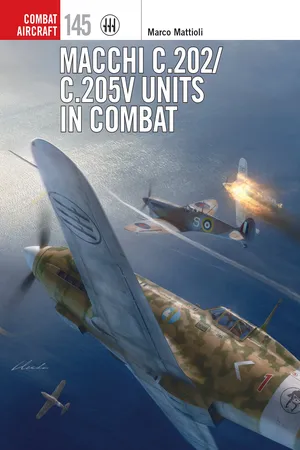
A study of the Macchi Folgore and Veltro, the most successful Italian fighters in World War II. With specially commissioned profiles, the book examines how these fighters were conceived, their performance and the fascinating stories of their pilots.
Italian fighters, such as the Fiat G.50 and Macchi C.200, had always struggled with their straight-line speed and restricted armament when engaging their Allied counterparts. To solve these problems, Macchi initially designed the C.202 Folgore using German engines, which contributed to create a faster aircraft, with a superior rate of climb and reachable altitude. Folgore's success in various North African engagements then paved the way for the development of Macchi's most successful fighter, the C.205V Veltro, which managed to combine increased speed and increased power.
Packed with specially commissioned artwork and original photos, and written by Italian military aviation specialist Marco Mattioli, this fascinating book explores how the premier Italian fighter of the war came to life and the historical circumstances that prevented it from becoming one of the most dreaded aircraft in the Mediterranean.
- 96 pages
- English
- ePUB (mobile friendly)
- Available on iOS & Android
eBook - ePub
Macchi C.202/C.205V Units in Combat
About this book
Trusted by 375,005 students
Access to over 1 million titles for a fair monthly price.
Study more efficiently using our study tools.
Information
CHAPTER ONE
ULTIMATE MACCHI FIGHTERS
Following a series of flawed pre-war evaluations that convinced the leadership of the Regia Aeronautica to opt for radial engines rather than inline powerplants due to the former being more reliable and less complicated, Italy entered World War 2 in June 1940 with its fighter units equipped with obsolescent Macchi C.200 and Fiat G.50 monoplanes and Fiat CR.32 and CR.42 biplanes.

C.202 prototype MM445 was rolled out unpainted, bar pre-war green, white and red rudder markings that also included the House of Savoy crest. The aircraft made its maiden flight from Lonate Pozzolo on 10 August 1940 with Macchi test pilot Guido Carestiato at the controls (Maurizio Di Terlizzi Collection)
In the early actions that ensued, on the Italian border with France, in the Balkans and in Africa, it soon became evident that despite the skill of Italian fighter pilots, their underpowered and under-armed aircraft were not a match for modern Allied fighters powered by reliable inline engines that on average produced around 1000 hp. By contrast, the Fiat radials fitted in C.200s, G.50s and CR.42s could barely muster 870 hp. To make matters worse, French and British fighters were usually armed with up to eight machine guns (the Dewoitine D.520, Morane-Saulnier MS.406 and Bloch MB.150 series fighters even had 20 mm cannon). Italian fighters started the war with just two 7.7 mm machine guns.
Senior officers within the Regia Aeronautica and Italian Prime Minister Benito Mussolini had become increasingly aware of this technical inferiority as Italy prepared for war, and despite them urging both Fiat and Alfa Romeo to design more powerful radial engines, nothing materialised. As a result of this failure, the General Staff of the Regia Aeronautica was forced to ask Italy’s German ally for a more powerful engine in the form of the tried and tested Daimler-Benz DB 601, as fitted to the Bf 109E.
Accordingly, an agreement was reached for Alfa Romeo to licence-build the V12 1175 hp liquid-cooled DB 601A-1 as the RA.1000 RC41-I Monsone (Monsoon). The first six DB 601s had been delivered to the Regia Aeronautica by late 1939, with two being allotted to Macchi in Varese, in the Lombardy region of northern Italy. One of these engines was fitted to a slightly modified C.200 airframe, with the resulting fighter being designated the C.202, later named Folgore (Lightning).

Legendary Macchi test pilot Guido Carestiato performed the maiden flights of both the Folgore and Veltro protoypes in August 1940 and April 1942, respectively. On 24 October 1942, he attacked an RAF Lancaster of No 5 Group during a daylight raid on Milan while flying C.202 MM9402. Six years later, while a member of the Macchi mission to Egypt, he tested the C.205Vs delivered to the REAF (Author’s Collection)
Designed by engineer Mario Castoldi, the ‘new’ fighter was 60 mph faster than the C.200 thanks to the combination of increased power from the DB 601 and improved streamlining from its smaller frontal area. The C.202 also had an enclosed cockpit and slightly modified wings. Macchi test pilot Guido Carestiato subsequently commented positively on these aspects of the aircraft after completing prototype MM445’s maiden flight from Macchi’s facility at Lonate Pozzolo on 10 August 1940. Aside from boasting a top speed of 372 mph, the aircraft could also climb to an altitude of 20,000 ft in around six minutes and cruise at 37,500 ft – the C.200 could not exceed 29,200 ft.
In September the C.202 was ordered into series production, with three manufacturers – Macchi, Breda and SAI Ambrosini – receiving contracts in an effort to accelerate deliveries to frontline units. Macchi duly supplied its first aircraft to the Regia Aeronautica on 30 June 1941, with Breda following suite on 2 October and SAI Ambrosini 18 days later.
4° Stormo’s 9° Gruppo was the first unit to be issued with C.202s, with Serie I production aircraft being delivered to Gorizia, in northeastern Italy. Other units to see combat with the Folgore included 1° Stormo’s 6° Gruppo, 4° Stormo’s 10° Gruppo, 51° Stormo’s 155° and 20° Gruppi, 3° Stormo’s 23° Gruppo, 150° and 21° Gruppi Autonomi, 53° Stormo’s 151° and 153° Gruppi, 54° Stormo’s 16° and 7° Gruppi, 154° and 24° Gruppi Autonomi, 3° Stormo’s 18° Gruppo, 22° Gruppo Autonomo, 2° Stormo’s 13° Gruppo (which received aircraft from 4° Stormo) and 161° Gruppo Autonomo, which also received used C.202s from other units. Altogether, the three companies produced 13 series of C.202s totalling almost 1300 Folgores (392 by Macchi, and the balance split between Breda and SAI Ambrosini) over three years.

The C.200 Saetta would provide the foundation for Dr Mario Castoldi’s C.202. Although the aircraft was a joy to fly (like the majority of Italian fighters in World War 2) thanks to it being highly manoeuvrable and light on the controls, the C.200 was both underpowered and under-armed (Tony Holmes Collection)

The clean and compact engine installation of the DB 601 in the C.202 gave the fighter a very small frontal area, just as it did in the Bf 109. Unsurprisingly, the Folgore’s forged magnesium alloy cantilever engine mounting was also very similar to the one used in the Messerschmitt fighter (Tony Holmes Collection)
C.202s saw widespread service, quickly demonstrating a marked superiority over the Tomahawk, Kittyhawk, Hurricane I/II and Fulmar in North Africa and the Mediterranean. However, the Folgore met its match with the Spitfire VB/C, although experienced pilots could often hold their own in combat with the RAF’s best fighter.
...Table of contents
- Cover
- Title Page
- Table of Contents
- Chapter One: Ultimate Macchi Fighters
- Chapter Two: Folgores Over Malta
- Chapter Three: Fighting Over North Africa
- Chapter Four: Other Theatres
- Chapter Five: Defending Italian Soil
- Chapter Six: After the Armistice
- Chapter Seven: In Foreign Service
- Appendices
- Colour Plates Commentary
- eCopyright
Frequently asked questions
Yes, you can cancel anytime from the Subscription tab in your account settings on the Perlego website. Your subscription will stay active until the end of your current billing period. Learn how to cancel your subscription
No, books cannot be downloaded as external files, such as PDFs, for use outside of Perlego. However, you can download books within the Perlego app for offline reading on mobile or tablet. Learn how to download books offline
Perlego offers two plans: Essential and Complete
- Essential is ideal for learners and professionals who enjoy exploring a wide range of subjects. Access the Essential Library with 800,000+ trusted titles and best-sellers across business, personal growth, and the humanities. Includes unlimited reading time and Standard Read Aloud voice.
- Complete: Perfect for advanced learners and researchers needing full, unrestricted access. Unlock 1.4M+ books across hundreds of subjects, including academic and specialized titles. The Complete Plan also includes advanced features like Premium Read Aloud and Research Assistant.
We are an online textbook subscription service, where you can get access to an entire online library for less than the price of a single book per month. With over 1 million books across 990+ topics, we’ve got you covered! Learn about our mission
Look out for the read-aloud symbol on your next book to see if you can listen to it. The read-aloud tool reads text aloud for you, highlighting the text as it is being read. You can pause it, speed it up and slow it down. Learn more about Read Aloud
Yes! You can use the Perlego app on both iOS and Android devices to read anytime, anywhere — even offline. Perfect for commutes or when you’re on the go.
Please note we cannot support devices running on iOS 13 and Android 7 or earlier. Learn more about using the app
Please note we cannot support devices running on iOS 13 and Android 7 or earlier. Learn more about using the app
Yes, you can access Macchi C.202/C.205V Units in Combat by Marco Mattioli,Richard Caruana,Gareth Hector in PDF and/or ePUB format, as well as other popular books in History & 20th Century History. We have over one million books available in our catalogue for you to explore.