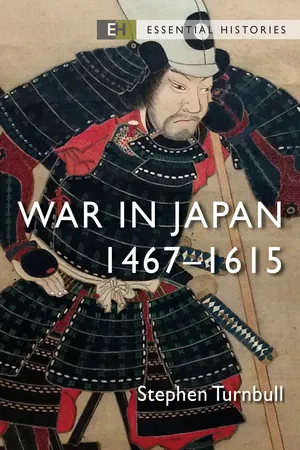
Fully illustrated with colour maps and 50 images, this is an accessible introduction to the most violent, turbulent, cruel and exciting chapter in Japanese history.
In 1467 the Onin War ushered in a period of unparalleled conflict and rivalry in Japan that came to be called the Age of Warring States. In this book, Stephen Turnbull offers a masterly exposition of the wars, explaining what led to Japan's disintegration into rival domains after more than a century of relative peace; the years of fighting that followed; and the period of gradual fusion when the daimyo (great names) strove to reunite Japan under a new Shogun. Peace returned to Japan with the end of the Osaka War in 1615. Turnbull draws on his latest research to include new material for this updated edition, covering samurai acting as mercenaries, the expeditions to Korea, Taiwan and Okinawa, and the little-known campaigns against the Ainu of Hokkaido, to present a richer picture of an age when conflicts were spread far more widely than was hitherto realised.
With specially commissioned maps and all-new images throughout, this updated and revised edition provides a concise overview of Japan's turbulent Age of Warring States.
- 144 pages
- English
- ePUB (mobile friendly)
- Available on iOS & Android
eBook - ePub
About this book
Trusted by 375,005 students
Access to over 1.5 million titles for a fair monthly price.
Study more efficiently using our study tools.
Information
THE FIGHTING (PART 1)
The Age of Fission

The account of the Hōjō in the previous chapter showed how war broke out in one area of Japan and continued for almost a century until reunification began. This was a pattern repeated across the country as fission took place until about 1570, and is a topic that can only be dealt with adequately on a geographical basis.
The Mōri and the battle of the holy island
Far to the west of the Hōjō domain on the shores of the Inland Sea lay the lands of Ōuchi Yoshitaka, who was the exact opposite of Hōjō Sōun. He was no opportunist, but an aristocrat whose family had served the shogun for generations. Following the collapse of the shogunate he had tried to safeguard the best interests of the local inhabitants by ruling them himself. Naturally this involved wars with neighbours, but it was through the machinations of one of his own retainers that the Ōuchi were overcome.
The retainer’s name was Sue Harukata, and his usurpation represented a further way of becoming a sengoku daimyō. Harukata revolted against his lord and seized his domains in a coup. However, Yoshitaka had other loyal retainers under him, and one of them, Mōri Motonari, set out to avenge his master. Mōri Motonari is probably the best example in Japanese history of an ambitious small landowner, and his honourable vengeance served him well. In 1555 the Mōri owned a small castle called Miyao on the holy island of Miyajima where the religion of Shintō traditionally required that neither birth nor death should take place. Motonari made a great show of fortifying Miyajima, which he then allowed Sue Harukata to capture. His enemy was now cornered on this tiny scrap of land, so one dark night Motonari launched an amphibious operation and caught the Sue army off guard. His fleet rowed through the great torii (shrine gate) that still exists to this day (although much repaired) and appears to be floating on the sea. In spite of torrential rain they made a successful landing. By their subsequent victory the Mōri were launched on their campaign for local supremacy, which soon changed tack towards overcoming their master Ōuchi Yoshinaga, just as Sue Harukata had done.

The battle of the holy island of Miyajima was an important step in the rise to power of Mōri Motonari. Here, Motonari’s fleet passes through the famous torii in a blinding rainstorm.
We know that Motonari was using the newly introduced harquebuses at this time, because among his decrees is an order to his retainers to collect urine-soaked soil from stable floors to be used in the making of saltpetre for gunpowder. During the following year of 1556, Motonari made good use of the harquebuses against the castle of Susumanuma, one of the Ōuchi’s remaining possessions. Susumanuma was built in the middle of a swamp and had resisted his siege for several months, so Motonari tried a combination of old and new technologies. Bundles of bamboo and straw matting were used to provide a firm footing in the swamp, and this allowed massed harquebuses to be brought up close enough to fire into the beleaguered castle.
More local campaigns followed, particularly against the Amako family, and involved the Mōri’s skilled use of sea power among the mass of tiny islands that dotted the Inland Sea. In 1563 the Mōri conducted an epic siege on Shiraga Castle in Izumo Province against the Amako. One remarkable feature of this long and savage operation was that the Mōri dug a tunnel into the castle moat to intercept its water supply. The defenders countermined, the tunnels met, and there was then a fierce underground hand-to-hand fight. A relieving army from a nearby Amako Castle then arrived, but in spite of this Shiraga Castle fell to the Mōri.
Motonari also came to grips with the Ōtomo family on nearby Kyushu when they contested the castle of Moji, which occupied a prominent vantage point overlooking the straits of Shimonoseki. Moji changed hands between the Ōtomo and the Mōri five times between 1557 and 1561, with gunfire, amphibious assault and even a bombardment from Portuguese ships. The latter was a unique event in Japanese history, and provided a dramatic illustration of the devastating effects of cannonballs against a mainly wooden fortress.
Kawanakajima and the ‘Three Kingdoms’
Back in the Kantō the Hōjō victory at the night battle of Kawagoe had meant huge changes within the Uesugi family, and the next we hear of an Uesugi going into battle it is in the person of Uesugi Kenshin, who, like the Hōjō, changed his name to something formerly illustrious. In Kenshin’s case, he obtained the family name from the last of the Uesugi line who had been defeated by the Hōjō and had sought refuge with him. As Uesugi Kenshin, this new force on the scene marched against the Hōjō in 1561 and laid siege to Odawara Castle, but after two months of fighting he could make no impression on it and withdrew when the Takeda threatened his own territories.
The borders of the Hōjō domain touched those of Uesugi Kenshin and Takeda Shingen to make up the ‘Three Kingdoms’, but the latter two rivals are most renowned in Japanese history because they fought no fewer than five battles in the same place within a period of ten years. The place was Kawanakajima, and the fighting varied from impressive stalemates to at least one massive encounter, the fourth battle of Kawanakajima, in 1561. This produced among the largest percentage casualty figures for any battle of the Sengoku Period.
Kawanakajima is an area of flat land crossed by rivers beneath tall wooded mountains. The strategy adopted by Takeda Shingen was to flush out the Uesugi troops from their position on the hill of Saijōyama by a surprise night attack. Once down on the plain and disorganised, the renowned Takeda cavalry would be able to ride them down at ease. However, Uesugi Kenshin learned of the plan and secretly brought his army off the hill before the Takeda launched their raid. While Takeda Shingen was still ignorant of what had happened, the Uesugi came looming out of the early morning mist in a surprise attack of their own against the Takeda lines. So great was the shock that the Uesugi vanguard broke through as far as the Takeda headquarters troops who made up Shingen’s personal bodyguard, and the two commanders are believed to have fought a single combat.

The death of Takeda Nobushige is depicted in this painted screen of the battle of Kawanakajima. He is shown to right of centre wearing a black horo (cloak).
In one more example of the shifting alliances during these turbulent times, Hōjō Ujiyasu and Takeda Shingen were to be found as allies two years later besieging Kenshin’s castle of Musashi-Matsuyama. It was the only time all three armies came together in the same place. The Takeda brought up a team of miners from the gold mines of Kai Province. They dug tunnels into the hill of Matsuyama and managed to collapse two of the castle’s wooden towers.
The year 1564 found the Hōjō pitted against the Satomi once more. Satomi Yoshihiro began an advance, Ujiyasu responded, and history was repeated when the two met in battle at Kōnodai, the place where Ujiyasu’s father Ujitsuna had defeated Yoshihiro’s father Yoshitaka in 1538. This time the Hōjō were by far the stronger force, with 20,000 troops to the Satomi’s 8,000. The Hōjō attacked up the castle slope and were repulsed, which gave the Satomi a false sense of security. The following morning Ujiyasu sent his son and heir Ujimasa in an encircling movement to the Satomi rear. Satomi Yoshihiro was trapped, but taking his sword in his hands he broke through the Hōjō line, only to see his 15-year-old son killed by the Hōjō retainer Matsuda Yasuyoshi. As had happened to others in samurai history, Yasuyoshi felt remorse at having killed a young boy, and left the battlefield to live as a priest for the rest of his life. Hōjō Ujiyasu expressed emotions at winning the battle in his own way. He set up his camp stool on the edge of Kōnodai hill above the river, and composed a poem.
Conquering the foe
As I wished at Kōnodai
Now do I behold
The evening sunshine of Katsuura

Takeda Shingen, one of the greatest of all the sengoku daimyo, is shown here wearing his favourite helmet ornamented with a white horsehair plume.
One of the greatest assets that Hōjō Ujiyasu possessed was seven fine sons, and two of them were to earn glory for themselves in 1569 when, with their former alliance now sundered, the mighty Takeda Shingen moved against the Hōjō. The campaign provided Hōjō Ujiyasu with the final challenge of his reign. Shingen’s army entered Musashi Province out of Kai and first laid siege to Hachigata Castle, which was defended by Ujiyasu’s third son, Ujikuni. They failed to capture it and moved on to Takiyama, held by the second son, Ujiteru, where they were similarly repulsed. To carry on from there to the Hōjō capital of Odawara with two intact fortresses behind him was a surprising decision for the experienced Takeda Shingen, and he certainly seems to have outreached himself. His resulting siege of Odawara only lasted three days, after which he burned the castle town outside Odawara and withdrew.
Hōjō Ujiyasu quickly realised that he had been given an excellent opportunity for a decisive showdown with the Takeda. He also appreciated that this would have to be done in the mountains if the Hōjō were not to face the famous Takeda cavalry on the flat plains of Musashi Province. The plan was for Ujiteru and Ujikuni to ambush the Takeda as they made their way home through the pass of Mimasetoge. This was carried out, and may well have succeeded until, after a day of fighting, Yamagata Masakage, one of the Takeda’s most experienced generals, launched a devastating flank attack on the Hōjō left wing. The main body of the Takeda then broke through and escaped.
Southern Japan: the Kyushu wars
The Ōtomo family of Kyushu, whom the Mōri fought at Moji, were one of the strongest sengoku daimyō families in southern Japan, but as in so many cases during the Sengoku Period, a daimyō’s complacency proved to be his undoing. The Ōtomo provided an example of this during another classic night battle. It was fought at Imayama in 1570, when Ōtomo Sōrin’s army were surprised during a celebration.
In 1570 Sōrin’s objective was the territory of Ryūzōji Takanobu in Chikuzen Province, and he had appointed his son Chikasada as commanding general to lay siege to Saga Castle. Saga had a garrison of only 5,000 men against the Ōtomo’s probable 60,000, an estimated figure that was brought to the Ryūzōji’s emergency council of war by scouts. The Ōtomo army was spread in a huge arc round Sa...
Table of contents
- Cover
- Title Page
- Dedication
- CONTENTS
- INTRODUCTION
- BACKGROUND TO WAR
- WARRING SIDES
- OUTBREAK
- THE FIGHTING (PART 1)
- THE FIGHTING (PART 2)
- THE WORLD AROUND WAR
- HOW THE WAR ENDED
- CONCLUSION AND CONSEQUENCES
- CHRONOLOGY
- FURTHER READING AND ACKNOWLEDGEMENTS
- eCopyright
Frequently asked questions
Yes, you can cancel anytime from the Subscription tab in your account settings on the Perlego website. Your subscription will stay active until the end of your current billing period. Learn how to cancel your subscription
No, books cannot be downloaded as external files, such as PDFs, for use outside of Perlego. However, you can download books within the Perlego app for offline reading on mobile or tablet. Learn how to download books offline
Perlego offers two plans: Essential and Complete
- Essential is ideal for learners and professionals who enjoy exploring a wide range of subjects. Access the Essential Library with 800,000+ trusted titles and best-sellers across business, personal growth, and the humanities. Includes unlimited reading time and Standard Read Aloud voice.
- Complete: Perfect for advanced learners and researchers needing full, unrestricted access. Unlock 1.5M+ books across hundreds of subjects, including academic and specialized titles. The Complete Plan also includes advanced features like Premium Read Aloud and Research Assistant.
We are an online textbook subscription service, where you can get access to an entire online library for less than the price of a single book per month. With over 1.5 million books across 990+ topics, we’ve got you covered! Learn about our mission
Look out for the read-aloud symbol on your next book to see if you can listen to it. The read-aloud tool reads text aloud for you, highlighting the text as it is being read. You can pause it, speed it up and slow it down. Learn more about Read Aloud
Yes! You can use the Perlego app on both iOS and Android devices to read anytime, anywhere — even offline. Perfect for commutes or when you’re on the go.
Please note we cannot support devices running on iOS 13 and Android 7 or earlier. Learn more about using the app
Please note we cannot support devices running on iOS 13 and Android 7 or earlier. Learn more about using the app
Yes, you can access War in Japan by Stephen Turnbull in PDF and/or ePUB format, as well as other popular books in History & Japanese History. We have over 1.5 million books available in our catalogue for you to explore.