The Douglas F3D Skyknight was an early but effective attempt at combining new technologies together in a lethal package capable of shipboard operation.
Whereas most fighters relied on speed and maneuverability, the portly, straight-winged F3D relied on three radars, four 20mm cannon, and – most importantly – darkness. Having first flown in March 1948, the Skyknight's first taste of war came in September 1952, when Marine Night Fighter Squadron 513 [VMF(N)-513] deployed to Korea. The most important job assigned to VMF(N)-513 was the escorting of USAF B-29 bombers over northern Korea. Whereas Chinese and North Korean MiG-15s relied on ground-controlled intercept radar for steering guidance into firing positions, the F3D, with its own onboard radars, was autonomously lethal – it could detect, track and target MiGs all on its own. Skyknight crews ended the Korean War with six nocturnal kills in exchange for one combat loss.
After the war, 35 Skyknights were converted into electronic warfare (EW) aircraft. As US air operations over North Vietnam intensified in early 1965, the need for a tactical EW jet to provide electronic countermeasures (ECM) protection to accompany strike packages north became apparent. For all of its early effectiveness over North Vietnam, the proliferation of radar-guided guns and missiles began to erode the advantage created by EF-10 escort support, which flew its last combat mission in October 1969.
This highly illustrated volume explores the F3D Skynights and their deployment during the Korean and Vietnam wars, using first-hand accounts from aircrew, original photographs and 30 profile artworks to explore their key roles as an escort aircraft and electronic warfare aircraft.
eBook - ePub
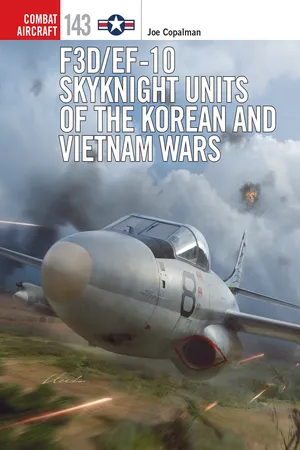
F3D/EF-10 Skyknight Units of the Korean and Vietnam Wars
- 96 pages
- English
- ePUB (mobile friendly)
- Available on iOS & Android
eBook - ePub
F3D/EF-10 Skyknight Units of the Korean and Vietnam Wars
About this book
Trusted by 375,005 students
Access to over 1.5 million titles for a fair monthly price.
Study more efficiently using our study tools.
Information
CHAPTER ONE
SKYKNIGHTS OVER KOREA
The Douglas F3D Skyknight entered service in December 1950 as the US Navy and US Marine Corps’ first carrier-based jet nightfighter. Given the demanding specifications for what became the Skyknight, the design, by Ed Heinemann, was surprisingly conventional, with straight wings, low-profile engine nacelles tucked in close to the fuselage and a tail that looked more at home on a World War 2-era medium bomber than a jet fighter.

A well-weathered F3D-2 from VMF(N)-513 ‘Flying Nightmares’ flies just above a solid undercast over South Korea. The unit proved the Skyknight’s prowess as a nightfighter with a 6-to-1 kill ratio (Jim Sullivan Collection)
The F3D featured a wide fuselage to incorporate the Westinghouse AN/APQ-35 radar system, consisting of two different radars mounted in tandem in the Skyknight’s cavernous nosecone. Installed at the rear of the nosecone was the large dish for the AN/APS-21 search radar, used for detecting and tracking targets, with the smaller AN/APG-26 gun-laying radar dish mounted in front of it. Under optimal conditions, the AN/APS-21 could detect targets up to 20 miles away, while the AN/APG-26 could lock on to targets up to 2.25 miles ahead. Additionally, the Skyknight carried an AN/APS-28 tail warning radar with a ten-mile detection range – a system that would prove critical in the dark skies over North Korea.
Shortly after accepting its first Skyknights, the US Marine Corps began preparing its initial cadre of F3D pilots, radar operators (ROs) and maintainers for service in the Korean War. The unit chosen to receive the jet was Marine All-Weather Fighter Squadron (VMF(N)) 542, which departed Kimpo, in South Korea, in March 1951 and returned to Marine Corps Air Station (MCAS) El Toro, in California, for conversion from the F7F Tigercat to the F3D-1.
Following more than a year of instruction on the new jet, air- and groundcrews trained on the Skyknight would head back to South Korea with 15 improved F3D-2s. This model featured more powerful Westinghouse J34-WE-36 turbojet engines, each rated at 3400 lb st (the D-1 had been fitted with J34-WE-32s of 3000 lb st), a bulletproof windscreen, an autopilot and a few additional upgrades.
Once in-theatre, the aircraft and their crews would join the ‘Flying Nightmares’ of VMF(N)-513. The latter had already been deployed for more than a year, flying the F4U-5N Corsair and F7F Tigercat on night ground attack missions and combat air patrols (CAPs).
The F3D cadre commenced its journey to South Korea on 27 May 1952 when an advance party led by Col Peter D Lambrecht departed El Toro for K-8 air base near Kunsan to begin the Skyknight bed-down process with VMF(N)-513, arriving on 1 June after a quick stop in Japan. The remainder of the F3D cadre reached Yokosuka, in Japan, on 18 June, with 15 jets being transported to a nearby Naval Air Station at Kisarazu. Here, groundcrew prepared each aircraft for the short hop to Itami air base, where the Skyknights underwent further preparation for the flight to Kunsan. The remaining US Marine Corps personnel departed for Kunsan to prepare for the arrival of the aircraft.

The first cadre of US Marine Corps Skyknight pilots, ROs and maintainers trained on F3D-1s with VMF(N)-542 at MCAS El Toro in southern California between March 1951 and April 1952. Just 28 ‘Dash Ones’ were built by Douglas, including this aircraft, BuNo 123757. It had briefly served with US Navy unit VC-3 prior to being passed on to VMF(N)-542 (Tailhook Association)

The Skyknight’s Westinghouse AN/APQ-35 radar system consisted of the AN/APS-21 search radar and AN/APG-26 targeting radar, with the antenna dishes arranged in tandem order in the aircraft’s spacious nose. The larger dish of the AN/APS-21 is seen here at the rear, while the much smaller dish for the AN/APG-26 is mounted forward of it (Tailhook Association)
While at Itami, the Skyknights had their Glossy Sea Blue scheme painted over with flat black, while the high-visibility unit markings were replaced by dull red stencilling. It was hoped that this change in schemes would reduce the enemy’s ability to visually acquire the F3D in the night skies over North Korea.
Of the 15 aircraft shipped to Japan, the cadre took 12 to South Korea, with Col Lambrecht leading the first flight of four Skyknights from Itami to K-8 on 24 June. The F3D cadre jumped right into local operations from Kunsan, with the first test and area familiarisation flights taking place the day after the jets’ arrival. By the 27th, all 12 aircraft had reached K-8.
Unfortunately, the Skyknights would not be able to fly combat missions over North Korea for several months, as the cadre deployed without the gun barrel extensions required to fire the four M2 20 mm cannon that were the aircraft’s only armament. The ‘Nightmares’ continued to restrict the F3D to local flights throughout July 1952, keeping crews busy with area familiarisation, test flying and night intercept training to build proficiency utilising the APQ-35 radar system.
The squadron finally received the first five sets of gun barrel extensions on 5 August. Installation was completed and a test flight the following day confirmed the weapons functioned properly. During the course of the month, VMF(N)-513 accepted 16 more sets of barrel extensions. With a growing fleet of combat-ready aircraft, the unit soon began sending armed jets into the night sky for live missions.
The first operational F3D mission in Korea had not been planned as such. Royal Air Force exchange pilot Sqn Ldr John R Gardener and his US Marine Corps RO SSgt Kropp had been on a local air intercept training sortie on the night of 7 August when a ground controller diverted them to search for an aircraft squawking an emergency identification friend or foe (IFF) code. While orbiting in the area they had been vectored to, the controller informed them the aircraft in question was not actually in distress after all.
Before entering the war in earnest, all Skyknight crews met for a briefing on 9 August with a trio of controllers from ‘Dentist’, the ground-controlled intercept (GCI) site on Ch’o-do Island (off the west coast of North Korea) that they would be working with for night combat air patrol (NCAP) missions. The briefers laid out the coordination procedures for F3D pilots preparing to fly operationally under their control. Conversely, the ‘Nightmares’ sent three officers to Ch’o-do to observe controllers working live intercepts in order to give the squadron a better understanding of what they saw on their scopes.
Col Lambrecht and his RO, 2Lt James Brown, flew the first NCAP mission on 11 August, orbiting north of Ch’o-do before being vectored north along the North Korean coast. The flight was uneventful, with no contacts or intercepts made. The next evening, Maj James Martin and his RO, MSgt Thompson, received a vector from ‘Dentist’ toward an unidentified aircraft. As they closed with the bogey, they encountered enemy jamming of their AN/APS-21 radar, likely from a ground station inside North Korea, and ‘Dentist’ called off the intercept. Three hours later, Maj Harold Eiland and MSgt Piekutowski encountered the same jamming in a nearby area.

F3D-2 crews from VMF(N)-513 pose in front of a ‘Nightmares’’ Skyknight at Kunsan in this autumn 1952 photograph. The first F3D-2s had arrived at K-8 on 24 June 1952, and they were flown alongside VMF(N)-513’s F4U-5N Corsairs and F7F-3N Tigercats – an example of the latter is parked to the left of the Skyknight (Tailhook Association)
Throughout August, the ‘Nightmares’ learned first-hand the challenges crews faced when hunting the enemy in the dark. Given the limits of the technology at the time, ROs commonly received solid vectors from GCI operators to contacts they failed to detect themselves on radar in the jet. Conversely, Skyknight crews sometimes reported seeing navigation lights from aircraft the GCI controllers had never detected. But even when the aerial and ground-based systems worked together, the process of closing with, identifying and locking up an enemy aircraft with the AN/APG-26 proved difficult.

Delivered without the gun tube extensions for the Skyknight’s four 20 mm cannon, ‘Nightmare’ F3D-2s (including BuNo 124608, seen here breaking away from its flight lead) were initially restricted to local familiarisation and post-maintenance test flights in the Kunsan area from late June through to early August 1952 (Jim Sullivan Collection)
Describing such an encounter in August 1952, Capt Lyle B Matthews Jr wrote;
‘We were given a vector to intercept a bogey at approximately [grid location] YC 1065. At the time, we had 4800 lbs of fuel remaining and we were flying at 30,000 ft indicated. A head-on run was set up by “Dentist” but no joy. We then followed the bogey on an approximate rectangular course, which seemed to be centred over the position being worked by “Flytrain 35” [F7F Tigercats flying night interdiction] and “Fatface” [a US Navy PB4Y-2 Privateer flareship] below. We kept requesting lower altitudes from “Dentist”, until at an altitude of 11,000 ft we were informed that the bogey’s “angels” were 20 [altitude of 20,000 ft]. Thirty seconds later, we had an airborne target on our gear at eight miles. When assured that the contact was solid, we gave a “Roger Dee” [code acknowledging radar lock-up on “Dentist’s” intended contact].
‘We then set up a climb at 240 [knots] indicated, which gave us a slight overtaking speed. At one-and-a-half miles, we attempted a lock-on, and found that our [AN/APG-]26 antenna was stuck in the up position. We then closed to minimum range on the AN/APS-21 gear – about 1000 ft – but I was unable to obtain a visual on the bogey. We were synchronised behind the bogey for about three minutes, with no visual obtained. We then proceeded through minimum range at a slight overtaking speed, but at about that time the bogey must have turned to a southerly heading, for our next report from “Dentist” had the contact at “nine o’clock” at eight miles.’
In addition to the occasional MiG-15 nightfighter, Skyknight pilots also faced the far more common threat of high-calibre anti-aircraft artillery (AAA). Radar-guided searchlights could turn night into day, illuminating even high-flying F3Ds enough to give gunners adequate visibility to lead their targets. A common tactic the enemy employed was setting traps for American nightfighters by using a MiG as ‘bait’, the jet flying straight and level with its navigation lights on, tempting Skyknight pilots to give chase. Working in concert with Chinese GCI, the ‘bait’ MiG led kill-hungry F3D crews into well-constructed ambushes, with enemy gunners waiting in the dark below.
Capt Dean Caswell was one of the first F3D pilots to encounter such a trap during an NCAP on 15 August. Detailing this encounter for the squadron’s command diary, he recalled;
‘I was vectored by “Dentist” onto a bandit in the Antung area. I believe the bandit was a jet-type aircraft by vectors and speed indicated. Four miles southeast of Antung, I observed three bright arc-type lights in a line running northwest to southeast, estimated to be one half-mile apart. These lights stayed on for two minutes. As these lights went off, four batteries of two searchlights each came on in a five-mile radius west of Antung. Those lights picked me up. I believed I was mouse-trapped and evaded the lights immediately.’
The same night Caswell encountered the searchlight trap, the squadron experienced its first loss. Col Lambrecht and his RO, 2Lt James M Brown, departed Kunsan for an NCAP mission and simply failed to return. The squadron sent up an F4U-5N to search Lambrecht’s last known position, followed by two F7Fs, but none of the crews spotted any fire, wreckage or evidence of the aircraft. Despite the tremendous blow to squadron morale caused by the loss of a well-liked commanding officer so early into a combat tour, the Skyknight crews continued their night...
Table of contents
- Cover
- Title Page
- Table of Contents
- Chapter One: Skyknights Over Korea
- Chapter Two: Cold War Elint
- Chapter Three: ‘Whales’ Over Vietnam
- Appendices
- Colour Plates Commentary
- eCopyright
Frequently asked questions
Yes, you can cancel anytime from the Subscription tab in your account settings on the Perlego website. Your subscription will stay active until the end of your current billing period. Learn how to cancel your subscription
No, books cannot be downloaded as external files, such as PDFs, for use outside of Perlego. However, you can download books within the Perlego app for offline reading on mobile or tablet. Learn how to download books offline
Perlego offers two plans: Essential and Complete
- Essential is ideal for learners and professionals who enjoy exploring a wide range of subjects. Access the Essential Library with 800,000+ trusted titles and best-sellers across business, personal growth, and the humanities. Includes unlimited reading time and Standard Read Aloud voice.
- Complete: Perfect for advanced learners and researchers needing full, unrestricted access. Unlock 1.5M+ books across hundreds of subjects, including academic and specialized titles. The Complete Plan also includes advanced features like Premium Read Aloud and Research Assistant.
We are an online textbook subscription service, where you can get access to an entire online library for less than the price of a single book per month. With over 1.5 million books across 990+ topics, we’ve got you covered! Learn about our mission
Look out for the read-aloud symbol on your next book to see if you can listen to it. The read-aloud tool reads text aloud for you, highlighting the text as it is being read. You can pause it, speed it up and slow it down. Learn more about Read Aloud
Yes! You can use the Perlego app on both iOS and Android devices to read anytime, anywhere — even offline. Perfect for commutes or when you’re on the go.
Please note we cannot support devices running on iOS 13 and Android 7 or earlier. Learn more about using the app
Please note we cannot support devices running on iOS 13 and Android 7 or earlier. Learn more about using the app
Yes, you can access F3D/EF-10 Skyknight Units of the Korean and Vietnam Wars by Joe Copalman,Jim Laurier,Gareth Hector in PDF and/or ePUB format, as well as other popular books in History & 20th Century History. We have over 1.5 million books available in our catalogue for you to explore.