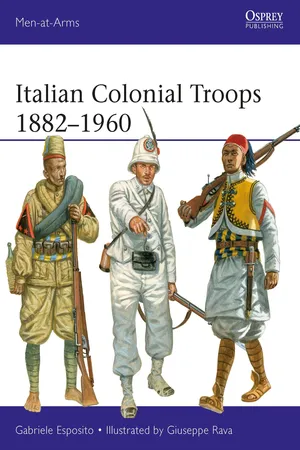
A complete illustrated study of the varied range of Italian colonial units who served in East and North Africa.
Italy only unified as a nation in 1870 and was late, and therefore impatient, in the 'scramble' for Africa. An initial foothold in Eritrea/Somalia, north-east Africa, led to a disastrous defeat in Ethiopia in 1896 at the Battle of Adwa, but Italian Somaliland was later consolidated on the west coast of the Red Sea.
During 1911, Italy also invaded Libya, securing the coast, however fighting continued throughout World War I and only ended in the early 1930s. A number of native colonial regiments were raised in both Italian East Africa and Libya (in the latter, even a pioneering paratroop unit), of which most fought sturdily for Italy against the Allies in 1940–43. These units had particularly colourful uniforms and insignia. Another small guard unit also served in the Italian concession at Tientsin, China in 1902–1943. After World War II, a remnant unit served on in Somalia under a UN mandate until 1960.
This intriguing volume describes and illustrates the dress and equipment used by these forces and details how they were deployed to maintain a colonial empire for over half a century.
- 48 pages
- English
- ePUB (mobile friendly)
- Available on iOS & Android
eBook - ePub
Italian Colonial Troops 1882–1960
About this book
Trusted by 375,005 students
Access to over 1.5 million titles for a fair monthly price.
Study more efficiently using our study tools.
Information
PLATE COMMENTARIES

1: Basci buzuk, Orda Esterna, 1887
2: Chasseur, 1st Regt, Cacciatori d’Africa, 1888
3: Ascaro, Native Cav Sqn ‘Asmara’, 1893–94
A: ERITREA, 1887–1911
A1: Basci buzuk, Orda Esterna, 1887
Initially the basci buzuk wore semi-civilian dress of a red tarbusc with a black or dark blue tassel, a white knee-length blouse, loose white trousers (often rolled up), and brown sandals, with a coloured waist-sash. From 1887 the members of the Orda Interna wore a blue scarf around their tarbusc, while the Orda Esterna were identified by green. Rank, if any, was shown by a simple black patch on the right sleeve, bearing different numbers of red stars. The coloured waist-sashes came to be adopted as a fundamental element of Italian colonial uniforms, the colours and patterns being varied to identify the different units (see under Plate B3) . On formal occasions the basci buzuk might wear over his blouse a dark blue jacket decorated with red trim and yellow piping. This man’s main weapon is the single-shot Remington ‘rolling block’ rifle, produced in .43in calibre for the Egyptian Army; most irregulars also carried curved sabres and/or knives.
A2: Private, 1st Regiment, Cacciatori d’Africa, 1888
The early uniform of the Italian ‘African Chasseurs’ included an M1887 cork helmet, bearing a crowned white-metal frontal badge of two bugle-horns set on the Italian red/white/green national cockade. The Chasseurs’ single black feather, rising from a red pompon, was clearly inspired by the raven feather worn on their headgear by the metropolitan Alpini (mountain infantry). On the fold-down collar of the white tropical jacket are the five-point white-metal Savoy stars of the Regio Esercito (Italian ‘Royal Army’). Note the front skirt corners buttoned up to clear the cartridge pouch worn on a waist belt, and also the slung 1876 canteen and off-white haversack. The rifle is a bolt-action 10.4mm Vetterli-Vitali M1870/87 with a four-round magazine.
In 1889 the Cacciatori d’Africa received a new M1887 khaki (‘light bronze’) linen uniform, including a helmet cover. The M1887 jacket had shoulder straps; a standing collar (though often opened and worn folded down) with white cloth stars; two ‘Norfolk-style’ pleats down the front; and, for NCOs and warrant officers, red points-up chevrons on both forearms, with a tall loop extending from the top chevron. This uniform also appeared in white for barracks dress. In 1894 a new model of cork helmet was introduced, worn by that date with a green feather panache. In the same year officers received a parade uniform of a dark blue ‘patrol jacket’ with black frontal frogging, and dark blue trousers.
A3: Ascaro, Squadrone di Cavalleria Indigena ‘Asmara’, 1893–94
This is the first uniform adopted by the Eritrean cavalry. The scarves wrapped around the red tarbusc cap were in identifying colours for the Asmara and Keren squadrons. Through this is pinned a crowned white-metal lancers’ badge, and a single hawk feather was attached at the back (hence the Eritrean cavalrymens’ nickname of ‘Penne di Falco’). From about 1890 the Eritrean ascari, both foot and mounted, began to wear this simple white waist-length ‘stable jacket’ instead of the previous knee-length blouse (see A1); from 1904 ranks were indicated by red points-up sleeve chevrons, and later the same number of silver stars appeared on the front of their headgear. They also began using canvas leggings (though foot soldiers continued to march barefoot, and troopers rode without boots or spurs). Initially the horsemen were armed only with sabre and carbine (here, the 6.5mm M1891 moschetto da cavalleria with its characteristic fold-back fixed bayonet, which arrrived in 1893), but later they received cavalry lances.
In 1908 the cavalry adopted a khaki jacket which differed from that of the infantry (see under Plate B3) in that it retained the frontal pleats of the Italian 1887 design; this was also produced in a white parade version. The subsequent M1928 cavalry jacket was also produced in both khaki service and white parade versions. From 1913 the Penne di Falco replaced their old canvas leggings with new brown leather gaiters. The cavalryman’s waist-sash remained red from about 1890 up until World War II.

1: Ascaro, 1st Mtn Arty Bty, 1912
2: Zaptiè, Compagnia CC. RR., 1912
3: Muntaz, 14th Native Bn, 1935
B: ERITREA, 1912–1935
B1: Ascaro, 1st Mountain Artillery Battery, 1912
Eritrean artillerymen were dressed quite similarly to the infantry, their uniforms following the evolution of the latter from 1908 to 1940. From about 1890 a simple white jacket was introduced, but from 1904 that was replaced with this new model shaped like a stable jacket, with a standing collar and two pockets; it could be worn alone or, as here, over the traditional white knee-length blouse. From about 1890 the tassel of the tarbusc and the waist-sash worn by all ascari began to appear in unit identifying colours, but for the whole artillery these were black and yellow respectively. This artilleryman’s main weapon is a moschetto 91 per truppe speciali, a shortened M1891 rifle, and his ammunition pouches are of the two-pocket bandolier type issued to mounted troops. The sabre for Eritrean and Somali artillerymen was Italian-made.

Eritrean sciumbasci of the cavalry Squadrone Indigeno in 1913; for the tarbusc colours see the earlier ‘Penne di Falco’ illustrated as Plate A3. This senior NCO wears the white parade version of the M1908 jacket tucked under his red waist-sash, and has just received brown leather knee-gaiters. He is armed with a holstered revolver...
Table of contents
- Cover
- Title Page
- Table of Contents
- Background
- Chronology
- The Units: Eritrea
- Somalia
- Italian East Africa, 1936–41
- Libya
- Select Bibliography
- Plate Commentaries
- eCopyright
Frequently asked questions
Yes, you can cancel anytime from the Subscription tab in your account settings on the Perlego website. Your subscription will stay active until the end of your current billing period. Learn how to cancel your subscription
No, books cannot be downloaded as external files, such as PDFs, for use outside of Perlego. However, you can download books within the Perlego app for offline reading on mobile or tablet. Learn how to download books offline
Perlego offers two plans: Essential and Complete
- Essential is ideal for learners and professionals who enjoy exploring a wide range of subjects. Access the Essential Library with 800,000+ trusted titles and best-sellers across business, personal growth, and the humanities. Includes unlimited reading time and Standard Read Aloud voice.
- Complete: Perfect for advanced learners and researchers needing full, unrestricted access. Unlock 1.5M+ books across hundreds of subjects, including academic and specialized titles. The Complete Plan also includes advanced features like Premium Read Aloud and Research Assistant.
We are an online textbook subscription service, where you can get access to an entire online library for less than the price of a single book per month. With over 1.5 million books across 990+ topics, we’ve got you covered! Learn about our mission
Look out for the read-aloud symbol on your next book to see if you can listen to it. The read-aloud tool reads text aloud for you, highlighting the text as it is being read. You can pause it, speed it up and slow it down. Learn more about Read Aloud
Yes! You can use the Perlego app on both iOS and Android devices to read anytime, anywhere — even offline. Perfect for commutes or when you’re on the go.
Please note we cannot support devices running on iOS 13 and Android 7 or earlier. Learn more about using the app
Please note we cannot support devices running on iOS 13 and Android 7 or earlier. Learn more about using the app
Yes, you can access Italian Colonial Troops 1882–1960 by Gabriele Esposito,Giuseppe Rava in PDF and/or ePUB format, as well as other popular books in History & African History. We have over 1.5 million books available in our catalogue for you to explore.