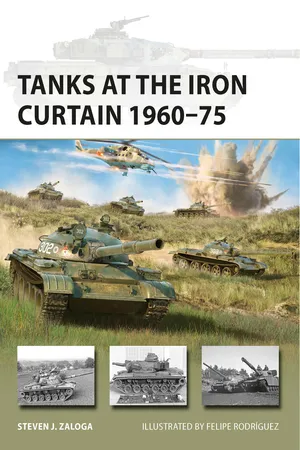
A new analysis of the technology and tanks that faced off against each other on opposite sides of the Iron Curtain, during the very height of the Cold War.
From the 1960s onwards, there was a generational shift in tank design and warfare with the advent of CBR (chemical, biological, radiological) protection and a move away from HEAT ammunition to APFSDS. This shift confronted the growing threat of guided anti-tank missiles and saw the introduction of composite armor. Soviet heavy tanks and tank destroyer/assault guns became obsolete, giving way to the technological might of the T-62 and T-64, while NATO forces employed the Chieftain, AMX-30, Leopard I, and M60, plus the initial attempt at a common US-German tank, the MBT-70.
Using detailed illustrations and contemporary photographs, this companion volume to NVG 301, Tanks at the Iron Curtain 1946–60 focuses on key battle tanks and their technology to give a comprehensive overall picture of how tanks developed during modern times.
- 48 pages
- English
- ePUB (mobile friendly)
- Available on iOS & Android
eBook - ePub
Tanks at the Iron Curtain 1960–75
About this book
Information
THE TANKS, DOCTRINE, AND ORGANIZATION
Soviet Union
In 1960, the Soviet Union was producing a comprehensive array of tanks that would form the basis of the Soviet Army’s tank force through the decade. In the light tank category, the production of the PT-76B ended in 1967. Development of the improved PT-76M with a redesigned hull was completed, but did not enter production. In 1960, the Stalingrad Tractor Plant (STZ) began work on the Obiekt 906, a substantially redesigned version armed with an 85mm D58-T gun. This was intended both to replace the PT-76 in tank units, as well as the ASU-85 assault gun in the airborne force. It was not accepted for production. The issue was re-examined in the early 1970s with competitive designs from the Kurgan plant (Obiekt 685) and the Stalingrad plant (Obiekt 934), both armed with the 100mm 2A48 gun. These failed to win support, in large measure because the army had grown accustomed to using wheeled reconnaissance vehicles in reconnaissance roles. As a result, the PT-76 lingered on in the reconnaissance role through the 1970s.
The backbone of the Soviet tank force was the T-55 tank that entered production in 1958. It was an evolutionary upgrade of the T-54A tank, incorporating a more comprehensive PAZ (Protivoatomnaya zashchita: counter-radiation protection). In terms of armor, firepower, and mobility, it was very similar to the T-54A.
Although the PAZ protective suite on the T-55 shielded the crew from radioactive fall-out, it did little to protect them against the radiation from a nuclear blast. A type of lead-impregnated plastic was developed along with an improved air filtration system to better protect against fall-out and chemical weapons than the T-55’s overpressure system alone. These modifications were incorporated into the improved T-55A tank and production began in August 1963.
The D10-T 100mm gun used on the T-55 was a 1944 adaption of an existing naval gun and not optimized for the antitank role. In the late 1950s, the new D54-T 100mm gun had been developed that offered significantly better anti-armor performance. The two main medium tank design bureaus in Kharkov and Nizhni-Tagil offered both an evolutionary and revolutionary approach to adopting the new gun. Aleksandr Morozov’s tank design bureau at Kharkov’s Malyshev tank plant offered a revolutionary solution, the radical new Obeikt 430 tank. It was a completely new design incorporating an innovative opposed-piston diesel engine, a lightweight suspension, composite armor in the hull, and the D54-TS 100mm gun. Politics and changing threat perceptions intervened before it entered production.
In 1958, premier Nikita Khrushchev had been shown the new T-12 100mm Rapira smooth-bore antitank gun. He insisted that the Soviet Army receive at least 200 tanks armed with this weapon by 1959. Leonid Kartsev’s design bureau at the Uralvagon Zavod (UVZ: Ural Rail-Car Factory) in Nizhni-Tagil was assigned this task. The T-12 ammunition was not well suited to tank use due to the length of its propellant casing. Instead, the new U5-T Molot (hammer) gun was developed that used the advanced projectile of the Rapira, but which had an increased 115mm bore to provide the ammunition with shorter dimensions better suited to Soviet tank turrets. Uralvagon developed two derivatives of the T-55 to fit the new generation of guns, the Obiekt 165 armed with the D54-TS as preferred by Moscow’s tank bureaucracy, and the Obiekt 166 Yubileniy (Jubilee) armed with “Khrushchev’s bastard,” the 115mm U5-T gun.
In December 1960, the new American M60 tank was issued to US troops in Europe for the first time. The initial Soviet evaluation of the design was issued to senior army officers in January 1961. It judged that the M60 had better glacis armor than the previous M48 and that its new 105mm gun was superior to the 100mm gun on the T-54/-55. Furthermore, the new D54-T gun was inadequate to frontally penetrate the new NATO tanks. The commander of the Soviet Ground Forces, Marshal V.I. Chuikov, was infuriated to learn that NATO was receiving a 105mm tank gun. Chuikov, the victor of Stalingrad, was a coarse and profane soldier of the old school, with no subtle understanding of tank technology. When informed that the next generation Obiekt 430 tank would still be armed with a 100mm gun even though NATO now had a 105mm gun, he made it abundantly clear that he wanted the next Soviet tank to have a bigger gun than NATO. Chuikov didn’t want to hear any technical arguments about the advantages of the D54-T 100mm gun. Since Khrushchev had already decided that heavy tank production cease in favor of missile tanks, this meant that a larger gun would have to be mounted on the medium tanks.

The T-62 tank was an evolution of the T-55, using essentially the same powertrain and suspension, but with an elongated hull. The new U5-TS 115mm gun required a new turret design of a more hemispherical shape than the T-55’s distinctive egg shape.

The T-62 underwent continual upgrades during its production run. Starting in 1971, the turret was modified with the addition of a mounting for the 12.7mm DShKM heavy machine gun to deal with the attack-helicopter threat.
Chuikov called the head of the GBTU Main Armor Directorate, Marshal Pavel P. Poluboyarov, into his office in Moscow for a severe dressing down. Poluboyarov admitted that Uralvagon had developed a tank with a 115mm gun, but that there had been problems with the stabilizer. Chuikov screamed at Poluboyarov, “Why are you jerking me around over this stabilizer? I don’t care if it’s mounted on a pig! Just come up with this gun!” Chuikov demanded that a more powerful gun be fielded immediately and he didn’t care whether it was mounted on Kharkov’s preferred Obiekt 430 modified for the 115mm gun or Nizhni-Tagil’s Obiekt 166. Since the Obiekt 166 had already been designed around the 115mm gun, it was ready for production. On the other hand, it would take time to adapt the Obiekt 430 to the 115mm gun, called the Obiekt 432. This was largely due to the need to develop split-case 115mm ammunition suitable for Obiekt 432’s autoloader. The impatient Chuikov made it very clear he wanted a more powerful tank immediately.
To placate the tank bureaucracy as well as Chuikov, in July 1961 the head of the defense industry recommended adopting both the Obiekt 166 with the U5-TS Molot 115mm gun as well as the related Obiekt 165 with the rifled D54-T 100mm gun. Government approval took place on August 12, 1961, with the Obiekt 166 being designated as T-62. On January 8, 1962, Obiekt 165 was accepted for Soviet Army use as the T-62A. The T-62 gradually replaced the T-55 on the production lines at Kharkov and Nizhni-Tagil, though it remained in production at Omsk until 1978, mainly for the export market.
These decisions led to the production of four different ammunition types for the medium tanks – two different 100mm and two different 115mm types. Clearly, this had to be simplified. The D54-T 100mm rifled gun offered better accuracy than the U5-TS Molot 115mm gun at longer ranges, but testing of production guns found performance problems when firing its APDS (armor-piercing, discarding-sabot) ammunition due to sabot interactions with the muzzle brake. The U5-TS Molot had its own accuracy problems due to its hasty origins since it was developed by simply boring out the 100mm rifled gun rather than starting from scratch; barrel stiffness was marginally inferior to the original 100mm gun. The U5-TS had some advantages over the D54-T in terms of cost since the 115mm APFSDS (armor-piercing, fin-stabilized, discarding-sabot) projectile used a steel penetrator which was much less costly than the 100mm APDS projectile with an expensive tungsten carbide core. By switching the 115mm penetrator from steel to tungsten carbide, its armor pene...
Table of contents
- Cover
- Title Page
- Table of Contents
- Introduction
- The Tanks, Doctrine, and Organization
- Tanks in Battle
- Technical Analysis
- Further Reading
- eCopyright
Trusted by 375,005 students
Access to over 1.5 million titles for a fair monthly price.
Study more efficiently using our study tools.
Frequently asked questions
Yes, you can cancel anytime from the Subscription tab in your account settings on the Perlego website. Your subscription will stay active until the end of your current billing period. Learn how to cancel your subscription
No, books cannot be downloaded as external files, such as PDFs, for use outside of Perlego. However, you can download books within the Perlego app for offline reading on mobile or tablet. Learn how to download books offline
Perlego offers two plans: Essential and Complete
- Essential is ideal for learners and professionals who enjoy exploring a wide range of subjects. Access the Essential Library with 800,000+ trusted titles and best-sellers across business, personal growth, and the humanities. Includes unlimited reading time and Standard Read Aloud voice.
- Complete: Perfect for advanced learners and researchers needing full, unrestricted access. Unlock 1.5M+ books across hundreds of subjects, including academic and specialized titles. The Complete Plan also includes advanced features like Premium Read Aloud and Research Assistant.
We are an online textbook subscription service, where you can get access to an entire online library for less than the price of a single book per month. With over 1.5 million books across 990+ topics, we’ve got you covered! Learn about our mission
Look out for the read-aloud symbol on your next book to see if you can listen to it. The read-aloud tool reads text aloud for you, highlighting the text as it is being read. You can pause it, speed it up and slow it down. Learn more about Read Aloud
Yes! You can use the Perlego app on both iOS and Android devices to read anytime, anywhere — even offline. Perfect for commutes or when you’re on the go.
Please note we cannot support devices running on iOS 13 and Android 7 or earlier. Learn more about using the app
Please note we cannot support devices running on iOS 13 and Android 7 or earlier. Learn more about using the app
Yes, you can access Tanks at the Iron Curtain 1960–75 by Steven J. Zaloga,Felipe Rodríguez in PDF and/or ePUB format, as well as other popular books in Historia & Historia de Europa del Este. We have over 1.5 million books available in our catalogue for you to explore.