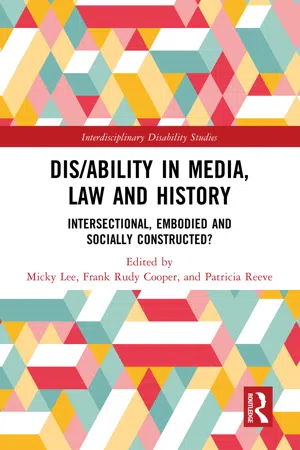
This book explores how being "disabled" originates in the physical world, social representations and rules, and historical power relations—the interplay of which render bodies "normal" or not.
Do parking signs that represent people in wheelchairs as self-propelling influence how we view dis/ability? How do wheelchair users understand their own bodies and an environment not built for them? By asking questions like these the authors reveal how normalization has informed people's experiences of their bodies and their fight for substantive equality. Understanding these processes requires acknowledging the tension between social construction and embodiment as well as centering the intersection of dis/abilities with other identities, such as race, class, gender, sex orientation, citizen status, and so on.
Scholars and researchers will find that this book provides new avenues for thinking about dis/ability. A wider audience will find it accessible and informative.
Trusted by 375,005 students
Access to over 1.5 million titles for a fair monthly price.
1 Introduction: Dis/abilities at the Intersections
Micky Lee, Frank Rudy Cooper, and Patricia Reeve
DOI: 10.4324/9781003257196-1
We three authors are old enough to remember when you rarely saw “handicapped” parking signs. Our memory goes back before the Americans with Disabilities Act (ADA) changed the legal landscape for people with dis/abilities in the United states of America.1 Most of the 30 years since the passage of the ADA have seen “handicapped” parking signs with a figure sitting up straight in a stationary wheelchair. The provision of such “easily recognizable” signs is part of municipal compliance with the ADA. Today, though, the trend in signage is toward a new image: a self-propelled figure tilted forward in a chair that is in motion (Figure 1.1). Such signs reconfigure the meanings of agency, mobility, and dis/ability by depicting dis/abled people as active participants in their environments. They represent dis/abled drivers as self-moving corporeal subjects who are also objects of legal discourse.2 The new signs are a simple symbol that “dis/ability” is both embodied— constituted by the configuration of a body in a physical world—and socially constructed—made meaningful through historical representations of the body in society and law.
Figure1.1 A parking sign for persons with dis/abilities outside Cambridge City Hall, Massachusetts (photo credit: Micky Lee).
It is important to explain how embodiment and social constructionist perspectives have theorized dis/abilities before suggesting what interventions this volume offers. Theories of embodiment are multifaceted. Some dis/ability scholars privilege the body as a medium for sensory experiences including pleasure and its opposites: psychological and chronic illnesses that cause pain and discomfort. Others conceive of the body as a medium “for self-understanding and self-definition” and for interactions “with others and with the world more generally.” Additionally, some theorize that embodiment is a “mode of material/cultural analysis that illuminates the ‘political economy of difference’” created by the material and geographic specificities of globalization, labor markets, and the like (Wilkerson 2015, pp. 68–69). Running through each of these perspectives is the rejection of a medical model of dis/abilities. That model views the body as an object for scientific inquiry that is measured against a norm and seeks to correct its “impairments.” Instead, the embodiment approach rejects the premise that people sharing the same attributes would all subjectively experience their bodies in the same way. Given the manifold dimensions of what it means to be embodied, there is no objective means to distinguish an abled from a dis/abled body. Moreover, the body is fluid and subject to change. For example, our bodies change when we age, so all of us will experience different forms of dis/abilities. Dis/ability is always a process of being and becoming, it is not a fixed condition for anybody (Annamma et al. 2018). The embodiment approach thus questions what bodily normalcy is: at which point is the body normal, at which point abnormal? Would a normal body be made abnormal in another social context?
Embodiment theorists also ask how the body mediates daily activities and how the resulting experiences shape our self-identities in society (Silvers 2019). This approach also asks us to pay attention to how “major life functions such as mobilizing, hearing, seeing, communicating and understanding” (para. 46) shape our social experience and help us navigate the world on which we project our ambitions. From this perspective, dis/ability is about how individuals make dis/ability arises from an individual’s understanding of how the body conditions social experience and the ability to act in the world.
Now we turn our attention to a social constructionist approach. The main social constructionist argument about dis/abilities is that they are socially produced. Ideologies engender hierarchies of normative and non-normative bodies. Likewise, these ideas give rise to a built environment that fails to take different bodily abilities into account, as illustrated by the absence of designated spots for dis/abled drivers prior to the passing of the ADA.
The social constructionist approach was first proposed by the Union of the Physically Impaired Against Segregation (UPIAS) based in the UK in the 1970s, and it has been known as the social model of dis/abilities. The UPIAS advocated for dis/ability rights, arguing that society is organized in a way that excludes populations with dis/abilities. Therefore, the UPIAS aimed to empower populations with dis/abilities through political actions. It rejected a definition of dis/ability as bodily impairments and refused to see populations with dis/abilities as recipients of charitable benefits. Instead, it proposed that dis/abilities result from social and physical environments that neglect the needs of populations with physical dis/abilities. The UPIAS also rejected medical and psychological solutions to dis/abilities that purport to understand and “cure” them.3 One goal of social constructionist advocates, then, is to change how society organizes itself such that populations with dis/abilities enjoy full citizenship and substantively equal rights and privileges (Hall 2019).
Going back to the wheelchairs example, we can argue that bodily mobility and immobility themselves are socially constructed. Humans are not born with a dis/ability, they are made dis/abled by the normalization of unmarked parking spots, lack of a ramp, and so on. Equally, people are made abled because architects and city planners designed parking lots with an abled-bodied bias, creating spaces that accommodate abled bodies and afford them mobility.
In this edited collection, we problematize dis/ability by examining the strengths and shortcomings of both embodiment and social constructionist approaches while contending that each approach can challenge, complicate, and compensate for the other. We have reservations about a strong version of embodiment theory, which, while not ignoring ideology, grounds its analysis in the bodily senses. Accordingly, we examine the agency of the body in its navigation of material landscapes and in the upholding and challenging of power relations. As was shown, whether a body is abled or dis/abled is made and unmade by society. However, we are not among those who suggest that dis/ability is meaningful only through its construction in language, for there is a body in the wheelchair image we are discussing. We acknowledge that bodily experiences of pain are not simply discursive. We then recognize that an embodiment approach excels at pointing out how the body's existence changes the social world, which in turn changes the meaning and movement of the body. Further, how we describe the world influences how we act in it and upon it. A strong social constructionist approach holds that language distinguishes people with different bodies, resulting in the unsurprising (but not inevitable) hierarchization of those differences. These constructed differences in turn create ableism or the normalization of certain bodily and mental configurations over others. Ableism guides the configuration of material life, making some bodies abled and others dis/abled.
To illustrate how “abled” bodies are normalized, recall that most parking spots are unmarked. The “regular” spot is like the “flesh” in flesh-colored emojis (white or a strange yellow that obviously stands in for white) or the “man” in “woman.” The “normal” is signaled unquestioningly and accepted as given. But the normalization of “abled” bodies does not stop at discursive imaginings of physical dis/ability. Think of what happens when one rolls or walks into a grocery store and the environment contains loud noises, flashing lights, and food samples. People who are “on the spectrum” or diagnosed as Attention deficit disorder-hyperactivity disorder (ADD-HD) are easily affected by such distractions, and their dis/abilities are thus triggered in some environments and not others. The cultural norms of treatment of those considered dis/abled ameliorate or exacerbate that dis/ability. Even though the ADA requires buildings to provide access to the people with bodily dis/abilities, it has not yet required every public place to have quiet hours to accommodate patrons who fall onto the spectrum or to have less colorful displays and quieter environments for patrons with ADD-HD.
In search of a hybrid perspective on embodiment and social construction of dis/abilities, we proceed as follows. First, we will explore the tension and interplay between embodiment and social constructionist approaches to dis/abilities. That section will examine how these methods complement and contradict one another. Next, we will discuss the two contributions offered by the volume. We begin by centering intersectionality theory's consideration of multiple aspects of identity at once. We then discuss how our own disciplines—media studies, critical legal studies (CLS), and the cultural and social histories of embodiments—have interrogated and applied these theoretical frameworks and accounted for the tensions between them. We conclude with an overview of contributors’ chapters.
From medical model to synthesis
This volume is the product of our individual inquiries into the interaction between the embodied experiences of dis/ability and social experiences of it. We recognize that the acting of one upon the other is historically conditioned and, consequently, that the social and civic status of people with dis/abilities has waxed and waned through time. In short, the embodied and social experiences of dis/ability are mutable and historically contingent. It follows that the liberation of people with dis/abilities is impossible unless we undertake both rigorous analysis and the dismantling of the ableist ideas that delimit their individual and bodily autonomy.
Despite their shared rejection of the medical model, proponents of embodiment and social construction theories have frequently disagreed on how to understand the co-constitutive relationship between bodies and social discourse. This volume, therefore, seeks to understand whether one approach can complement the other, and how.
Rejection of a medical model by both approaches
We assert that there is a fundamental but potentially solvable conflict between embodiment and constructionist theories. Likewise, there is the potential for productive exchange between these approaches. For example, the two approaches coincide in their rejection of an older medical model that saw people with dis/abilities as physically, mentally, or otherwise lacking in ways that could be calculated as deficits. As we have argued, the medical model may appear to be a scientific, empirical lens on the human body, but it actually posits normative and non-normative bodies in binary terms. Prior to the age of science, ancient societies blamed dis/abilities on the work of evil spirits and later peoples interpreted dis/abilities as divine punishment for sin. The Enlightenment Era and modernity ushered in a new understanding of the body by externalizing the body from the person, making it a “thing” that could be examined, diagnosed, and fixed. Today, a medical model believes that the body can be seen and known by professionals and that the nature of the body remains unchanged over time and place (Loeser et al. 2017). This medical model sees abled and dis/abled bodies as dichotomous: one either has an abled body or a dis/abled body. Thus, the dis/abled body is a negation that needs to be corrected (Haegele & Hodge 2016).
Both embodiment and social constructionist theorists reject a medical model of dis/abilities for similar and dissimilar reasons. On the one hand, they agree that the medicalizing of dis/abilities has three deleterious effects. First, and as we have seen, it normalizes the abled body. Second, it assumes that a normal body exists and is attainable. The differentiation between a normal and an abnormal body legitimates the disproportionate allocation of resources to abled bodies (Garland-Thomson 2002). Third, the medical model sees a body with dis/ability as inferior to one without.
Both approaches also have differing reasons for rejecting the medical model. An embodiment approach rejects this paradigm because it does not take into account the subjective experiences of one's own body. Social constructionists reject the medical model primarily because it does not take into account the social factors that constitute how the body is understood and labeled.
The embodiment critique of social construction
Despite embodiment theorists and social constructionists’ mutual distrust of the medical model, they do not always agree with each other. Some embodiment scholars have found both medical and social constructionist models to be inadequate for understanding dis/abilities for several reasons. First, both approaches homogenize individuals (Haegele & Hodge 2016) by conceiving of bodily experience as a universal rather than a particularized phenomenon. Embodiment scholars thus reject both medical and constructionist models as under privileging the diversity of embodiment.
Second, embodiment scholars also reject the strong constructionist idea that “the body does not determine its own representation in any way because the sign [or cultural imprint] precedes” it. Thus, Siebers (2006) argues that constructivist representations of bodily pain fail to account meaningfully for the manifold dimensions of physical suffering and their implications for individuals experiencing it. He argues,
...
Table of contents
Cover
Half Title
Series Page
Title Page
Copyright Page
Dedication
Contents
List of Figures
List of Contributors
Acknowledgments
Foreword by Lauri Umansky
1 Introduction: Dis/abilities at the Intersections
Part I: Foundations: Experience and Theories
Part II: Rehabilitation, Disablement, and the State
Part III: Representation, Liminality, and Resistance
Part IV: The Political Embodiment of Personhood
Index
Frequently asked questions
Yes, you can cancel anytime from the Subscription tab in your account settings on the Perlego website. Your subscription will stay active until the end of your current billing period. Learn how to cancel your subscription
No, books cannot be downloaded as external files, such as PDFs, for use outside of Perlego. However, you can download books within the Perlego app for offline reading on mobile or tablet. Learn how to download books offline
Perlego offers two plans: Essential and Complete
Essential is ideal for learners and professionals who enjoy exploring a wide range of subjects. Access the Essential Library with 800,000+ trusted titles and best-sellers across business, personal growth, and the humanities. Includes unlimited reading time and Standard Read Aloud voice.
Complete: Perfect for advanced learners and researchers needing full, unrestricted access. Unlock 1.5M+ books across hundreds of subjects, including academic and specialized titles. The Complete Plan also includes advanced features like Premium Read Aloud and Research Assistant.
Both plans are available with monthly, semester, or annual billing cycles.
We are an online textbook subscription service, where you can get access to an entire online library for less than the price of a single book per month. With over 1.5 million books across 990+ topics, we’ve got you covered! Learn about our mission
Look out for the read-aloud symbol on your next book to see if you can listen to it. The read-aloud tool reads text aloud for you, highlighting the text as it is being read. You can pause it, speed it up and slow it down. Learn more about Read Aloud
Yes! You can use the Perlego app on both iOS and Android devices to read anytime, anywhere — even offline. Perfect for commutes or when you’re on the go. Please note we cannot support devices running on iOS 13 and Android 7 or earlier. Learn more about using the app
Yes, you can access Dis/ability in Media, Law and History by Micky Lee, Frank Rudy Cooper, Patricia Reeve, Micky Lee,Frank Rudy Cooper,Patricia Reeve in PDF and/or ePUB format, as well as other popular books in Social Sciences & Social History. We have over 1.5 million books available in our catalogue for you to explore.