- 304 pages
- English
- ePUB (mobile friendly)
- Available on iOS & Android
eBook - ePub
About this book
2018 and 2019 Washington State Book Award Finalist (Biography/Memoir) • Excerpted in The Atlantic and Politico • TIME Magazine – One of 6 Books to Read in Honor of the 50th Anniversary of Martin Luther King Jr.'s Death
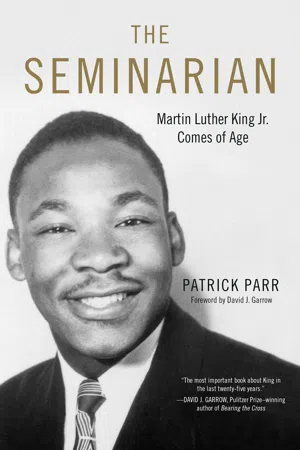
Martin Luther King Jr. was a cautious nineteen-year-old rookie preacher when he left Atlanta, Georgia, to attend divinity school up north. At Crozer Theological Seminary, King, or "ML" back then, immediately found himself surrounded by a white staff and white professors. Even his dorm room had once been used by wounded Confederate soldiers during the Civil War. In addition, his fellow seminarians were almost all older; some were soldiers who had fought in World War II, others pacifists who had chosen jail instead of enlisting. ML was facing challenges he'd barely dreamed of.
A prankster and a late-night, chain-smoking pool player, ML soon fell in love with a white woman, all the while adjusting to life in an integrated student body and facing discrimination from locals in the surrounding town of Chester, Pennsylvania. In class, ML performed well, though he demonstrated a habit of plagiarizing that continued throughout his academic career. But he was helped by friendships with fellow seminarians and the mentorship of the Reverend J. Pius Barbour. In his three years at Crozer between 1948 and 1951, King delivered dozens of sermons around the Philadelphia area, had a gun pointed at him (twice), played on the basketball team, and eventually became student body president. These experiences shaped him into a man ready to take on even greater challenges.
Based on dozens of revealing interviews with the men and women who knew him then, The Seminarian is the first definitive, full-length account of King's years as a divinity student at Crozer Theological Seminary. Long passed over by biographers and historians, this period in King's life is vital to understanding the historical figure he soon became.
Martin Luther King Jr. was a cautious nineteen-year-old rookie preacher when he left Atlanta, Georgia, to attend divinity school up north. At Crozer Theological Seminary, King, or "ML" back then, immediately found himself surrounded by a white staff and white professors. Even his dorm room had once been used by wounded Confederate soldiers during the Civil War. In addition, his fellow seminarians were almost all older; some were soldiers who had fought in World War II, others pacifists who had chosen jail instead of enlisting. ML was facing challenges he'd barely dreamed of.
A prankster and a late-night, chain-smoking pool player, ML soon fell in love with a white woman, all the while adjusting to life in an integrated student body and facing discrimination from locals in the surrounding town of Chester, Pennsylvania. In class, ML performed well, though he demonstrated a habit of plagiarizing that continued throughout his academic career. But he was helped by friendships with fellow seminarians and the mentorship of the Reverend J. Pius Barbour. In his three years at Crozer between 1948 and 1951, King delivered dozens of sermons around the Philadelphia area, had a gun pointed at him (twice), played on the basketball team, and eventually became student body president. These experiences shaped him into a man ready to take on even greater challenges.
Based on dozens of revealing interviews with the men and women who knew him then, The Seminarian is the first definitive, full-length account of King's years as a divinity student at Crozer Theological Seminary. Long passed over by biographers and historians, this period in King's life is vital to understanding the historical figure he soon became.
Tools to learn more effectively

Saving Books

Keyword Search

Annotating Text

Listen to it instead
Information
Edition
1Subtopic
Political BiographiesYear III
Revelation

A vespers service in the Crozer chapel, circa the late 1940s. The chapel, located on the first floor of Old Main, is where ML and other seminarians had various classes and worshipped throughout the week. Courtesy of Colgate Rochester Crozer Divinity School, Rochester, NY
7
Forbidden Love
Term 1, September 12–
November 22, 1950
“Martin talked slowly, delivering every sentence with Delphian assurance and oracular finality. . . . That afternoon, in the middle of the day and the middle of the week, he wore a collar, tie, and three-button suit. He was a small-framed person, who walked and talked slowly with a kind of Napoleonic assurance. He looked like a major event about to happen.”
—Dr. Samuel Proctor, former Crozer and Boston University graduate,
upon meeting ML for the first time1
upon meeting ML for the first time1
In Love but Struggling: “Man of a Broken Heart”
Term 1 had not yet gotten under way, and already the demands of ML’s final year at Crozer were hanging over him. To officially complete seminary, every student needed to pass a battery of comprehensive examinations, both written and oral, during the fall of their third year. It was by no means a cakewalk; both Walter McCall and Marcus Wood would fail their first go-around.2
The written portion consisted of “two three-hour written examinations” that were scheduled to begin on Thursday, September 7, nearly a week before the start of the term. According to the exam’s study guide, topics would span the entire Crozer curriculum, from the liberal theology espoused by George W. Davis to the practical perspective on the Gospels championed by Morton Enslin.3
And ML couldn’t just spend the rest of the week preparing, because his other responsibilities demanded attention. As student body president, he was scheduled to address incoming students during orientation that same Thursday. And he was playing host to other members of the King family, who were in town for the annual meeting of the National Baptist Convention (NBC). The event was being held in Philadelphia on September 6–10, and not only was Martin Sr. obliged to make his usual appearance, but Mama King was slated to play the organ for the “women’s division,” and Daddy King’s brother Joel, also a Baptist minister, was in attendance as well.4
While ML would have expected his family to swing by Crozer while they were in the area, he may have had a few twinges of annoyance, and not just at giving up precious study time. After all, Crozer and Philadelphia had been his second home for the last two years. Now, as student body president and a prominent local preacher, he had a certain reputation to maintain that might be threatened by parental encroachment.
At one point during their visit, ML took Daddy King and Uncle Joel down into the basement of Old Main to show off his pool skills. Uncle Joel was stunned when ML, appearing to have no fear, lit a cigarette in front of his father. Daddy King had never had any patience for smoking, drinking, cursing, or even pool. Uncle Joel, considerably younger than Martin Sr., even remembered when he himself was in college and his brother smacked a cigar out of his mouth. But as they watched ML knock in a few pool balls, puffing away like a natural, Daddy King did nothing. Later, Uncle Joel asked his brother why he didn’t try to discipline ML there in the basement. Daddy King remained silent. “Never got an answer,” said Joel King.5 Martin Sr. must have realized that his son had outgrown such heavy-handed parenting.
Though defiant in his leisure activities, in other respects ML was still following in his father’s footsteps. He joined Daddy King at the NBC meeting, even persuading Horace Whitaker and Walter McCall to attend. Probably borrowing his father’s car, he drove his two friends to the site of the event, an auditorium near the Thirtieth Street Station in downtown Philadelphia.6
It was Whit’s first time attending such a gathering, and he found it reminiscent of a “mass jungle.” Whit watched in frustration as the ministers behind the pulpit onstage competed for attention with vendors strolling up and down the aisles “selling hats” and “shouting” at the attendees. Joel King, too, recalled that attendees would get so wound up at certain speakers that they would scream comments such as “If you pick up that mike, I’ll cut your heart out!” The rowdy energy was still good spirited, if surprising to first-time attendees.7
At the time, the National Baptist Convention reported a membership of around four million people, predominantly African American. An estimated seven thousand delegates turned out for the annual meeting, which featured singing and pleas from Pennsylvania governor James Duff for tolerance and racial integration. The report issued after the event stated that attendees were pleased “to see the walls of injustice and inequality crumbling daily before our eyes.”8
As soon as the NBC thunderstorm dispersed and ML’s family left the area, it was time for the start of classes—and for the comprehensive oral exam. The test would last for forty-five minutes to an hour and focus on two particular theological areas of the student’s choosing, but be broad enough to “discover the student’s ability to think in an integrative manner over all the areas of theological education.”9
Despite ML’s demanding schedule, when both the written and oral examinations were completed, he stood out from the rest. In a note by Charles Batten to Morehouse College, the dean informed ML’s alma mater of the results. “We have just had a period of comprehensive examinations and only one man was granted honors in them; it was King.”10

As ML turned his attention from what he’d learned in his first two years at Crozer to the final year that lay ahead of him, it would have been impossible to ignore the changes that were now roiling the school. The interim days of H. W. “Creeping Jesus” Smith were over. After a transition period that stretched over the latter two quarters of ML’s middle year, Dr. Sankey L. Blanton was now the seminary’s president, and he was eager to change its entire culture.
Dr. Blanton was a man of the South, a fifty-two-year-old North Carolinian who had previously been the dean of religion at Wake Forest University. Blanton brought with him an influx of southern energy, including six of his former Wake Forest students whom he persuaded to enroll at Crozer. One of them, Jack Bullard, remembers witnessing firsthand the transformation Blanton sought. “He represented a change of direction. He wanted to counteract the direction Enslin had been taking the faculty.” Whereas Enslin was a brilliant New Testament scholar but an indifferent preacher, Blanton “wanted more of a practical focus. . . . They were interested in pastors, not theological scholars.”11
The plan was not Blanton’s alone. Crozer’s board of trustees wanted to take advantage of a growing trend in America’s postwar religious culture—away from biblical scholarship and toward the populist appeal of charismatic evangelistic preachers—to not just increase enrollment but spike it. Thanks to Blanton’s efforts during the transition period, the school was already seeing results: while ML’s class had dwindled in his last year to only eleven students, the incoming junior class wa...
Table of contents
- Cover Page
- Title Page
- Copyright Page
- Dedication Page
- Contents
- Foreword by David J. Garrow
- Note to the Reader
- Prologue: On a Bus in Georgia, April 1944
- Year I: Genesis
- Year II: Exodus
- Year III: Revelation
- Appendix A. Crozer Incoming Class of 1948
- Appendix B. Events from ML’s Student Body Presidency
- Appendix C. A Brief History of the Crozers and Old Main
- Acknowledgments
- Notes
- Selected Bibliography
- Index
Frequently asked questions
Yes, you can cancel anytime from the Subscription tab in your account settings on the Perlego website. Your subscription will stay active until the end of your current billing period. Learn how to cancel your subscription
No, books cannot be downloaded as external files, such as PDFs, for use outside of Perlego. However, you can download books within the Perlego app for offline reading on mobile or tablet. Learn how to download books offline
Perlego offers two plans: Essential and Complete
- Essential is ideal for learners and professionals who enjoy exploring a wide range of subjects. Access the Essential Library with 800,000+ trusted titles and best-sellers across business, personal growth, and the humanities. Includes unlimited reading time and Standard Read Aloud voice.
- Complete: Perfect for advanced learners and researchers needing full, unrestricted access. Unlock 1.4M+ books across hundreds of subjects, including academic and specialized titles. The Complete Plan also includes advanced features like Premium Read Aloud and Research Assistant.
We are an online textbook subscription service, where you can get access to an entire online library for less than the price of a single book per month. With over 1 million books across 990+ topics, we’ve got you covered! Learn about our mission
Look out for the read-aloud symbol on your next book to see if you can listen to it. The read-aloud tool reads text aloud for you, highlighting the text as it is being read. You can pause it, speed it up and slow it down. Learn more about Read Aloud
Yes! You can use the Perlego app on both iOS and Android devices to read anytime, anywhere — even offline. Perfect for commutes or when you’re on the go.
Please note we cannot support devices running on iOS 13 and Android 7 or earlier. Learn more about using the app
Please note we cannot support devices running on iOS 13 and Android 7 or earlier. Learn more about using the app
Yes, you can access The Seminarian by Patrick Parr,David Garrow in PDF and/or ePUB format, as well as other popular books in Politics & International Relations & Political Biographies. We have over one million books available in our catalogue for you to explore.