eBook - ePub
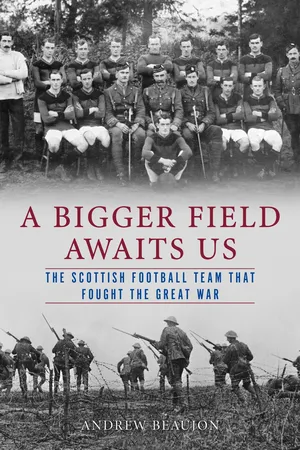
A Bigger Field Awaits Us
The Scottish Football Team That Fought the Great War
- 288 pages
- English
- ePUB (mobile friendly)
- Available on iOS & Android
eBook - ePub
About this book
A captivating and poignant tale, this is the little-known story of a group of Scottish athletes and their fans who went to war together—and what happened to the few who made it home. The saga of McCrae's Battalion brings much-needed human scale to World War I and explains why a group of young men from a small country with almost no direct connection to the conflict would end up sacrificing their careers, their homes, their health, and in many cases their lives to an abstract cause.
Trusted by 375,005 students
Access to over 1.5 million titles for a fair monthly price.
Study more efficiently using our study tools.
Information
1
A COMPANY
OF SPORTSMEN
In November 1914 the war came to Edinburgh in the form of a very long line around a squat beaux arts concert hall that had opened just months before with a grand dome up top and cheap wooden seats in the upper circle for working people. The seats were designed to bring sweet music into tough lives and to amplify the sounds from the stage. The massive pipe organ in the gallery shook everyone’s bum when the maestro played a low note, and you might even get a little bit of that buzz if a speaker had a low voice. On this Friday night the buzz was outside, as four thousand people waited for two thousand seats in weather the meteorological office had somewhat unhelpfully predicted as “variable, fair or fine to showery.”
You came to the Usher Hall through wet streets crowded by tall sandstone edifices that are now pinkish gray and glow gold at sunset. But in 1914 they were a somber gray, slathered with greasy dust from the coal that barely warmed the tenement flats and storefronts on the way. As you approached the Usher, heading down Lothian Road from Fountainbridge, maybe, or cutting through Bread Street Lane if you were canny, you entered the square where the city’s famous castle, at once visible by a gap in the skyline, watched over the street artists working.
Men wore long coats over their jackets and ties, their hats beacons of class: flat caps for the working classes; derbies, bowlers, and even sometimes top hats for those up the ladder. Women wore wide-brimmed hats that were simple and dark, sometimes with bows for effect, and their long coats covered simple dresses—shirtwaists over long, narrow skirts whose hemlines, inspired by daring Parisians, were just starting to creep up above the ankle. Such fashionable lasses might have kept their hands warm with muffs, another item that had lately come into style.
There was no admission price for the most desirable ticket in town, just your time, which you burned up happily waiting with everyone else desperate to cheer Sir George McCrae and the lads from Hearts.
Hearts is a nickname for the Heart of Midlothian Football Club. It was founded in 1874 in Gorgie, an area west of the city center whose forty thousand or so residents lived in tenements, in small flats off dark stairs in Georgian buildings, or, if they were from the artisan or skilled working classes, in terraced or colony houses where they didn’t have to share space with dozens of other families. The team took its name from the seventh of Sir Walter Scott’s Waverley novels, telling the story of an eighteenth century riot against an officious captain of the city guard. By 1914 it was a professional operation whose official rival was, and remains to this day, Hibernian Football Club. “Hibs” play in Leith, north of the city center.
Gorgie was a thriving commercial district in 1914. Like the nearby areas of Dalry and Shandon, it hosted a multitude of businesses and light industry—tanners, brewers, rubber works, printers, bakers, furniture makers, dairies, and even farms. Suburban railroads and tramways shuttled people around town; the Union Canal just to the south ran thirty-two miles to Falkirk, where it connected with the Forth and Clyde Canal into Glasgow.
The 1911 census counted just over half a million people in Edinburgh, then and now a breathtakingly beautiful city. Its castle sits on a four-hundred-foot-high volcanic plug that overlooks the Old and New Towns of the city center; a road runs eastward down the hill from the fortress about a mile to the Palace of Holyroodhouse, near the cliffs of the Salisbury Crags and the eight-hundred-foot-high hill Arthur’s Seat. From the top of Arthur’s Seat you can peer down on Leith and its docks on the Firth of Forth, a large estuary where the river Forth empties into the North Sea.
While Glasgow was a center of shipbuilding and heavy industry, Edinburgh’s character was influenced heavily by the businesses of finance and law. Edinburghers are famously distant and taciturn to outsiders. Edinburgh is one of those cities in which interlocking personal connections and a Calvinistic suspicion of ambition and success practically turn it into a small town; the phrase “A kent yer faither”—I know your father—is a supremely Edinburgh way of putting down anyone who might otherwise feel entitled to feel good about their accomplishments.
And yet it was in Edinburgh that George McCrae flourished without a father. He was the rarest of men in class-bound turn-of-the-century British society: a genuinely self-made man. McCrae was born up north in Aberdeen in 1860,1 the illegitimate son of a housemaid named Jane Buchan, who may have invented a last name and a father for the boy’s birth certificate. They moved to Edinburgh, where she raised George in her brother’s house. He was apprenticed to a hatter named Robert Nicol, “having been left at the age of ten to fight his own battles,” as he put it four decades later.2
George was hardworking and ambitious; six years after he entered his employ in Dunfermline, Nicol put the boy in charge of the family’s business, which he ran from its Edinburgh shop. At eighteen, McCrae added to his obligations by joining the British Army’s volunteer force as a reservist. Two years later he left the Nicol family and established a hats-and-hosiery business on Cockburn Street in Edinburgh’s Old Town, later expanding it into a company with headquarters on Princes Street, Edinburgh’s showiest address. Even at the start of his career, McCrae showed a talent for getting attention: he made a huge pair of gloves and drove them around town with a banner that read “Made to Measure by McCrae!” and a giant bowler cap that walked around town.3
At twenty-nine McCrae entered city government and immediately set to work straightening out Edinburgh’s tortured finances; he became the city’s treasurer two years later and in 1894 implemented the Corporation Stock Act that brought in £120,000, simplified the city’s accounts, and saved it significant money on legal fees and interest. He changed Edinburgh’s physical landscape as well, providing crucial support for the city to install electric lighting, acquire tramways, and rebuild the North Bridge that joins the Royal Mile to Princes Street.
In 1897 he became a candidate for lord provost, then the equivalent of mayor in a Scottish city, but lost to Sir Mitchell Mitchell-Thomson. Undeterred, McCrae set his sights on national politics, winning a seat in Parliament in 1899. There his nuts-and-bolts experience with local finances proved invaluable, and he contributed to projects including London’s water bill, providing physical training and school meals to poor Scottish children, and construction of housing projects in Dunfermline and Rosyth near the naval yards on the other side of the Firth of Forth from Edinburgh.
Throughout he remained a loyal member of the Fourth Royal Scots, who wore red tunics and were known as the “Water Rats” because its men were reputed as teetotalers. McCrae supported the 1907 act that created the Territorial Army, charged with defense of the homeland as well as serving as a reserve to the main British Army. In 1881 he was a sergeant and marched in a huge downpour past Queen Victoria. He received a commission in 1883 as a lieutenant and by 1905 took command of the regiment as a colonel. The Territorial Army turned the Fourth Royal Scots into the Sixth Royal Scots, and when George McCrae turned over command the unit was one of the best-run in the country. He was knighted in 1908 by King Edward at Buckingham Palace: “A draper who was three times treasurer of the city of Edinburgh, and is regarded in the House of Commons as an expert on financial subjects,” the King’s Birthday Honours list read.4

Sir George McCrae, photographed in 1901 by Sir (John) Benjamin Stone.
Collection of the National Portrait Gallery, London
McCrae married Eliza Cameron Russell in 1880 and had three sons and five daughters. McCrae never acknowledged his own illegitimacy. Jane Buchan lived with him by 1901 under the name Jane McCrae, their secret safe until she died the next year, when he listed himself simply as her employer on her death certificate. As the genealogist Alex Wood has written, Sir George’s rags-to-riches tale was acceptable in turn-of-the-century Britain; his unclear paternity was not.
“Lizzie” died of cancer in late 1913. War came soon after her death and all three of her sons served their country: George was a captain in the Fourth battalion of the Royal Scots, the Queen’s Edinburgh Rifles. William was in the Royal Artillery’s First Lowland City of Edinburgh Heavy Battery. Kenneth was somewhere in Buenos Aires at the war’s outbreak; Sir George had no idea where he was until six weeks later, when a telegram arrived from Liverpool: “I have come home for service,” it said, to Sir George’s pride.
Britain needed the McCrae boys. It needed all the men it could get. Although a formidable naval power, its professional army was minuscule compared to those on the continent. Germany had four and a half million men in its army. Austria-Hungary had three million. France and Russia, Britain’s partners in the Triple Entente that linked the countries’ interests, had four million and six million men at the ready, respectively. Unlike those countries, Britain had an all-volunteer army—the army, and most British people, found conscription repugnant.
But in June 1914 a nineteen-year-old Bosnian nationalist Gavrilo Princip set in motion forces that would eventually challenge many British self-conceptions. Archduke Franz Ferdinand was heir to the Austro-Hungarian throne, a decaying empire that barely held on to a collection of Baltic states, including Bosnia and Herzegovina. He was visiting Sarajevo on June 28, when Princip succeeded where one of his coconspirators had failed earlier in the day with an ineffective bomb: Franz Ferdinand’s driver got them out of that situation but later took a wrong turn that dumped them into an alley right where Princip happened to be standing. Princip took advantage of the mix-up and placed bullets in the archduke and his wife, Sophie, before the driver could reverse out.
Europe’s leaders were bound together at the time by a series of complex alliances and blood ties that defy easy taxonomy. Kaiser Wilhelm II of Germany was a cousin to both King George V of Britain, who had taken the throne in 1910, and Empress Alexandra of Russia. Germany had a close alliance with Austria-Hungary. Anti-Serb riots followed in Vienna and Brno. Led by Franz Ferdinand’s uncle Emperor Franz Joseph I and encouraged by Kaiser Wilhelm, the Austro-Hungarian government issued to Serbia a set of demands on July 23, among them to help Austria-Hungary suppress the “subversive movement directed against the integrity of the Monarchy,” arrest officers it suspected of colluding with the rebels, and to censor publications that “shall incite to hatred and contempt.”
Serbia felt it had little choice but to comply. It agreed to all conditions but asked that a judicial inquiry Austria-Hungary demanded be conducted by the Permanent Court of Arbitration at the Hague instead of in Serbia. The capitulation wasn’t enough. Austria-Hungary declared war on Serbia on July 28.
Russia had close relations with its fellow Slavic state Serbia and began mobilizing its military. Austria-Hungary moved its forces against Russia in turn. Germany was bound by an alliance to Austria-Hungary and declared war on Russia on August 1. It also declared war on France, which was allied to Russia.
Britain and Germany had signed a treaty in 1839 guaranteeing Belgian neutrality, but Germany’s long-established plan for a war with France required a swift route to Paris, and poor little Belgium was simply in the way. Britain and Germany had been circling each other like the biggest, most belligerent kids on the playground for years. For the most part, the competition was limited to the seas, where each tried to keep the bigger navy afloat. That contest came ashore when Britain issued its own ultimatum to Germany: stay out of Belgium. German troops crossed the border that night. At 11:00 PM on August 4 Britain declared war.
The British people greeted war with unprecedented patriotism and optimism. Following a report in the Daily Mail of Irish soldiers singing it, a music-hall song called “It’s a Long Way to Tipperary” became an anthem for the nation as it headed to a war most thought would be over quickly, probably by Christmas. Mass-market newspapers had been a part of daily life for only about twenty years; just as many people caught up on current affairs at the cinema, from newsreels that played before features.
It was through newspapers and posters that Lord Herbert Kitchener, a military hero and Britain’s newly appointed secretary of state for war, called for one hundred thousand volunteers to join the country’s armed forces. His request inspired a famous propaganda poster featuring an illustration of Kitchener pointing at the reader, his eyes regarding them sternly between his field marshal’s cap and squirrel...
Table of contents
- Cover Page
- Title Page
- Copyright Page
- Contents
- People to Remember
- Introduction: The Handsomest Man in the World
- 1 A Company of Sportsmen
- 2 The Scientific Game
- 3 The Sport in War
- 4 In Sunshine and in Shadow
- 5 Rare Sport, My Masters
- 6 Get the Devils on the Run
- 7 In Search of Adventure
- 8 I Think We Can Do Better Than This
- 9 Over the Top
- 10 The City of Beautiful Nonsense
- 11 We Did Miss the Boys
- 12 The Moppers-Up
- 13 Clogged With Mud and Useless
- 14 The Rendezvous of All Sportsmen
- Epilogue: The Last Post
- Acknowledgments
- Notes
- Bibliography
- Index
Frequently asked questions
Yes, you can cancel anytime from the Subscription tab in your account settings on the Perlego website. Your subscription will stay active until the end of your current billing period. Learn how to cancel your subscription
No, books cannot be downloaded as external files, such as PDFs, for use outside of Perlego. However, you can download books within the Perlego app for offline reading on mobile or tablet. Learn how to download books offline
Perlego offers two plans: Essential and Complete
- Essential is ideal for learners and professionals who enjoy exploring a wide range of subjects. Access the Essential Library with 800,000+ trusted titles and best-sellers across business, personal growth, and the humanities. Includes unlimited reading time and Standard Read Aloud voice.
- Complete: Perfect for advanced learners and researchers needing full, unrestricted access. Unlock 1.5M+ books across hundreds of subjects, including academic and specialized titles. The Complete Plan also includes advanced features like Premium Read Aloud and Research Assistant.
We are an online textbook subscription service, where you can get access to an entire online library for less than the price of a single book per month. With over 1.5 million books across 990+ topics, we’ve got you covered! Learn about our mission
Look out for the read-aloud symbol on your next book to see if you can listen to it. The read-aloud tool reads text aloud for you, highlighting the text as it is being read. You can pause it, speed it up and slow it down. Learn more about Read Aloud
Yes! You can use the Perlego app on both iOS and Android devices to read anytime, anywhere — even offline. Perfect for commutes or when you’re on the go.
Please note we cannot support devices running on iOS 13 and Android 7 or earlier. Learn more about using the app
Please note we cannot support devices running on iOS 13 and Android 7 or earlier. Learn more about using the app
Yes, you can access A Bigger Field Awaits Us by Andrew Beaujon in PDF and/or ePUB format, as well as other popular books in Geschichte & Britische Geschichte der Neuzeit. We have over 1.5 million books available in our catalogue for you to explore.