Urban pests are common all over the world. These include cockroaches, flies, mosquitoes, bed bugs, ticks, fleas, ants, termites, rodents and others. These pests thrive in human structures, where there is food, warmth and places to hide. Urban pests are one of the leading causes of illnesses in humans due to allergies, bites, food contamination and phobias. They can also cause significant damage to property and structures. Knowledge and training in this field is vital for professional and trainee pest managers. This book is specifically intended to provide an aid to such candidates. The book contains 500 multiple-choice questions (and answers) grouped into the following major topic areas: · The history of urban entomology · Household pests · Cockroaches· Flies· Mosquitoes· Bed bugs· Termites· Sporadic pests· Stored product pests· Vertebrate pests· Pesticides and pesticide formulations· Handling pesticides · Integrated Pest Control Produced in a convenient format that can be used at any time in any place, the book allows the reader to learn and revise the subject and much more. Its structure allows the study of one topic area at a time, progressing through a simple introduction followed by key revision questions, many of which require students to use their practical knowledge. The answers to each of the questions are provided at the end with short explanations wherever appropriate.
eBook - ePub
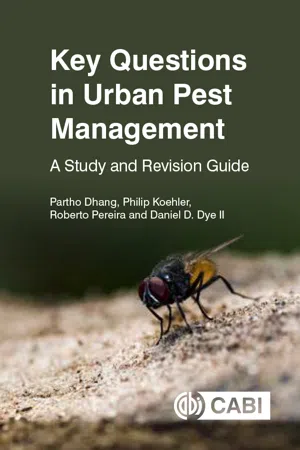
Key Questions in Urban Pest Management
A Study and Revision Guide
- 168 pages
- English
- ePUB (mobile friendly)
- Available on iOS & Android
eBook - ePub
Key Questions in Urban Pest Management
A Study and Revision Guide
About this book
Trusted by 375,005 students
Access to over 1.5 million titles for a fair monthly price.
Study more efficiently using our study tools.
Information
Topic
Sciences biologiquesSubtopic
Entomologie1 Introduction to Urban Pest Management
As little as 1% of the earth’s total land mass has been transformed into urban centers called cities, and these cities astoundingly carry 50% of the world’s population. It is estimated that by 2050, almost 70% of all people will live in cities. Consequent to this development, urbanization is now growing vertically into high rise buildings as well as horizontally into the natural habitats surrounding cities. Such development brings concentrations of people and activities, producing enormous waste. This waste creates countless man-made niches and micro-habitats which together make urban areas susceptible to pest invasion and long-term harborage.
Urban centers are extremely well suited for a group of invertebrate and vertebrate organisms that have associated their lives with humans and their activities. These organisms cause pain, annoyance, emotional distress, disability and loss to humans as a result of bites, stings and physical reactions, in addition to a plethora of diseases and significant damage to buildings. All of these organisms collectively are called urban pests. Urban pests include household, structural and public pests and this distinguishes them from agricultural and forest pests.
Need for Pest Management
Pest control is becoming a necessity for humans. Apart from diseases, the sight of pests triggers various types of negative behavior: anger, disgust and, almost inevitably, the use of a toxic chemical spray. This human behavior has made pest management an easily tradeable business. However, the degree of the trade is dependent on the nature of the service the practitioner is offering and the environment where the service is required. An occasional trail of ants in the home may be a mere nuisance; in contrast, a single ant in a hospital can have serious consequences. The tolerance to pest infestations varies from situation to situation. In comparison to a home or shopping center, institutional kitchens, healthcare facilities and critical manufacturing complexes demand detailed and careful design and planning to exclude pests.
Types of Urban Pests
Urban pests are categorized in various ways, and one method is by the nature of their interaction with humans. This is a useful and convenient approach, as by far the ideal definition of a pest is, “any organism that appears in a place where it is unwelcome to humans”. This definition further clarifies that pest status does not adhere to any taxonomic line, such as orders or families, nor a location.
Following are the most notable pest categories:
Pests associated with human blood
Insects representing half a dozen orders use humans as a source of food. Direct blood feeders such as mosquitoes and bed bugs rank top in the group of insects causing intentional injury. The next group are the ecto-parasites such as lice, fleas and ticks which cause injury and diseases. Ticks are known to transmit Lyme disease, tick-borne encephalitis and also tick paralysis. Similarly, fleas are associated with plague, and lice with typhus.
Pests inflicting injury
Envenomation by bees, ants and wasps is another source of injury to humans which at times could be fatal. Insect venom is considered a leading cause of human mortality through direct injury by arthropods.
Pests associated with allergens, contamination and phobia
A number of pests have gained significance by becoming known as sources of allergens, food contamination and entomophobia.
Pests of stored products
These are a relatively inconspicuous group which humans encounter in stored products. Stored items such as food, clothing, furnishings, artifacts and books are continuously attacked by these groups of pests. They include insects, rodents and birds.
Pests of buildings and structures
Insect pests of structures and buildings have made themselves notable by using parts of human dwellings as food and shelter. Termites and powderpost beetles regard wood used in construction as well as furnishing as potential food. Ants living in soil too have become a major structural pest in recent times. Rodents, bats and birds are also significant pests of structures as they cause damage, defacement and disease.
The History of Urban Pest Management
The history of human interaction with pests goes back to the beginning of civilization. Both insects and rodents have been responsible for disease and death in humans, and ever since efforts to minimize their interaction with humans have grown to be an important public and private undertaking. ...
Table of contents
- Cover
- Half Title
- Title
- Copyright
- Contents
- About the Authors
- Preface
- Acknowledgements
- Books Referred to and for Further Reading
- 1. Introduction to Urban Pest Management
- 2. Pest Identification
- 3. Mosquitoes
- 4. Bed Bugs
- 5. Flies
- 6. Cockroaches
- 7. Subterranean Termites
- 8. Drywood Termites
- 9. Powderpost Beetles and Wood Pests
- 10. Ants
- 11. Fleas, Ticks and Mites
- 12. Sporadic Pests
- 13. Stored Product Pests
- 14. Rodents
- 15. Birds and Bats
- 16. Pesticides and Formulations
- 17. Handling Pesticides
- 18. Integrated Pest Management
- 19. Answers
- Cabi
- Back
Frequently asked questions
Yes, you can cancel anytime from the Subscription tab in your account settings on the Perlego website. Your subscription will stay active until the end of your current billing period. Learn how to cancel your subscription
No, books cannot be downloaded as external files, such as PDFs, for use outside of Perlego. However, you can download books within the Perlego app for offline reading on mobile or tablet. Learn how to download books offline
Perlego offers two plans: Essential and Complete
- Essential is ideal for learners and professionals who enjoy exploring a wide range of subjects. Access the Essential Library with 800,000+ trusted titles and best-sellers across business, personal growth, and the humanities. Includes unlimited reading time and Standard Read Aloud voice.
- Complete: Perfect for advanced learners and researchers needing full, unrestricted access. Unlock 1.5M+ books across hundreds of subjects, including academic and specialized titles. The Complete Plan also includes advanced features like Premium Read Aloud and Research Assistant.
We are an online textbook subscription service, where you can get access to an entire online library for less than the price of a single book per month. With over 1.5 million books across 990+ topics, we’ve got you covered! Learn about our mission
Look out for the read-aloud symbol on your next book to see if you can listen to it. The read-aloud tool reads text aloud for you, highlighting the text as it is being read. You can pause it, speed it up and slow it down. Learn more about Read Aloud
Yes! You can use the Perlego app on both iOS and Android devices to read anytime, anywhere — even offline. Perfect for commutes or when you’re on the go.
Please note we cannot support devices running on iOS 13 and Android 7 or earlier. Learn more about using the app
Please note we cannot support devices running on iOS 13 and Android 7 or earlier. Learn more about using the app
Yes, you can access Key Questions in Urban Pest Management by Partho Dhang,Philip Koehler,Roberto Pereira,Daniel D Dye II in PDF and/or ePUB format, as well as other popular books in Sciences biologiques & Entomologie. We have over 1.5 million books available in our catalogue for you to explore.